Mukdahan Navy seizes 3.4 tonnes of frozen pork
Riverine officers in Wan Yai stopped a Mekong boat-to-pickup transfer of frozen pork skin and meat, then recovered a Bangkok-plated Toyota after the crew fled.
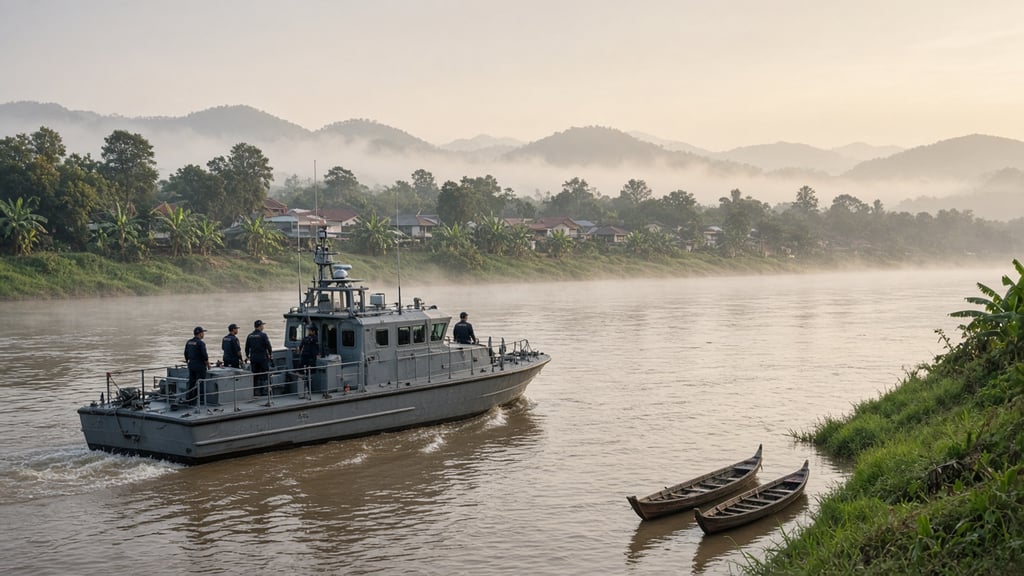
Royal Thai Navy riverine officers in Mukdahan cut off a night-time Mekong transfer of frozen pork in the first hour of 29 November 2026, recovering about 3.4 tonnes of undeclared carcass products before the load could move inland.
The cargo, later counted at 3,480 kilograms, split between roughly two tonnes of frozen pork skin packed in 100 cardboard boxes on a pickup truck and 1,480 kilograms of frozen pork cuts in 74 black sacks still sitting on a steel boat. The landing point was the riverbank at Ban Wan Noi, Chanot subdistrict, in Wan Yai district, a thin stretch of Thai shore facing Savannakhet in Laos.
Mukdahan's Mekong Riverine Unit boat station had been tipped that a long-tail steel boat would cross from Laos, offload at Wan Noi, and feed a waiting vehicle. Officers set a combined water and land watch. Around 00:30 they found the boat against the bank and a group shifting cargo onto a truck. When the patrol identified itself, the handlers dumped the load and ran.
By 01:00 a land team had recovered a Toyota Revo pickup, Bangkok registration 2 ฒฒ 3659, on the Ban Na Phaeng road in Wan Yai subdistrict. The driver used local lanes and escaped. Officers then found the steel boat, its outboard still fitted, with more frozen meat hidden aboard. Boat, truck, and cargo went to the Mukdahan boat station for a joint count, then to Wan Yai police.
European brands on a Lao river crossing
Box labels on the skin lot were not the unmarked sacks of a village run. Cartons carried the English line FROZEN PORK BACK RIND, the Spanish CORTEZA DE LOMO DE CERDO CONGELADA, and the Vietnamese DA LỢN ĐÔNG LẠNH. Two commercial marks were recorded: Costa Brava, tied to Frigorificos Costa Brava S.A. of Girona, Spain, and Tönnies, the German meat group. A Vietnamese sticker named CÔNG TY TNHH XNK THỰC PHẨM HỒ TÂY, a Hanoi-area food import-export firm.
Those marks do not prove the factories ran the river crossing. They show a commercial cold-chain that had already left Europe, passed through Vietnamese paperwork, and then left the legal corridor. Mukdahan sits on about 72 kilometres of Mekong frontage opposite Savannakhet, with the Second Thai-Lao Friendship Bridge as the declared route. A steel boat at Wan Yai at half past midnight is the opposite of that route.
The pattern is not new on this bend of the river. On 2 November the same boat station, working with Ranger Task Force 2103 and Surasakmontri infantry, stopped a laden keel boat at Ban Paluka and detained two Lao boatmen from Ban Tha Sano in Savannakhet. That load was 97 yellow sacks of frozen pork skin, about 1,843 kilograms. In August, riverine and livestock teams at Ban Na Po recovered more than 1.5 tonnes of frozen pork skin whose packaging included Tönnies markings, with officers tracing a likely path through Vietnam into Laos and then across the Mekong.
Disease risk and the statutes
Frozen rind and cut meat are carcasses under Thai livestock law. The Department of Livestock Development has spent four years warning that undeclared pig products can carry African swine fever and foot-and-mouth disease into Thai herds. African swine fever does not make people sick. In pigs it is a haemorrhagic virus that can kill quickly, survives for months in pork products, and spreads when swine eat contaminated meat or when farms share trucks and boots.
Cheap frozen imports also hit farmers when the meat is clean. A September seizure of about two tonnes of frozen pork skin on the Nakhon Phanom side of the same corridor was valued by the agriculture security centre at around 220,000 baht, a price licensed Thai producers cannot match. Legal carcass imports require a Department of Livestock Development licence for each shipment, an origin health certificate, and clearance at a designated port. Living animals and carcasses are restricted goods on the Customs list.
Wan Yai investigators are treating the 29 November load as two stacked offences. Customs Act B.E. 2560 section 242 covers bringing goods into the kingdom without customs formalities: up to 10 years in prison, or a fine of four times the value including duty, or both, with forfeiture even if no one is convicted. Animal Epidemics Act B.E. 2558 section 31 requires a licence from the director-general before any carcass is imported. Section 68 sets the penalty at up to two years, a fine of up to 200,000 baht, or both. The driver of the Bangkok-plated Revo and the group that ran from the bank remain at large.
What This Means for Expats and Travelers in Thailand
African swine fever is not a human illness. The practical risk for residents is uninspected meat in wet markets, grilled-pork stalls, and mookata shops, plus the farm-price shock that follows a local outbreak. If a stall is selling frozen skin or packed cuts far below the going rate, and the seller cannot show a livestock movement document, do not treat that as a bargain. Minced pork and rind are easy to blend with legal product once sliced.
Travelers using the Second Friendship Bridge at Mukdahan should not carry pork, sausages, or dried meat as snacks or gifts. Carcass products without a livestock permit are restricted goods. Residents who keep backyard pigs, even a few animals for a restaurant, should isolate any new frozen supply of unknown origin and call the provincial livestock office or the DLD 4.0 tip line rather than putting it in a kitchen.
Comment verification
Step 1 of 3
Verify your email once to publish your comment. Your email is never shown publicly.
Enter the 6-digit code sent to .
Choose the display name shown next to your comments.