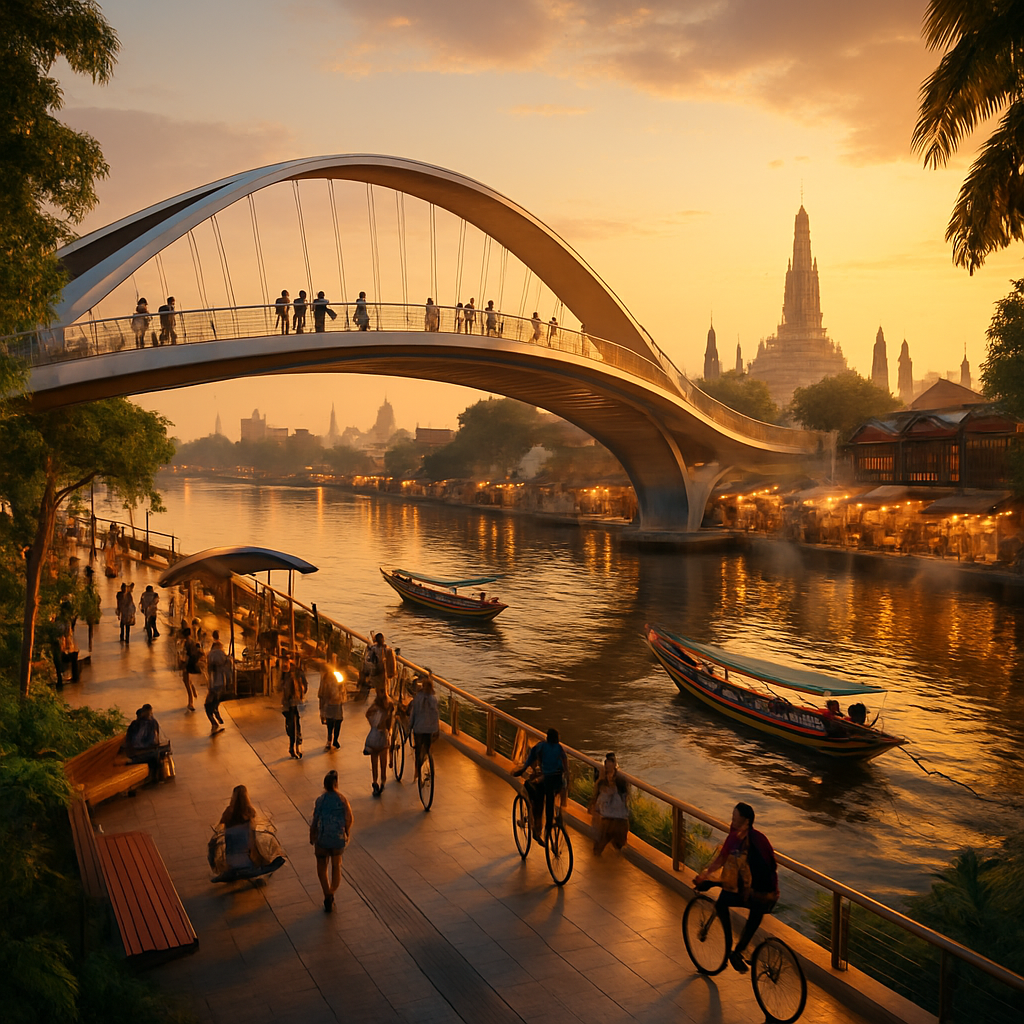
Imagine stepping off the bustling sidewalks of Song Wat, the scent of grilled seafood and incense tugging at your attention, and turning toward a new, elegantly arcing footbridge that sweeps you across the Chao Phraya River. That’s the vision Bangkok has just unveiled: a pedestrian-and-cycle bridge concept designed by international architecture studio MVRDV, created to stitch together Phra Nakhon and Thonburi while giving the city a fresh, people-first landmark.
Bangkok’s river crossings are famously bound to cars and to a patchwork of ferries that run on limited schedules. This proposal flips that script. Rather than another vehicle artery, the new bridge is dedicated to walkers and cyclists, offering a continuous, safe route between historic neighbourhoods on both banks. It would sit between the Phra Pok Klao Bridge and King Taksin the Great Bridge, linking Song Wat Road with the area around Wat Thong Thammachat — places steeped in history but hungry for smoother, greener connections.
More Than a Shortcut: A Riverfront Stage
MVRDV’s concept treats the span not merely as infrastructure but as public space: a place to stroll, linger, and enjoy riverside panoramas. Picture shaded promenades, pause points where tourists and locals alike can watch long-tail boats drift by, and gentle grades that make the crossing accessible for strollers and e-bikes. The design leans into the modern “walkable city” philosophy — promoting quality of life, reducing car dependence, and nudging urban mobility toward healthier, lower-emission modes.
For the neighborhood of Song Wat — a historic artery of small shops, Chinese shophouses, and food stalls — the bridge promises more than convenience. It’s a tool for cultural tourism, a way to invite visitors from Thonburi’s temples and backstreets to explore Phra Nakhon’s heritage lanes without the friction of ferry timetables or bus transfers. On the Thonburi side, connections to Wat Thong Thammachat could invigorate local businesses and create new walking circuits that celebrate both spiritual and mercantile histories.
Safety, Comfort, and Everyday Use
The proposal emphasizes a smooth, everyday experience. Instead of steep ramps or flighty staircases, the corridor is conceived with gradual slopes and clear circulation for pedestrians and cyclists. Lighting, railings, and viewpoints are part of the conversation — small design choices that add up to a safe, inviting environment at dawn commutes and twilight strolls alike. During festivals and weekend markets, the bridge could transform into temporary public square, hosting performances or weekend pop-ups that animate the riverfront.
The environmental angle matters too. By encouraging walking and cycling across a major river artery, the project aligns with Bangkok’s broader climate and mobility goals. It would be a visible signal that the city values low-impact transport and thoughtfully designed public realms — a welcome counterpoint to the car-oriented developments that have dominated much urban planning.
Where the Project Stands
At the moment, the bridge is a concept moving through study and preliminary design. Bangkok officials say an Environmental Impact Assessment (EIA) is in preparation, a necessary step to evaluate ecological, social, and traffic effects. After the EIA and further design work, the plan still requires review and budget approval by the Bangkok Metropolitan Council before any shovels hit the riverbank.
So, the idea skids into the realm of possibility — tantalizing and realistic, but not yet concrete. That interim period matters: it’s when designers refine details, stakeholders voice their hopes and concerns, and the public can shape the way the riverfront will function for generations.
How You Can Follow and Get Involved
If you want to read the concept, track updates, or share feedback, the project is listed under Policy P023 on Bangkok’s Open Policy portal. The site hosts documentation and public comment channels where residents and visitors can weigh in before plans are finalized. Visit the city’s platform here: openpolicy.bangkok.go.th.
Ultimately, this proposed Chao Phraya pedestrian bridge is more than an engineering solution: it’s an invitation. An invitation to walk more, to cross more slowly and observe more closely, and to rediscover Bangkok’s twin riverbanks in a calmer, greener way. If realized, it could become one of those simple urban moves that quietly change daily life — a slender thread linking neighborhoods, histories, and people across the river.











I wrote this piece and I’m eager to hear what people think — is a people-only bridge feasible in Bangkok’s current transport mix?
Looks pretty, but who pays for it? Bangkok has worse priorities than a fancy footbridge, in my opinion.
Funding is a valid concern; the project still needs council approval and EIA, so public input could shape funding priorities and phasing.
Phasing won’t help if gentrification eats Song Wat. Tourist bridges are cash cows for developers, not locals.
That’s a serious point: impact assessments must include socio-economic displacement metrics and mitigation strategies alongside environmental analyses.
As someone who lives near the river, a safe crossing for bikes would be a blessing during rush hour and festivals.
If the bridge takes people off ferries won’t boat operators lose income and jobs? The social ripple effects could be ugly.
True, change affects livelihoods, but better connectivity could bring more customers to both sides and new opportunities.
Ferry culture is part of Bangkok’s soul; replace it and you lose history. We should be careful what we modernize.
Design can complement ferries rather than replace them — integrated transport planning can preserve traditional services while expanding options.
I don’t trust planners to keep traditions. They say ‘integrate’ and then bulldoze.
A bridge for pedestrians is great, but will it actually reduce car use? Many people drive out of habit rather than need.
Habit shifts slowly; visible infrastructure like this makes people rethink short trips, especially if it’s faster than waiting for a ferry.
Modal shift requires complementary policies — bike lanes, bike-share programs, reduced parking incentives — not just a bridge.
Also enforcement and safety matter: a nice bridge won’t help if surrounding streets are hostile to cyclists.
You’ve all missed the climate angle: even small reductions in short car trips add up in dense cities.
Sounds like another Instagram backdrop. Locals won’t benefit, tourists will, and rents go up.
That’s cynical but grounded. Community land trusts or local business protections could help preserve affordability.
Or regulate short-term rentals and create incentives for local vendors to stay in the neighborhood.
I love the idea of pause points and shaded promenades — Bangkok needs more human-scale spaces, not more highways.
Totally agree; the concept emphasizes public space. If the design is finalized, those small choices could really change day-to-day life.
Technically promising, but the EIA must rigorously assess hydrodynamics, long-term scour, and how piers might affect riverine ecosystems.
Exactly — and design detailing must consider maintenance costs and lifecycle emissions, not just initial capital outlay.
As a civil engineer, I worry many projects skip lifecycle planning because budgets rarely cover long-term upkeep.
Maintenance is political too — who will own and operate the bridge after it’s built?
Access for elderly and disabled people is crucial. Gentle slopes are great, but will there be rest areas and covered lifts if needed?
Lifts can be expensive and break down; designing for gradual slopes is the best universal-access solution.
Universal design should be non-negotiable; retrofitting accessibility is far costlier than including it from the start.
Night safety is my worry — lighting and patrols are essential. Otherwise people won’t use it after dark.
Lighting can also invite cops and security that push vendors away. There’s a balance to strike between safety and occupation.
I miss how the river used to feel less curated. New bridges can sterilize a place; sometimes the roughness is the charm.
But those ‘rough’ places often lack sanitation and safety. Thoughtful design can preserve character while improving conditions.
Preserve charm by keeping prices down so vendors aren’t forced out, simple as that.
Many commenters are raising this trade-off — preservation versus improvement — and it’s exactly what public consultation should address.
From an urbanist view, a mid-river pedestrian link can stitch fragmented walkability networks, but only if last-mile connections are funded too.