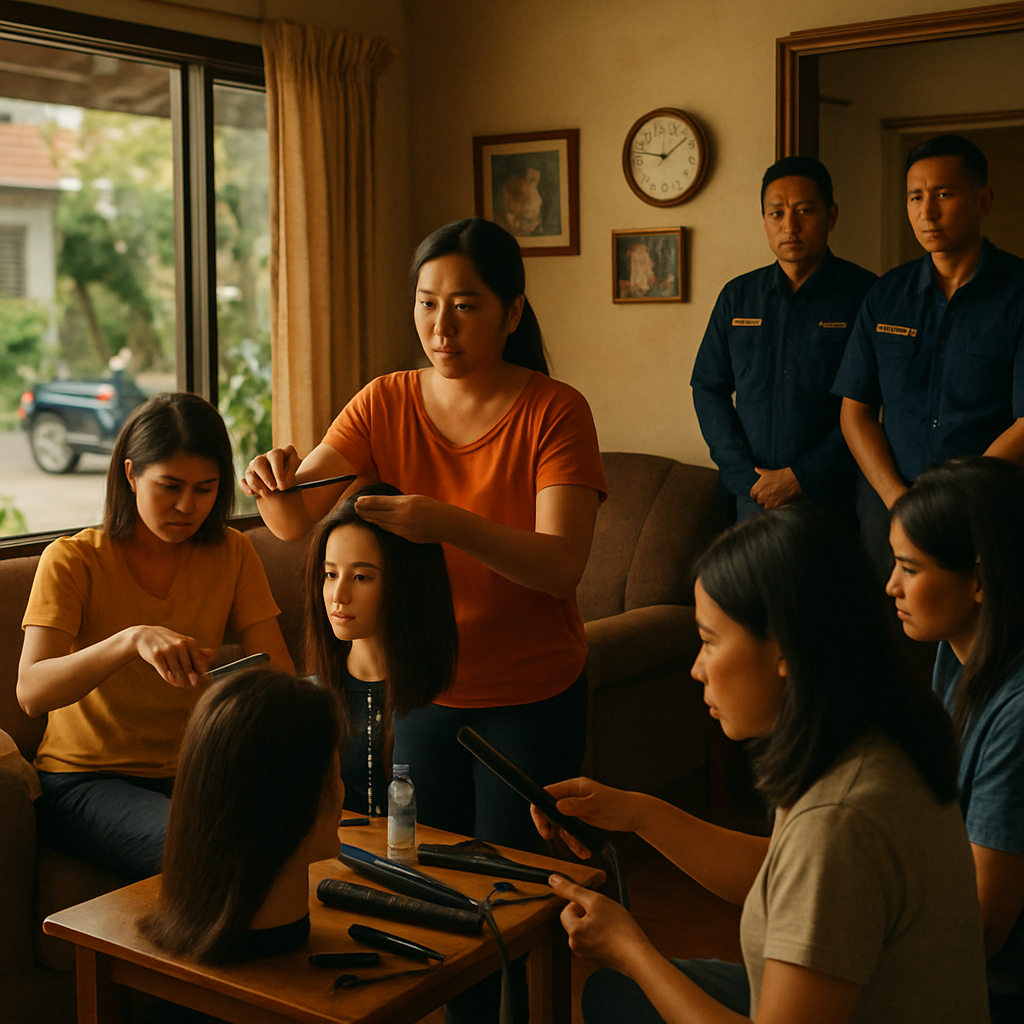
In a scene that sounds more like a neighbourhood makeover show gone wrong than a police drama, a 36-year-old Myanmar woman was arrested in Nonthaburi on January 14 after officials say she ran an unlicensed hairdressing school for fellow Myanmar nationals in Bang Bua Thong. The operation, according to immigration officers, allegedly crossed Thailand’s labour-law line that reserves certain professions — including hairdressing and beauty instruction — for Thai citizens.
The tip-off came not from a disgruntled client or a steaming salon rival, but from video evidence that showed the woman teaching hairstyling techniques at a house in Bua Thong Village, Moo 6, Bang Rak Phatthana subdistrict. Nonthaburi immigration teams, joined by the provincial employment office and district administration officers, staged a coordinated raid at about 1:30pm. What they found was ordinary on the surface — scissors, a flat iron, and four women learning cuts and straightening — but, officials say, unlawful under Thai labour rules.
Authorities identified the woman as Nan Thu Thu Kwaw Oo. At the time of the raid she was instructing four other Myanmar women while a fifth client received hair treatment. Nan told officers she was unemployed and that the sessions were simply free lessons she offered to neighbours. She denied operating a salon or any formal training centre, describing the gatherings as informal community help rather than a business.
Immigration investigators, however, reported a different picture. After looking into the matter, officials concluded Nan had been working as both a hairdresser and an instructor for about three to four months and was earning roughly 8,000 baht per month. Given that both hairstyling and training in the field are listed as protected occupations under Thai labour laws — reserved for citizens — the authorities moved to detain her for questioning and subsequent legal processes.
Importantly, the women receiving the training and treatment were not charged. Officials found no evidence of wrongdoing on their part, and they were released from the scene without penalties. Nan was taken to the Nonthaburi Immigration Office for questioning and later transferred to the Bang Bua Thong Police Station as the case moved into formal proceedings.
For readers trying to parse what this means in practical terms: Thailand’s labour regulations restrict certain trades to citizens in an effort to protect local employment markets. That can include professions in beauty, hairstyling, and other skilled services, and foreign nationals working or teaching in those fields without proper permits can face enforcement action if discovered.
There’s always more to the human story beneath the headlines. Support networks among migrant communities often fill gaps where formal employment and training are inaccessible. Offering “free lessons” can be a genuine act of neighbourly support — or, officials may decide, a cover for an informal income stream. The reality frequently sits somewhere in the middle, shaded by economic necessity and immigration red tape.
Local reporting — including Thairath — framed the incident within this legal context and relayed the official timeline. The case also underscores the increasingly vigilant approach by authorities toward informal work setups that may fall afoul of labour regulations. And it comes amid other enforcement actions: in related news, Thailand’s Central Investigation Bureau (CIB) and the Crime Suppression Division (CSD) recently arrested another Myanmar national for alleged involvement in an illegal online gambling operation, highlighting broader scrutiny of illegal economic activities involving foreign nationals.
Readers should note that these are official allegations and reported findings, and final legal conclusions will depend on subsequent investigation and any court proceedings. For now, the story sits at the crossroads of migration, livelihoods, and law — a reminder that in the tight-knit neighborhoods outside Bangkok, an afternoon of haircuts and styling can sometimes have unexpected consequences.
Key takeaways:
- What happened: A Myanmar woman was arrested in Nonthaburi (Bang Bua Thong) on January 14 after being accused of running an unlicensed hairdressing school.
- Why: Hairstyling and instructing in the trade are protected occupations under Thai labour law and are restricted to Thai citizens.
- Evidence: Video footage prompted the investigation and subsequent raid at around 1:30pm.
- Outcome: The trainees were released without charge; the instructor was taken for questioning and legal action.
Whether viewed as community goodwill or unauthorised enterprise, the incident highlights the fragile balance migrant communities navigate in seeking work and training — and how easily a living-room lesson can escalate into a legal matter.


















This feels like a petty enforcement move that misses the bigger problem: migrants find work where they can. Laws protecting jobs are fine in theory, but criminalising small community teaching seems heavy-handed.
Protecting local labour markets is understandable, but blanket restrictions ignore realities of migration and informal economies; a policy that channels migrants into legal training and permit pathways would be smarter.
Exactly — instead of raids, why not accessible licensing courses or provisional permits? That would protect workers and reduce shadow markets.
Permits cost money and time. Governments act like migrants have endless resources, they don’t.
True, which is why subsidised training or mobile licensing outreach makes sense; cost barriers are exactly why informal skills-sharing happens in the first place.
Rules are rules. Thai citizens need their livelihoods protected and outsiders can’t just take regulated work. It’s about fairness and law, not cruelty.
Fairness matters, but enforcement should be proportional and non-discriminatory. If the law denies pathways for migrants to regularise skilled work, that legal framework itself deserves scrutiny.
So you think we should open protected trades to everyone? That will lower wages and flood the market.
Economic impacts are real, but protectionism can breed black markets and exploitation too. There are middle-ground policies like quotas or temporary licenses.
Quotas sound complicated. I just want local people to have first dibs on jobs in their country.
As someone from the Myanmar community, this hits home. People help each other learn because formal routes are closed or too expensive, not because they want to break the law.
They were just doing hair and teaching. Why arrest? That is mean.
Authorities worry about livelihoods turning commercial without regulation, but it still feels cruel when a neighbourly skillshare ends in detention.
Exactly, Tara. This will scare people from learning and push them further underground where exploitation is worse.
Video evidence prompted the raid — are we okay with surveillance being used to snitch on small community gatherings? That sets a nasty precedent for policing daily life.
People record everything now and any clip can be used. It’s not just about laws, it’s about power imbalances and who decides what counts as a crime.
Exactly, and often those wielding the power decide to enforce selectively; you see larger operations ignored until politically convenient.
Selective enforcement can violate due process and equal protection principles. Documentation should be transparent and investigations proportionate.
Small-scale informal teaching probably only affected a handful of clients and contributed little to the market. Arresting teachers for giving lessons feels like policy overreach.
Policy overreach or preserving standards? Hairdressing might seem trivial, but licensed training ensures hygiene and safety.
Hygiene and safety could be addressed via community health workshops instead of arrests. There are constructive alternatives.
If the trainees weren’t charged, why take the instructor in? That feels performative and punitive toward one vulnerable person.
Because the instructor was alleged to be making money and acting as an unlicensed trainer; they probably needed to investigate income and intent.
This story reveals the gap between law and lived reality. Migrant networks are survival mechanisms and often the only accessible option for skills transfer.
From a policy standpoint, protected-occupation lists are relics of import substitution and labor protectionism. Reform should aim to balance citizen employment with integration and skills development.
I don’t trust the explanation that it was just free lessons. Money changes hands in these setups even if unofficial.
What worries me is how selectively laws are enforced against migrants but ignored when locals do similar informal teaching. Consistency matters for legitimacy.
Local salons spend money on rent and taxes; someone teaching at home without paying the same costs can undercut licensed businesses. I get the enforcement.
We should ask why migrants lack access to legal training and work. Enforcement without reform just punishes the already disadvantaged.
This could have been a civil matter — fines or warnings — rather than immediate detention. Law enforcement escalated too quickly.
If hairstyling is a protected trade, then rules are doing their job. Imagine if anyone could teach any profession without standards; chaos.
There’s a racialized element to enforcement sometimes. Are the same measures applied to all foreigners and locals equally? Evidence suggests not.
Community training sessions are essential in migration hubs. Authorities should create pathways to formal recognition instead of criminalising them.
The tone of the raid — video, coordinated officers — reads like a deterrent message. That sends fear through migrant neighborhoods, reducing trust in officials.
I support protecting Thai jobs, but we also need clear, humane policies for migrants who provide needed services. There’s a balance to strike.
Does anyone know whether the instructor had attempted to regularise work? That detail would change how I view the enforcement.
In my community most try to regularise but face bureaucratic hurdles and costs. Many give up and rely on informal solutions.
People criminalise survival. The state should offer practical solutions like short-term permits tied to sectors with verified demand.
If someone teaches without certification, clients might be at risk. Standards exist for a reason and should be upheld to protect consumers.
This is also a free-speech and community autonomy issue; neighbours helping neighbours is part of social capital and worth preserving where safe.
Enforcement could be selective to make headlines. Arresting one person gives the impression of action without systemic change.
The article mentions a monthly income of ~8,000 baht. That’s hardly a lucrative enterprise; criminal sanctions for such small earnings seem disproportionate.
When I was younger everyone learned trades informally. The world changed, but maybe laws haven’t adapted to how people actually learn.
I worry about the chilling effect: will skilled migrants stop offering free help and thus impede community resilience?
There’s a risk of xenophobia shaping enforcement. We must be vigilant that laws serve public interest, not prejudice.
A common-sense fix: an inexpensive, short course that certifies basic hygiene and technique so small teachers can operate legally and safely.