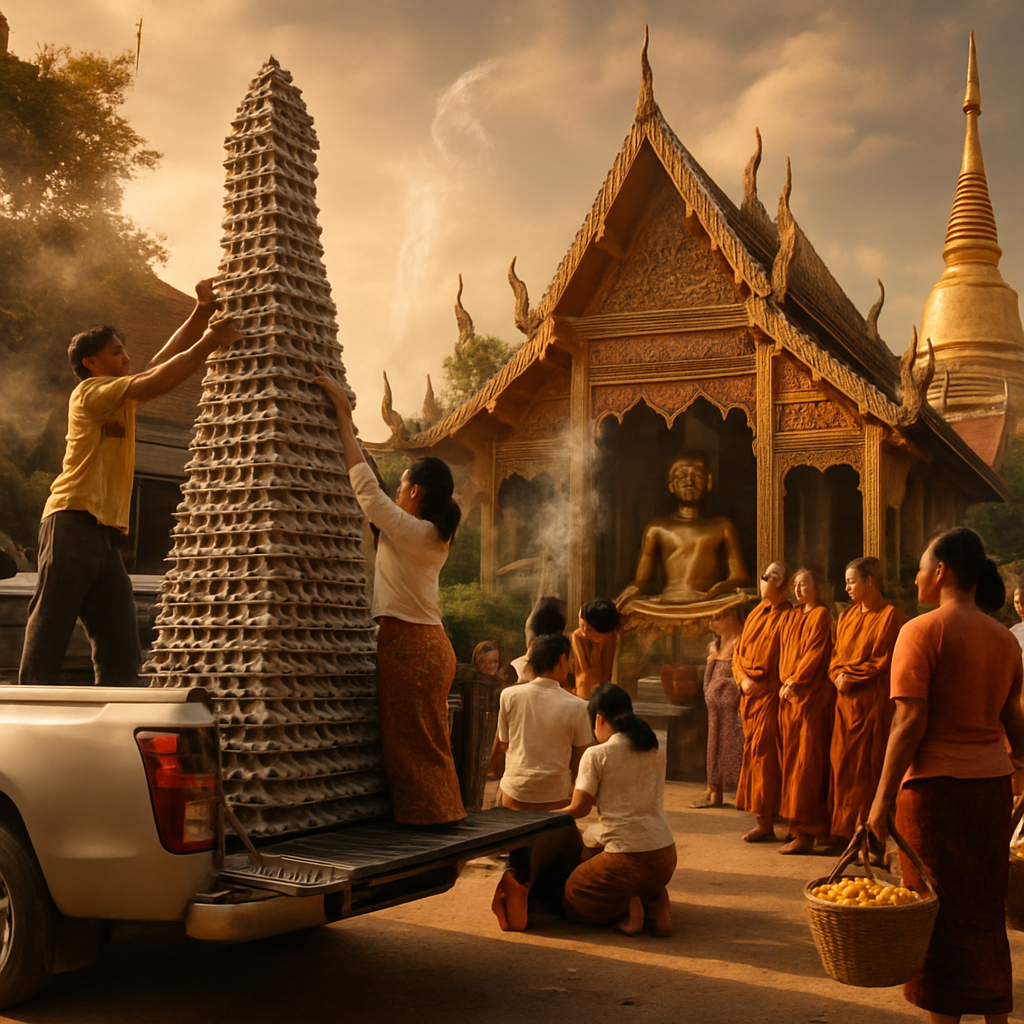
The sight was equal parts devotional, theatrical, and oddly festive: a pickup truck rolled up to Wat Mai Samakkhi in Nong Phai District on Sunday, not with floral wreaths or incense bundles, but with 5,000 chicken eggs stacked so high they towered over the couple who brought them. By the time family members had carefully unloaded and arranged the cartons, the column of eggs rose above human height — a glittering, fragile obelisk that drew a crowd of curious villagers, merit-makers and tourists to Wat Luang Pho Ham Jon in Huai Pong Subdistrict, Phetchabun.
The donors were Mr. Narongrit, 44, a real estate salesperson, and his wife, Ms. Sirirat, 45, who came with more than 10 relatives to fulfill a vow made to Luang Pho Ham Jon, a beloved Buddhist figure in the region credited by devotees with protecting worshippers from poverty and bringing financial stability. The date was December 28, 2025 — the last weekend before the New Year, when rituals of gratitude and hope often intensify.
“I promised Luang Pho Ham Jon that if I reached my sales targets, I would return with an offering,” Mr. Narongrit told temple-goers. True to his word, he delivered a donation both practical and symbolic: 5,000 eggs that will later be distributed to the poor and elderly in nearby communities. Around the temple, the morning air was filled with incense smoke, the murmur of prayers, and the soft clacking of egg cartons being stacked with almost surgical care.
Eggs have a longstanding place in Thai devotional practice, particularly at Wat Luang Pho Ham Jon. Devotees commonly offer eggs after prayers are answered as a symbol of gratitude, renewal and simple nourishment. At this temple, large-scale egg offerings are almost ritual in themselves — a visual testament to belief that material blessings and spiritual protection can go hand-in-hand.
After placing their offering, the couple performed traditional devotional rites before the statue of Luang Pho Ham Jon, joining other worshippers who had come seeking relief from financial worries or hoping to start the New Year on a lucky footing. The ceremony included a fortune-drawing ritual that quickly became the afternoon’s headline: the couple drew three numbered slips from a jar — 3, then 4, then 7 — three digits that fell in sequence and sent a ripple of excitement through the crowd.
As Buddhists and casual onlookers jotted down the digits, conversations quickly turned to New Year superstitions and lottery dreams. For many visitors, those numbers were not merely curiosity; they were talismans, a tiny electric jolt of possibility as the calendar turned toward 2026. Some said they had traveled specifically to Wat Luang Pho Ham Jon because of its reputation as a portal to prosperity; others admitted they were there for the spectacle, drawn by the novelty of a 5,000-egg stack and the communal joy it generated.
Temple officials said the surge in visitors reflected more than just curiosity or appetite for luck. “At the year’s end, people naturally think of gratitude, hopes for the future, and making merit,” a monk at Wat Mai Samakkhi told reporters. “These offerings show the strong cultural link between faith, gratitude, and practical hopes for financial security.”
The eggs themselves will have a second life beyond the altar. After the ceremonial rites, temple volunteers will arrange distribution to families in need — a concrete act of charity that extends the couple’s thanks into community support. In that sense, the offering performs double duty: it honors a spiritual promise and it feeds hungry households.
For Mr. Narongrit and Ms. Sirirat, the ritual was simple and sincere. He had achieved a business milestone and wanted to acknowledge that success in a place known for blessing livelihoods. She stood beside him, smiling as relatives carried away baskets of eggs destined for donation. The moment was a reminder that vows and gratitude still animate daily life in many Thai communities: a blend of piety, practicality and a little bit of theatrical flair.
Visitors left the temple with more than just numbers scrawled on scraps of paper. They carried the image of that improbably tall pile of eggs — a quirky, colorful emblem of hope as the New Year approaches. Whether anyone follows up on the 3-4-7 sequence remains the stuff of personal superstition, but the scene underscored something broader: when hope, faith and community converge, even the humblest kitchen ingredient can become a symbol of abundance.
As the sun dipped behind the temple’s chedis, the couple and their family dispersed back into the rhythm of daily life, comforted by the thought that a vow kept had been transformed into meals and blessings for others. Around Wat Luang Pho Ham Jon, visitors lingered a little longer than usual — perhaps to make their own quiet wishes, perhaps to glimpse again the towering testament to gratitude and good luck that had made the morning unforgettable.

















Five thousand eggs? That’s like a giant omelette waiting to happen. I wish I lived nearby to get some!
As a small farmer I can tell you moving that many eggs is a pain and a half, but when done right it helps people more than it looks. Donating eggs is practical and nutritious, not just showy. Hope they didn’t break too many in the stacking stunt.
Good point, I didn’t think about transport or breakage. The article said volunteers will distribute them, so maybe they planned it careful. Still cool to imagine the towering stack.
I was at Wat Luang Pho last year and the volunteers are very organized. They wrap cartons and sort immediately, very little waste. The ritual is about sharing, not wasting food.
This reads like a livestream of superstition repackaged as culture. People equate luck with numbers and eggs, and it ignores systemic issues like economic insecurity. Rituals don’t fix policy.
Culture isn’t just superstition, Larry; it’s how communities cope with uncertainty. Mocking rituals misses the point that these acts build trust and mutual aid. Besides, the eggs feed the needy — that’s concrete benefit.
I accept charity helps, but celebrating superstition publicly can perpetuate unhelpful beliefs. We should encourage structural solutions alongside community rituals.
Anthropologically, offerings like eggs function as both symbolic communication and social welfare mechanisms. They translate individual gratitude into redistributive acts that reinforce local reciprocity networks. Dismissing them as mere superstition flattens a complex socio-religious practice.
Interesting point about redistribution. But what about hygiene and food safety when those eggs are passed out? That concerns me as a health worker.
Temples typically follow simple hygiene protocols: checking yolk integrity, discarding visibly damaged cartons, and coordinating immediate distribution to minimize spoilage. There are improvements to be made, but the communal channel often ensures quick use.
Thanks, that helps. Still wish there were formal partnerships with public health teams for large-scale offerings.
This feels so performative — a pickup truck, relatives, and lots of cameras. Call it merit-making or PR for the seller’s business, either way it’s a spectacle that feeds people’s gambling hopes with lottery numbers.
Some donors do want attention, sure, but village rituals also create status and obligation. If a business owner gives, people remember and that can lead to real social capital, not just an Instagram photo. Let’s not throw the baby out with the bathwater.
I get social capital, but does it justify turning a temple into a billboard? The spiritual should be separate from self-promotion.
In many communities the line is blurred and has always been. People give to the temple to express thanks and to help others; publicity sometimes attracts more donations, which can be useful.
Why eggs though? Why not rice or money? Eggs seem weird but also cool, like building a tower of breakfast.
As a tourist I loved the visual of the egg obelisk, but I felt uneasy seeing people jot down numbers like 3-4-7. It looked like hope mixed with desperation. Is encouraging lottery behavior ethical?
We should also ask about animal welfare upstream. Where did these eggs come from? Were hens raised ethically? Big displays can mask exploitative supply chains.
Good point. Ritual exchanges rarely scrutinize supply chains, but scholars are increasingly interested in the ethics of donation provenance. It’s a ripe area for policy and community dialogue.
As a producer I can say most smallholders sell at market price and treat hens as livelihood. There are industrial bad actors though. Transparency would help reputations for donors too.
From an economics view, converting private income into public goods via religious giving can be efficient, but it’s regressive if people donate at the expense of household needs. We don’t know the donors’ financial state beyond the story.
I think you assume too much about their wealth. The article said the donor hit sales targets — that’s a success to celebrate. People are allowed to be thankful without being judged.
Practical note: temples often record donations and organize distributions to elderly villagers within days. The eggs will likely be used quickly and help many households through New Year meals.
That’s reassuring. I like the charity angle more than the superstition angle now. Still complex, but helpful.
Complex, yes, but local networks manage these things well most of the time.
Call me old-fashioned, but I prefer donations that fund education or healthcare rather than lottery-number theatrics. Short-term morale boosts are not long-term solutions.
Education and healthcare are important, but local rituals sustain social ties that enable those systems to work. Ignore culture at your peril, Larry D.
As someone from the city, these scenes can look exotic. But if the eggs feed grandparents and neighbors, then the theatrics have a human side. Not everything has to be reduced to policy.
I follow smallholder farmers online and they sometimes donate excess. This could be a case of surplus redistribution, which actually reduces waste if timed right.
I want to add that Luang Pho Ham Jon is beloved here. People go for comfort, not just numbers. The statue has a history of local miracles, real or not, but faith matters.
Faith shouldn’t be an excuse for encouraging gambling. Those numbers being hyped will drive a lot of simple people to spend money they can’t afford. That’s a social harm.
I worry too about vulnerable people seeing those numbers and chasing them. There should be more awareness about responsible gambling tied to these events.
The community could balance rituals with messaging: ‘make merit, but don’t gamble your rent away.’ Simple public service reminders at temples would help.
That’s sensible. Interventions that respect tradition while mitigating harm tend to be accepted more. Temple leaders could partner with NGOs for that purpose.
Still skeptical. When spirituality and commerce mix, the vulnerable often lose. I hope the couple’s intent was pure and not business marketing disguised as piety.
Kanya, motive is messy. Even if there’s self-interest, the community benefit can be real. I’d rather a little PR that ends up feeding elders than silence from fear of optics.
This thread is getting deep fast. I came for the egg tower and stayed for the debate, ha. Thanks everyone — learning a lot about how simple acts can mean different things.
As a comparative religion student, I’m fascinated by the materiality of offerings. Eggs symbolize life and renewal across cultures, so this resonates beyond Thailand. The spectacle fits human ritual logic.
I took pictures when I visited a temple like that once and people were kind. But I did feel like an outsider gawking at someone’s prayer. Tourists should tread carefully and be respectful.
Final thought: let’s keep talking about supply chains, hygiene, gambling risk, and charity outcomes. Rituals are complex; critique is fine but so is empathy for people’s ways of coping.