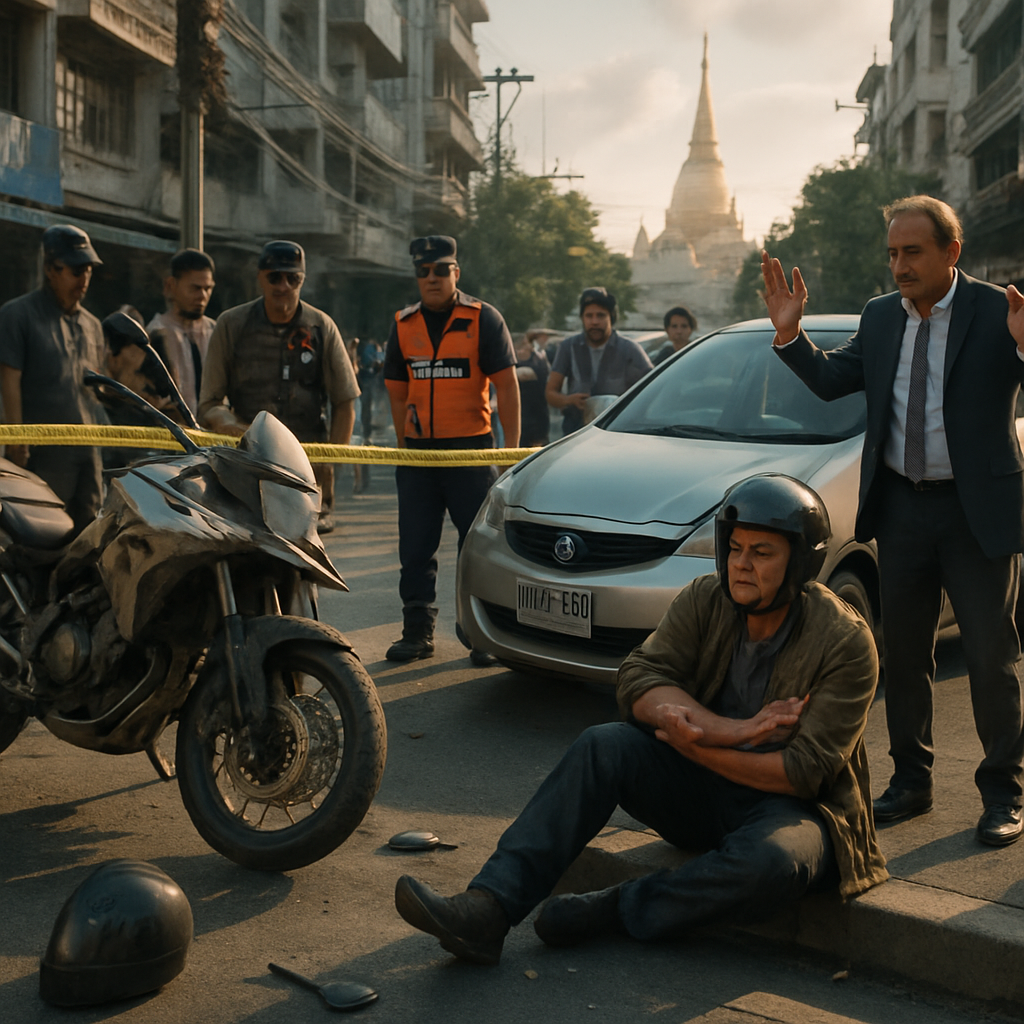
The quiet of a Tuesday morning on Rattanathibet Road was shattered by shouts, a scuffle — and ultimately a gunshot. What began as a conventional road-rage spat at Bang Plu Intersection on December 1 quickly escalated into a criminal case after a 65-year-old local lawyer association president shot a 36-year-old motorcyclist, leaving bystanders stunned and police sorting through competing stories.
A roadside confrontation turns violent
Rescue workers from the Ruam Katanyu Foundation and police arrived at the scene around 9:00 a.m. to find 36-year-old Bordin seated beside his silver-bronze Honda CB500X, clutching his left arm where a bullet wound had landed. Parked next to the motorcycle was a silver-bronze Toyota Altis — the car belonging to 65-year-old Natchanodom Haengwong-ngam, who remained at the scene and surrendered to officers.
Natchanodom, who identified himself as the president of a provincial lawyer association, told police he had been signalling to turn left when Bordin allegedly ignored the signal, rode too close, and kicked the car. According to his account, the motorcyclist then cut in front of him and made an obscene gesture, prompting Natchanodom to follow and confront the rider. Tempers flared, fists were reportedly banged against the car, and words were exchanged — and it was during this heated exchange that Natchanodom admitted to carrying a firearm and firing a shot.
Two versions of the same moment
Bordin’s version, relayed to Workpoint News, paints a different picture. He said the car cut in front of him and nearly caused a collision, so he honked his horn. He denied ever kicking or striking the vehicle and insisted he did not use vulgar language. Bordin said he attempted several times to leave the scene but was prevented from doing so by the car’s driver — and then was shot.
In contrast to the shooter’s statement that the gun was fired in a moment of provoked anger and without intent to flee, Bordin refused immediate medical transport offered by the shooter and later required treatment for his arm wound. Sources note both men were visibly shaken and tensions remained high as authorities processed the scene.
Offers, legal motion, and the hint of a cover-up
Complicating matters further, Bordin’s father revealed that a lawyer representing Natchanodom approached the family with a 150,000 baht offer to drop legal action — a move that raised immediate concerns about pressure, safety, and whether justice could be negotiated away. The family’s disclosure has shone a light on unequal power dynamics in the case and stoked public interest in how it will be handled by prosecutors and courts.
Local images of the scene — circulated by outlets such as SiamNews, Amarin TV, and Matichon — captured the aftermath: a stunned rider beside his damaged bike, the parked Altis, and officers cordoning off the intersection. The optics did little to calm debate, with social media quickly filling with commentary on road manners, privilege, and the dangers of carrying firearms during disputes.
Charges and next steps
Police have charged Natchanodom with attempted murder and discharging a firearm in a public place without necessary cause. Officers also confirmed his firearm licence will be revoked. Investigators noted that the suspect is attempting to frame the incident as an act of self-defence, but they added that such a claim will be assessed in court where evidence, witness statements, and forensic findings will carry weight.
At the scene, the balance between provocation and proportionality will be central to legal proceedings. Thailand’s courts will determine whether the shooting was an impulsive act of rage — as the suspect admitted — or a more calculated violation of the law.
A small intersection, a big conversation
What happened at Bang Plu Intersection is more than a single road-rage case: it’s a story that raises questions about road safety, how civilians handle confrontation, and how status or profession may influence interactions with the justice system. From honking and hand gestures to fists on a car and the flash of a firearm, the episode is a stark reminder that routine disagreements can spiral when tempers and weapons are involved.
As Bordin recovers and legal proceedings get underway, residents and online commentators will be watching closely — not just for the outcome in court, but for the broader message it sends about accountability on the roads. For now, the intersection is cordoned, statements have been recorded, and a high-profile name sits at the center of an investigation that could take months to resolve.
Police continue their inquiries, and the public awaits further updates as the case moves from the roadside to the courtroom.















This is insane — a lawyer shooting someone over a traffic spat? People with connections acting like they’re above the law is exactly what’s killing trust. I want to see a full, public investigation.
I agree the optics are terrible, but we shouldn’t convict in public before evidence is presented. Self-defence is a legal claim and the courts must decide whether provocation justified the shot.
Fair point about evidence, but offering money to settle screams cover-up and influence, not a simple misunderstanding. The power imbalance matters when a name and a suit can silence a victim.
150k baht? That’s like buying silence. If I saw that I’d be yelling corruption, too. Why does money always show up when someone important screws up?
If the shooter stayed and surrendered, that complicates the narrative of a deliberate getaway. Still, firing a gun in public is reckless no matter what.
Surrendering doesn’t absolve accountability; it may reduce flight risk but not the criminal action itself. He still pulled out a weapon and endangered bystanders.
I’m torn — road rage is pervasive and scary, but this feels like an escalation that could have been avoided if both parties took a breath. The firearm licence revocation seems appropriate given the facts stated.
From a legal ethics perspective, the association president should be held to a higher standard. The professional role intensifies public expectation of lawful behaviour, especially when wielding lethal force.
Higher standard or not, the reality is some people think a badge or title protects them. That line about trying to frame it as self-defence will be dissected in court.
I’ll be watching the forensics and witness statements. If witnesses corroborate the motorcyclist’s inability to leave, that undermines the self-defence claim strongly.
I don’t trust ‘he said, she said’ narratives on TV. The camera images and phone videos will matter more than titles and statements.
6th grader view: Why does anyone get a gun for driving? Just stop and talk or ignore. Guns only make fights worse.
That’s a simple and powerful take. De-escalation should be the default, not violence. Schools should teach better conflict skills early on.
Also, cash offers to families feel gross. Money shouldn’t be part of justice.
I’m worried this exposes systemic inequality: a prominent person allegedly offering hush money makes the public feel justice can be negotiated. That undermines faith in institutions.
Exactly, and the legal team approaching the family is a classic power play. Even if the offer is legal negotiation, the timing looks like intimidation.
Negotiation can be legal, but context matters. Approaching while the victim is vulnerable and before full investigation smells of coercion.
We need safeguards so victims can’t be pressured into settlements when they lack resources or legal advice. Public defenders and oversight could help.
Active commenter chiming in: If cameras caught the sequence, the case should be straightforward. But if it was only word vs word, expect a messy courtroom.
Witness credibility will be huge. Motorcyclists often lack the influence to be believed against a titled person, sadly.
That’s why community pressure and transparency matter. Social media can be noisy but it keeps things visible.
From a criminology standpoint, this is textbook escalation: minor traffic conflict → confrontation → weapons use. Preventative law and strict licensing could reduce such incidents.
Strict licensing is good, but enforcement matters too. How many weapons are legally held but irresponsibly used? Revoking the licence is a start.
Agreed. Policy should focus on safe storage, mandatory training refreshers, and clear behaviour clauses for licence holders.
Also, we need better anger management public campaigns. People explode over small things because no one’s taught impulse control.
Short and blunt: if you pull a gun you lose the moral high ground. No exceptions for ‘provoked’ in a crowded intersection.
Legally ‘provocation’ can mitigate culpability in some systems, but proportionality is key. A single shot in public seems disproportionate regardless of provocation.
That’s why the licence revocation is needed. People with guns must be held accountable quickly to protect the public.
I feel bad for the motorcyclist; he tried to leave and was allegedly blocked. That detail will be pivotal for self-defence claims. Hospitals treat the body, courts treat the story.
As someone who rides daily, blocking someone’s escape is terrifying. I’ve been boxed in and felt helpless; police need to prove who prevented whom from leaving.
Medical records, ballistic reports, and CCTV should tell most of the story if properly collected.
Passive observer: this is why I always avoid confrontation on the road. But justice must be blind to status; the association president should face the same consequences as anyone else.
We all want equality before the law, but press coverage and public outrage can sway prosecutors too. Let’s hope investigators follow procedures closely.
Education angle: teach conflict resolution in middle school and drivers’ safety classes. Small interventions can prevent big tragedies later.
Totally. Kids learn from adults — if adults resolve things with guns, the message to kids is dangerous.
Legal cynic here: high-profile names get softer treatment sometimes. I’ll reserve hope until I see charges stick and a conviction, not just headlines.
Cynicism is understandable, but we should also let the court process its course. If prosecutors are thorough, public scrutiny can help ensure fairness.
Fair enough. Still, I’ll be watching the bail terms and plea negotiations — they often reveal hidden preferential treatment.