Nonthaburi teen loses 3m to mule-account scam
A 19-year-old lost 2.96 million baht after a gang posing as Phichit police kept a four-day video call and coached a family-safe break.
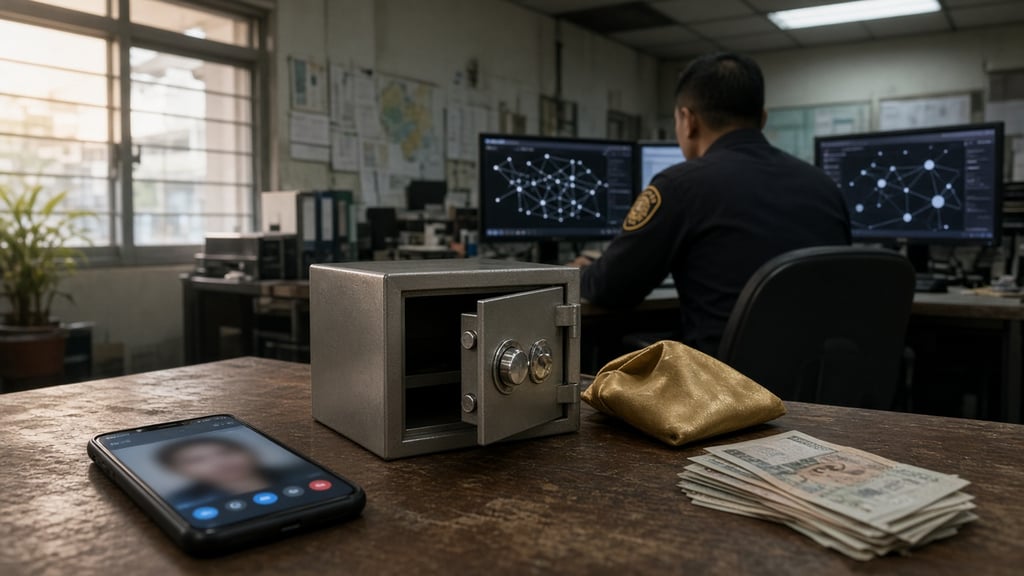
A 19-year-old in Thailand's Nonthaburi belt lost 2.96 million baht after a call-center gang accused the teenager of mule-account involvement, locked a one-way video call for four days, and then coached a family-safe break. The complaint reached Bangkok's Sai Mai Tong Rot volunteer desk at 11:00 on 29 November 2026, more than three weeks after a report was filed at Rattanathibet Police Station.
Provincial Police Region 1 is hunting the callers, a mule-account holder, and a masked courier who collected cash and gold from a rented apartment. No arrests in this file had been announced by Sunday afternoon. The case sits inside a wider 2026 shift: gangs are isolating students and recent school-leavers who will keep a camera on if they believe a police file is already open.
How a mule-account accusation became a four-day lockdown
The first call landed on the afternoon of 31 October, between 15:00 and 16:00. The voice claimed to be from a major mobile-network help desk and said the teenager's phone number and national ID card had been used to run mule accounts. The caller handed over a number presented as Phichit Police Station. Once the teenager rang that number, the conversation moved onto LINE under a station name, and a video call started.
Young victims are told the case is secret, that other complainants have died, and that speaking to family will drag parents into the file. The gang ordered the camera to stay on overnight, showing only the teenager's face, which stops a Google search or a walk to a real police counter. Thai police do not interview suspects on LINE, and they do not ask anyone to transfer money for inspection. Real officers do not coach anyone to open a family safe.
On 1 November the gang demanded a first inspection payment. The teenager pawned a gold necklace for 60,000 baht and sent it in two transfers, 50,000 then 10,000, into an account under the name Polchet. The next day the callers asked for other bank accounts and credit cards. The teenager said there was nothing left.
The safe, the apartment, and the courier
On 3 November, still on the video call, the gang asked about other assets. The teenager mentioned a home safe but did not know how to open it. The callers then walked through how to pry it with household tools. Inside were 12 bundles of 100,000 baht each, plus 30 baht of gold worth about 1.7 million, more than 2.8 million baht in family savings.
The gang ordered the teenager to rent a daily apartment, stay alone, and wait for officers to collect the goods. One cash bundle was set aside. The remaining 11 bundles and the gold were wrapped in cloth. About an hour later a man in glasses, a face mask, and long sleeves collected the wrapped cash and gold and left. The leftover bundle went into a bank account. Another 50,000 baht was sent to the same Polchet account.
The callers then told the teenager to drive to Rattanathibet Police Station to file a report, changed instructions mid-route, and finally said they were a call-center gang before hanging up. The teenager called family and friends, went into shock, and was taken to hospital. A police report followed on 4 November. Total losses in that complaint: more than 2.96 million baht.
A playbook now aimed at students
Ekkapop Lueangprasert, who runs the Sai Mai Tong Rot desk that received the teenager on Sunday, has been telling families that gangs have shifted from older victims toward students who are easier to cut off. In July and August 2026, Cyber Crime Investigation Bureau officers counted 2,058 cases among 18-to-22-year-olds, with combined losses of 207 million baht. About 96 percent involved fake police.
The same week this complaint became public, Pathum Thani officers pulled a 21-year-old student out of a Rangsit hotel after a gang claiming to be Nang Rong police accused her of mule-account links and forced a 24-hour video call. Chiang Mai police ran a similar hotel rescue in September. Krungthai Bank has told customers that runners now collect gold and cash in person to dodge mule-account freezes. That matches this file: most of the loss left in a bag, not a transfer window 1441 could freeze.
What police say they will do next
Pol. Lt. Gen. Naradej Tipparak, commander of Provincial Police Region 1, is coordinating with Rattanathibet Police Station to trace the Polchet transfers, the apartment handover, and the courier. The Ministry of Education's August briefing listed three things real officers will not do: they will not phone a student to announce a secret case, they will not add LINE to send warrants, and they will not ask for money to prove innocence. This complaint hit all three, then added a fourth: a lesson in how to force a family safe.
What This Means for Expats and Travelers in Thailand
Foreign residents keep gold and cash at home for the same reasons Thai families do: bank flags on large deposits, mule-account freezes, and jewellery that is easier to pawn than to explain. That stash is now a target. If a caller claims an ID card opened a mule account in Phichit, Ranong, Loei, or Buriram, hang up and walk into a real station. Do not add LINE, keep a camera on, pry a safe, or rent a room for the investigation.
Parents of students in Bangkok, Nonthaburi, Pathum Thani, and Chiang Mai should treat a sudden request for cash, a scholarship story, or a child who will not leave a hotel room as a possible live scam, not a private crisis. Call the university, then call 1441. A genuine police inquiry arrives as a written summons or an officer at the door, not as a four-day video call that teaches lock-picking.
No comments yet. Be the first to join the conversation.