SET Jump+ Enlists 142 Firms as KKP Flags ROE
SET's Jump+ puts 142 listed firms on three-year growth and transparency plans, as KKP says Thai stocks still need higher ROE and EPS.
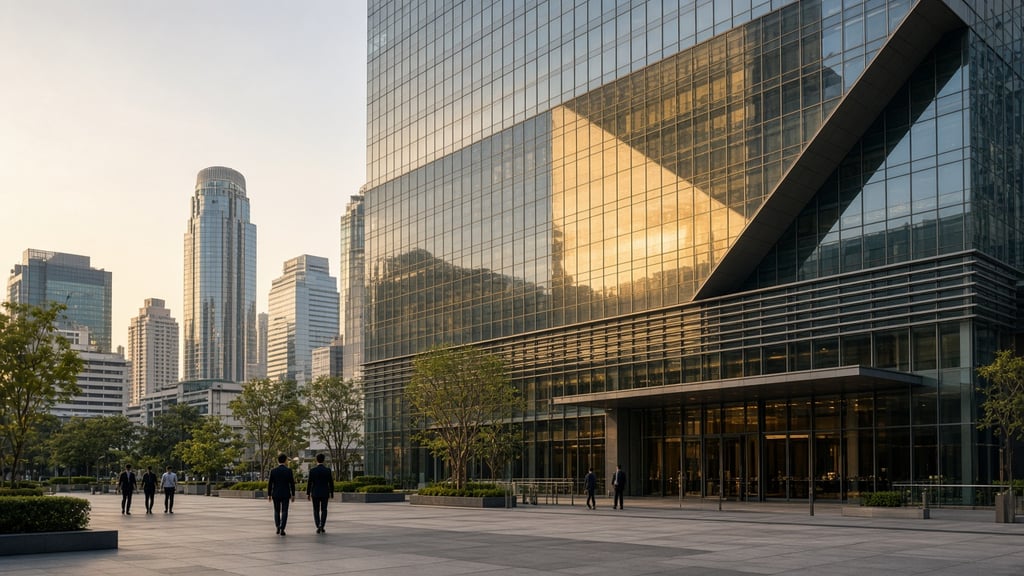
BANGKOK: The Stock Exchange of Thailand used Sunday's first Jump+ Investor Day to put 142 listed companies in front of ordinary investors, asking boards to show three-year growth, governance, and climate roadmaps rather than another round of market cheerleading. The same stage heard Kiatnakin Phatra's chief economist warn that the 2026 rebound in Thai shares is still not a durable recovery unless listed firms lift return on equity and earnings per share.
A Thai value-up programme, now at 142 issuers
Jump+ is SET's flagship attempt to import the corporate value-up campaigns that helped re-rate Japan's market. Issuers that joined before enrollment closed in March 2026 must publish a 2026-2028 plan covering business growth, corporate governance, and climate action, then update investors every six months and take questions on Opportunity Day earnings calls. The Capital Market Development Fund is backing the effort alongside the exchange.
SET's official six-month scorecard, released on 5 November, said every participating company had filed a first-half progress report and completed an earnings-call briefing. Eighty-seven percent of the group was judged on track across those three pillars. That is a high compliance rate for a voluntary programme, and it is still only a process score, not proof that the plans will raise cash returns.
The operating numbers inside the cohort look stronger than the wider Thai economy. Combined first-half net profit for the Jump+ cohort reached 211,572 million baht, 42.3 percent above the 2023-2025 first-half average. The group's net profit margin rose to 8.99 percent from 5.91 percent on the same three-year comparison. SET has also taken a slice of the roster on the road: with DBS Vickers Securities (Thailand), seven Jump+ names, JMART, JMT, MOSHI, PTTEP, RJH, TQM, and XO, met 15 Malaysian institutional funds on 3 November.
Sunday's Investor Day, held at the exchange's Ratchadaphisek headquarters from 09:30 to 16:00, was the first public showcase of those roadmaps for retail investors. SET president Asadej Kongsiri framed the project as a way to match investor demand with higher-quality listed supply, with trading liquidity as the bridge. Company booths and analyst panels pushed a simple rule: disclose both good news and misses as global markets swing through artificial-intelligence sell-offs, higher US Treasury yields, oil-price jumps, and geopolitical risk.
The exchange is also using Jump+ as a communications drill. A three-year plan that is never updated after a shock is just a brochure. SET wants members to keep talking when earnings undershoot, so investors can judge management quality in real time.
KKP's warning: a rebound is not a reset
Pipat Luengnaruemitchai, Kiatnakin Phatra's head of economics and investment research, used the Investor Day session on driving growth through the capital market to argue that Thai equities still trail Asian, emerging-market, and global peers. He dated the competitive fade from 2019, after a stronger 2012-2018 stretch, and said listed-company ROE has been sliding since 2015 in line with slower Thai growth.
KKP's reading of 2026 is that the first leg of the rally was a price-to-earnings re-rating after the election lowered political risk, not a sudden burst of earnings power. Energy profits later improved with higher oil prices, then valuations tightened again because prices ran ahead of actual profits. Electronics shares have seen the largest re-rating on artificial-intelligence supply-chain hopes, while tourism and hospitals look better placed for an ageing society.
The broker's medium-term numbers leave little room for a consumption-led boom. KKP expects Thai GDP to expand at an average of about 1.9 percent in 2026 and 2027. In a separate late-November note the same house cut its year-end SET Index target to a little above 1,500 points and said earnings growth excluding energy is running closer to 7 percent even as the index has already risen more than 10 percent.
SET's own October market report put the index at 1,518.59 at month-end, up 20.6 percent on the year, with a forward price-to-earnings ratio of 13.3 times and a dividend yield of 4.6 percent.
Independent research using LSEG consensus put year-end 2026 Thai ROE near 12.2 percent, against a world average of about 19.6 percent. The same snapshot put Thailand's dividend payout ratio near 61 percent, almost double the global mean. That mix, high cash returns and modest reinvestment, is what Jump+ is trying to disturb by forcing boards to publish growth roadmaps rather than rely on yield alone.
KKP also argued that attracting foreign factories is not the same as raising Thai profits. One large promoted project, worth about 29 billion US dollars, was described as roughly 80 percent imported content. Electronics exports with import content above 70 percent help explain why a strong export print can still coincide with a record trade deficit. If listed firms cannot capture more of that value, EPS will not compound just because the SET Index had a good year.
What This Means for Expats and Travelers in Thailand
That is useful for income-focused retirement portfolios, and it is a warning for anyone who assumed a 20 percent index bounce would keep compounding like a US tracker. Foreigners who already hold Thai bank, energy, or telecom names for the 4 to 6 percent yield should treat Jump+ progress reports as a credit file: which boards are buying back shares, lifting ROE, or just restating old sustainability slides.
Residents can still buy SET and mai stocks through a Thai broker. Many expats use Interactive Brokers or depositary receipts if they do not want single-country Thai risk. The Jump+ roster on SET's site, with six-month updates, is a cleaner watchlist than the SET50 for anyone trying to see which Thai companies are actually promising to grow. Year-end foreign profit-taking is a live risk after a double-digit rebound, which is why KKP's 1,500-area target matters more than Sunday's stage lighting.
Travelers with a short stay do not need a Thai brokerage account. Long-stay readers with baht pensions or a local job do. The SET Index peaked at 1,852.51 in February 2018 and traded as low as 1,053.79 in June 2025. A programme that makes 142 issuers publish plans will not rewind that lost decade on its own. It will, at least, give investors a public scorecard for whether Thai boards are finally being asked to earn their cost of capital.

No comments yet. Be the first to join the conversation.