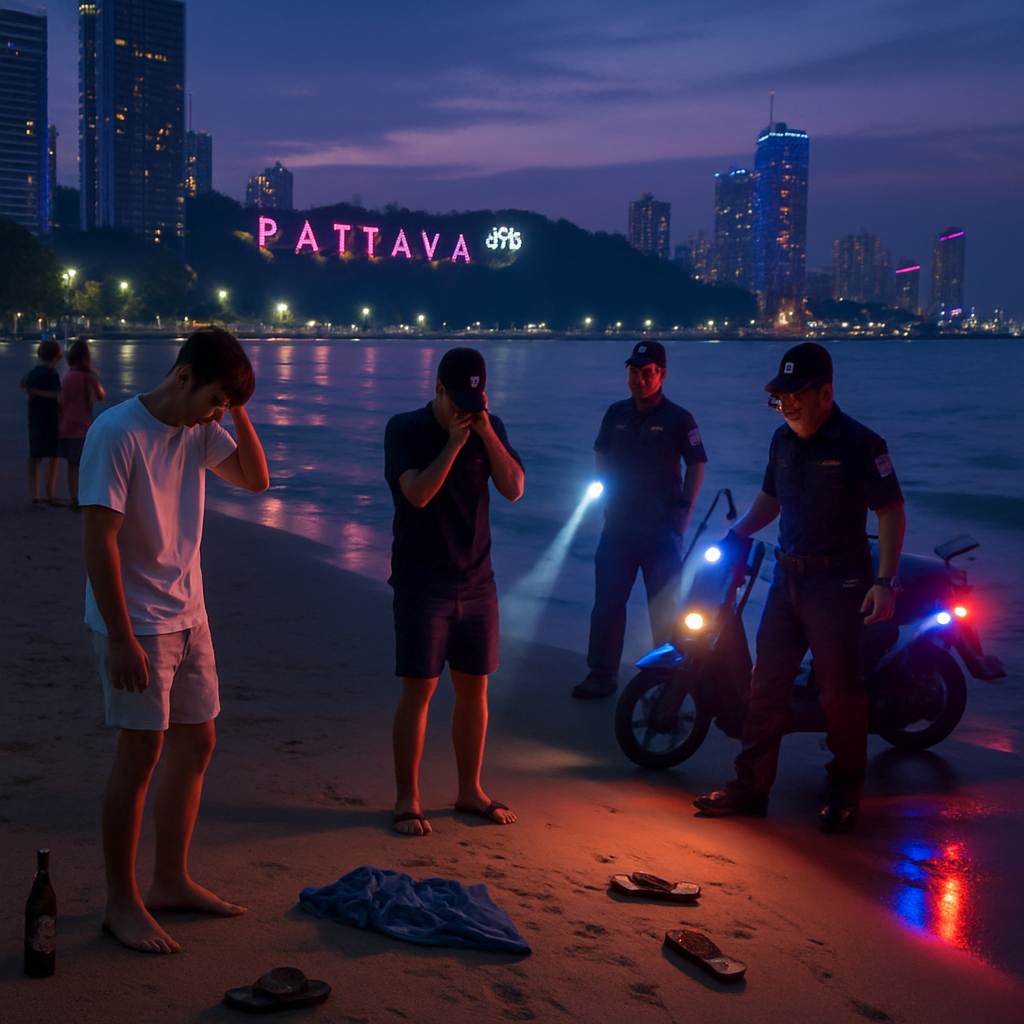
In the small hours of a January morning that most people reserve for sleep (or at least questionable late-night snacks), Pattaya Beach played host to an episode that might have been mistaken for a badly timed reality show. At approximately 4:19 a.m. on January 23, a passerby alerted Pattaya City Police Station after spotting what they believed was inappropriate behaviour between a man and a woman on the sand. What unfolded felt equal parts awkward, alarming, and — for onlookers — undeniably headline-ready.
Officers arriving at the beachfront found a foreign man and a Thai woman lying on the sand. The man was described as wearing a white T-shirt and shorts; the woman wore black. According to police reports, the couple appeared to be engaged in a sexual act when approached. The moment the uniforms moved in, both panicked, separated quickly and attempted to walk away — a feline scramble of dignity and sand.
The man has been identified as a 34-year-old British national. Police said he appeared heavily intoxicated and was incoherent during questioning. In the awkward post-script, he allegedly told officers he was autistic and claimed not to have been aware of his actions. The woman, identified by local reports as 61-year-old Nucharee, initially told officers she didn’t realise such behaviour violated Thai law. She even claimed to be Singaporean and studying in Thailand, a claim locals say contradicts the more familiar image of her strolling the beachfront for months on end.
Locals painted a more complex picture: instead of a carefree tourist or a student, many people who frequent the area said they’ve often seen Nucharee wandering the beachfront and worry she may be struggling with mental health issues. That detail complicates the story: what could look like a clear-cut arrest for public indecency on paper is, when you look closer, also a snapshot of vulnerability, intoxication and, possibly, loneliness.
CH7 News reported both individuals were charged with committing an obscene act in public — an offence that can carry a fine of up to 5,000 baht. The case has been forwarded to the investigative team for further legal proceedings. For those keeping score: yes, public displays of an intimate nature are illegal in Thailand, and police action in such cases is, from a legal standpoint, standard procedure.
It’s worth noting this is not an isolated incident. Earlier this month, a separate case in Patong, Phuket, saw two foreign tourists captured on camera engaging in a lewd act on a public street. Initial reports described the pair as heavily intoxicated men of Middle Eastern and Western descent. The recurrence of these episodes raises a bigger question beyond individual culpability: what is the role of public safety, alcohol consumption and mental health support in tourist hubs that run 24/7?
Pattaya and Phuket are famous — and sometimes infamous — for their vibrant nightlife, but with late nights come late-night problems. When intoxication blurs judgement and vulnerable people end up exposed on the sand or under streetlights, you’re left balancing compassion with the letter of the law. Authorities have to enforce public decency statutes, yet the human stories behind arrests often involve deeper societal issues: addiction, mental health, and the strain of cities that never truly sleep.
There are practical takeaways from this rather unpleasant beach tableau. Travelers should be reminded that local laws differ from those at home, and intoxication is no excuse for public indecency. Meanwhile, locals and authorities should consider how best to support people who repeatedly appear disoriented or at risk along tourist corridors. Arrests may be necessary at the moment, but long-term solutions will likely require outreach, mental health resources and community support.
For now, the Pattaya Beach incident sits in police files and newsfeeds, a cautionary anecdote for holidaymakers and residents alike. It’s an awkward bookmark in a city’s long list of after-dark tales: a reminder that the beachfront, for all its beauty and late-night charm, can also be a stage for poor choices and acute human frailty. Whether the outcome will be a fine, a court appearance, or something more restorative remains to be seen as the investigation continues.
In short: authorities acted on a report, two people were detained and charged, and questions linger. Behind every sensational headline is a mix of facts and people — and this Pattaya morning offered a little of both, coated, unfortunately, in sand.


















This is outrageous and embarrassing for tourists everywhere. If you visit another country, at least try to behave like an adult and respect local laws. Fines or not, it’s a stain on Pattaya’s reputation.
Hard to argue with that, but what about the woman’s situation? People are saying she might have mental health problems.
Mental health or not, public sex is public sex. The beach at 4 a.m. is not the place for that, and locals have every right to call the cops.
True, Larry, I didn’t mean to ignore her vulnerability. But we also can’t romanticize lawbreaking under the guise of illness.
This story makes me uncomfortable because it mixes possible mental health issues with criminal charges. Arresting someone who may be disoriented seems like treating a symptom rather than fixing a problem.
So we should just let folks wander naked then? There has to be a balance between compassion and public safety.
No one said let them wander naked, Sam. I said we should provide outreach and not just a ticket and a trip to court.
As a clinician, I agree with Maya about outreach. Crisis response teams and social services can reduce repeat incidents far better than punitive fines alone.
I live in Pattaya and have seen people like her wandering the beachfront for months. The city needs daytime programs and shelters, not just police patrols at night.
Shelters are great but who funds them? Tourists generate revenue, but they also bring these problems. Local governments are often underfunded.
True, Priya, funding is the hurdle, but public-private partnerships and NGOs can step in if there’s political will.
Legally, Thailand has clear statutes against public indecency, and enforcement is predictable. The messy part is the intersection of intoxication, alleged autism, and age disparity.
He claimed he was autistic — that could be used as a defense or explanation, but it shouldn’t be an automatic get-out-of-jail-free card.
Exactly, Deborah. A diagnosis requires assessment; causation between autism and the act is not established by a single claim.
Or he was drunk and saying anything to avoid responsibility. We’ve seen that defense before and it’s often dubious.
Skeptic, sobriety tests and witness statements will matter. The justice process should separate fact from excuse.
A fine up to 5,000 baht seems symbolic more than corrective. For many repeat offenders or vulnerable locals, a fine is meaningless and just burdens them further.
As an expat, I hate when tourists act like the rules don’t apply to them. This kind of headline fuels anti-tourist sentiment and harms local businesses.
But punishing tourists for every misstep without context is equally risky. If she truly is mentally unwell, the priority shouldn’t be a headline.
I hear you, Ben, context matters, but there should be consequences and education campaigns at bars and hostels to prevent this.
Education is good, but I’ve seen tourists laugh about laws until they get fined. Respect is the root of the problem, not just ignorance.
This reads like the usual after-hours debauchery in tourist towns. People act like the rules go away at night because they are on vacation.
Vacation isn’t an excuse for indecency, but it’s also not always about bad intentions. Alcohol impairs judgment and sometimes people wake up ashamed and traumatized.
Alcohol does impair judgment, Maria, and repeated intoxication events suggest a need for substance misuse resources in tourist districts.
Agreed that treatment is needed for frequent cases, but deterrence matters too. Visible enforcement keeps the peace for families and locals.
Deterrence without help is short-sighted. If authorities only arrest and fine, they’ll keep seeing the same faces on the beach.
If you’re in a foreign country, read up on their laws. This isn’t hard. Public lewdness laws are basic and very common worldwide.
Reading laws won’t help if someone is passed out drunk or mentally unwell though. Prevention is not just personal responsibility.
Responsibility matters either way. Tourists can’t hide behind ‘I didn’t know’ forever, especially when signs and local customs are obvious.
I worry about ageism here. The woman being 61 makes some people jump to conclusions about exploitation or vulnerability, but we don’t have full facts.
Good point, Priya. We shouldn’t assume exploitation, but age and repeated presence on the beachfront are red flags for needing social support.
Exactly — observation should lead to outreach, not only judgement or amusement at the headline.
Tourist hubs are like pressure cookers: alcohol, boredom, and anonymity mix poorly. Local governments should invest some tourism revenue into late-night welfare services.
From a public health perspective, repeated incidents indicate systemic gaps. We need integrated response protocols combining police, health workers, and NGOs.
Agreed. Law enforcement must be trained to identify mental health crises and route people to appropriate services rather than only penalizing them.
Training is one piece; funding and public awareness campaigns are equally important to create sustainable support.
I’m tired of seeing ‘mental health’ as a catch-all excuse for bad behavior. Sometimes it’s just poor choices amplified by alcohol and tourist entitlement.
And sometimes it is genuinely mental health. Blanket skepticism helps nobody and stigmatizes the vulnerable.
Fair, but we also shouldn’t let claims of illness erase personal responsibility. The two can coexist.