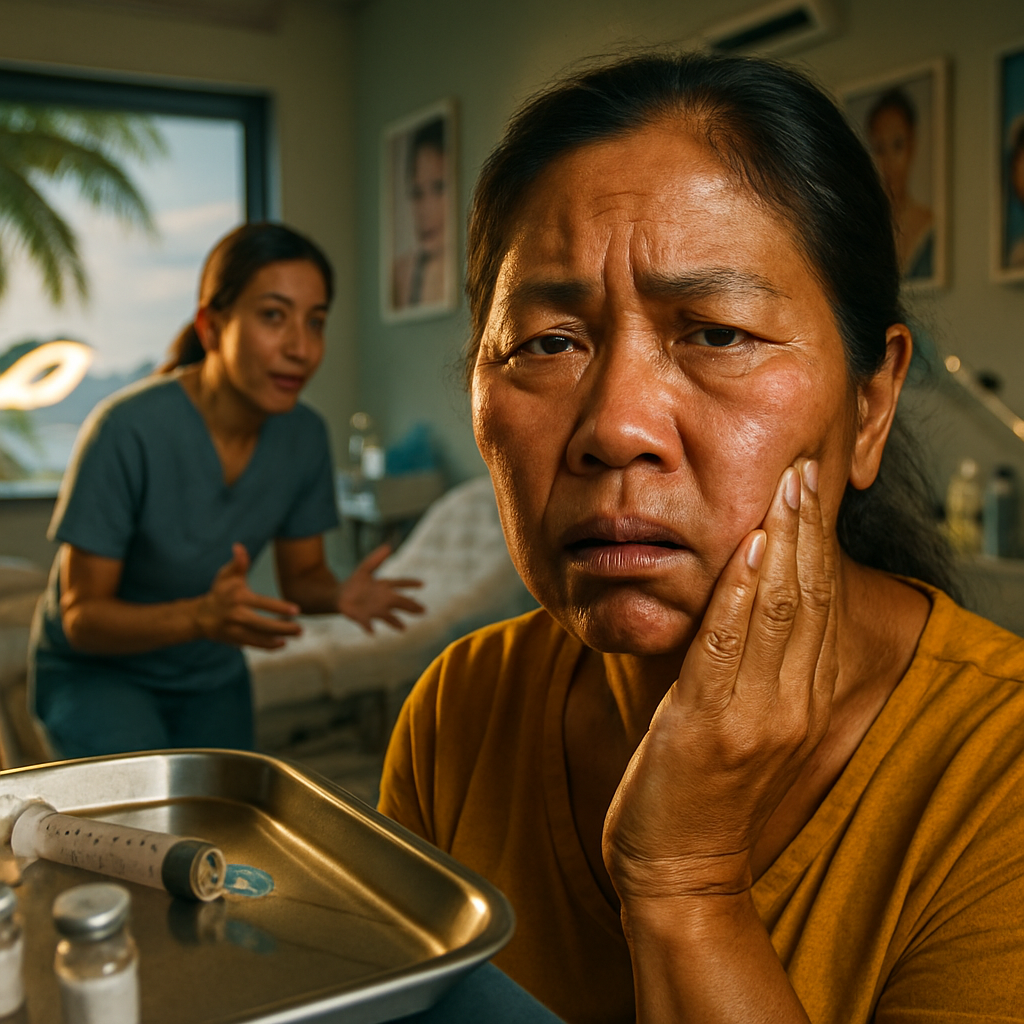
She went in for a simple melasma treatment and left with nearly two years of misery. A 37-year-old woman in Pattaya is warning others after a filler injection at a popular local clinic allegedly left her face swollen, distorted and painful—an ordeal that began in August 2023 and only started improving after further treatment in Bangkok late in 2025.
According to her account, the trouble started on August 17, 2023. Searching on Facebook for help with facial melasma, she booked an appointment at a clinic that has a branch in Sattahip, near her home. Once there, staff persuaded her to try facial fillers instead of the planned pigment treatment. A clinic worker — who identified themself as a doctor and offered to perform the procedure personally — touted a promotion: a “one-session” filler package advertised at 33,999 baht.
Trusting the clinic’s apparent legitimacy, she agreed. The visit cost her 40,000 baht in total and she received roughly 29cc of filler injected across her face. Within about a week, swelling, pain and noticeable facial distortion set in. She returned to the clinic and was given medication to reduce swelling, but nothing improved. In the second week, staff reassured her and, alarmingly, administered another filler injection — roughly 10cc more.
So began a string of follow-up visits over more than a year. The clinic continued to prescribe medication, but her symptoms persisted. Unsure what was going wrong, she sought a second opinion and on July 24, 2025, sought further testing at Queen Sirikit Naval Hospital. Physicians there reportedly found no evidence of an allergic reaction, which prompted her to suspect that the fillers themselves were the root cause. She continued to pursue treatment with the original clinic until November 2025, when she was referred to a Bangkok hospital. After receiving treatment there, the swelling gradually subsided and her face finally began to return toward normal.
Despite the clinic offering some financial compensation, the woman says she didn’t pursue the matter for money. Her priorities are accountability and public safety. She filed a police report with Sattahip Police Station and lodged a complaint with the Medical Council of Thailand. Her complaint raises an additional, troubling question: was the person who administered the injections actually a licensed physician? She noted that the name displayed outside the treatment room didn’t appear to match the individual who performed the procedure.
This case is not an isolated scare in Thailand’s cosmetic industry. The story comes amid other high-profile incidents: one report cited a doctor facing up to six months in prison after a cosmetic surgery six years ago left a patient in a coma, while another clinic owner linked to the case faces three months behind bars. Those outcomes highlight how cosmetic procedures, while often marketed as quick fixes, carry real medical risk and legal consequences when things go wrong.
There are several clear takeaways from the Pattaya woman’s experience. First, cosmetic clinics and injectors should be thoroughly vetted. Don’t rely solely on glossy social media posts or promotional pricing. Ask to see a practitioner’s actual medical license, verify their name against clinic signage, and seek records of their training and experience with specific procedures. If a staff member claims to be a doctor, request to speak with the named physician and confirm the credentials directly with the Medical Council.
Second, beware of pressure tactics and upsells. The woman arrived for melasma treatment and left having received a large volume of dermal filler she hadn’t originally sought. Always insist on time to consider alternative treatments, and don’t let discounts or persuasive staff rush you into invasive procedures.
Third, if symptoms emerge after any cosmetic treatment — unusual swelling, distortion, persistent pain, fever, or open wounds — request immediate evaluation from a qualified medical facility and keep detailed records of all clinic visits, prescriptions and communications. In this case, the absence of an allergic reaction guided clinicians toward suspecting the filler as the problem. That kind of diagnostic clarity can be essential when pursuing official complaints.
Finally, public safety depends on transparency and accountability. Financial offers do not replace responsibility. That’s why the woman chose to file a police report and report the clinic to Thailand’s Medical Council: not for a payout, but to ensure others don’t suffer the same fate.
Her message to anyone considering cosmetic work is simple but urgent: research thoroughly, verify credentials, and never let a promotional pitch outweigh your right to safe, informed care. Aesthetic enhancements can boost confidence — but only when performed by qualified, accountable professionals. When they aren’t, the consequences can ripple far beyond a bad Instagram photo.


















I lived this nightmare and I want others to know what happened. I went in for melasma and left with my face swollen and painful for nearly two years. I filed a police report and a complaint to the Medical Council because this shouldn’t happen to anyone.
That sounds horrific, Anna. Why would a clinic give her 29cc and then another 10cc a week later—who would agree to that?
Because people are vain and greedy clinics exploit it, plain and simple.
As a nurse who has seen filler complications, the volume is alarmingly high and signals poor judgment or lack of training. Infection, granuloma, or biofilm could cause years of problems. Patients should always be given clear consent forms and shown the injector’s license.
They did give me forms but nothing explained that amount or the risks clearly, and the name on the room didn’t match the person injecting me.
Medically, persistent swelling and distortion after filler can be due to infection, foreign body reaction, or delayed inflammatory response. The fact that clinicians ruled out allergy and symptoms resolved after proper treatment in Bangkok points to either inappropriate product or technique. This case highlights the need for stricter credential checks and traceability of injected materials.
Thank you, Dr. Lee — I hope authorities check the product lot numbers and whether the injectors were licensed, because I still want accountability.
Huge red flags here: uncontrolled volume, possible unlicensed injector, and repeated procedures despite worsening symptoms. Clinics should have documented protocols for complications and immediate escalation to hospitals when patients get worse. Regulators should mandate reporting of adverse events to build data and enforce standards.
From a public policy angle, cosmetic tourism and decentralized clinics create monitoring blind spots, especially where social media advertising outpaces regulation. A centralized registry of certified injectors and adverse events would help prevent harm. There’s an ethical obligation to ensure informed consent is meaningful, not performative.
Legally, the key questions are: was the person a licensed physician, was consent informed, and did the clinic follow the standard of care? Filing with the Medical Council is the right move; criminal charges depend on evidence of gross negligence or impersonation. Civil suits are possible but expensive and slow.
Exactly, Sophie. I’d also add that patients should be told what specific filler product was used and given batch information so adverse reactions can be traced.
I can’t believe this is still happening. Social media makes everything look so safe and pretty, but clearly it’s not. People need to slow down and verify things before agreeing to injections.
True, Joe, but sometimes people are desperate for quick fixes and clinics pressure them with deals. That vulnerability gets exploited.
Social media isn’t the sole villain; governments and medical boards must act. But users should quit trusting glossy ads blindly.
Fair point, Larry. Still, those before-and-after reels are manipulative and should carry warnings.
As a lawyer who handles healthcare cases, I’d advise anyone in this situation to preserve all records, receipts, photos, and messages. Police reports and Medical Council complaints create an official trail which is invaluable if you pursue legal action. Also, ask for any product information in writing from the clinic.
Documenting everything is critical, but remember statutes of limitation vary. Quick action improves chances of justice and evidence gathering.
Not every clinic is criminal. Sometimes complications occur even under proper care, and sensational headlines hurt responsible providers. We should encourage safe practice, not blanket condemnation.
I agree not all clinics are at fault, but this story includes potential impersonation and upselling that crosses ethical and legal lines and must be investigated.
This is why some people think cosmetic procedures are pointless. You risk your health for looks and then wonder why things go wrong. Society needs to stop idolizing instant beauty.
That’s a harsh generalization. Many patients seek procedures for legitimate psychosocial reasons; proper regulation and education, not shaming, reduce harm.
I didn’t do this for vanity; I went for melasma treatment and they pushed the filler. Blaming patients ignores clinic responsibility.
Fair point, Anna. If they coerced you that’s on them, not you. I still think we should question the culture that normalizes risky tweaks.
The root problem is a lack of transparency: ads, promotions, and fake credentials. If clinics had to publish verified licenses and complication rates, people would make safer choices. Why is that not already mandatory?
Mandatory disclosure would face pushback from private practices, but transparency laws have precedent in other areas of healthcare and could be adapted. It’s a policy choice with strong public health benefits.
Hospitals often have infection control audits but cosmetic clinics rarely see similar inspections. We need routine checks and easy public access to provider credentials.
Exactly, Rina. Making credentials easy to verify online would cut down impersonation and create accountability.
Clinics must have emergency plans and clear referral pathways to qualified hospitals when things go wrong. Patients should be told when a procedure is beyond a clinic’s capacity. Too often staff try to ‘manage’ complications beyond their expertise.
They kept giving me meds and told me to wait; no urgent referral until much later. That delay cost me months of pain and distress.
Delays in escalation can worsen outcomes. Immediate imaging and cultures might have helped pinpoint infection early on in such a case.
I hope regulators require clinics to show documented referral agreements with hospitals and maintain logs of adverse events.
This story intersects ethics, law, and consumer behavior: the moral duty to inform, the regulatory duty to protect, and the sociocultural drivers of cosmetic demand. Multi-stakeholder responses—education campaigns, stricter licensing, and litigation where warranted—are needed. We should study such cases to craft better policy.
Research data could indeed strengthen regulatory proposals and court cases, but collecting consistent adverse-event data requires legal mandates and cooperation from clinics.
Agreed. Without data we treat these as isolated anecdotes rather than systemic failures.
As someone who runs a clinic, I feel the sting of stories like this because they taint the whole sector. That said, clinics must be transparent and ensure only qualified personnel inject. Customers should ask for credentials and product details before consenting.
Clinic owners saying this while some clinics clearly cut corners rings hollow. Consumers need protections beyond self-advocacy.
Pamela, I agree protections are needed, and reputable clinics should support regulation that helps differentiate safe practices from bad actors.
I was planning a trip to Thailand for a procedure but now I’m terrified. How can medical tourists verify clinics abroad? This story makes me reconsider entirely.