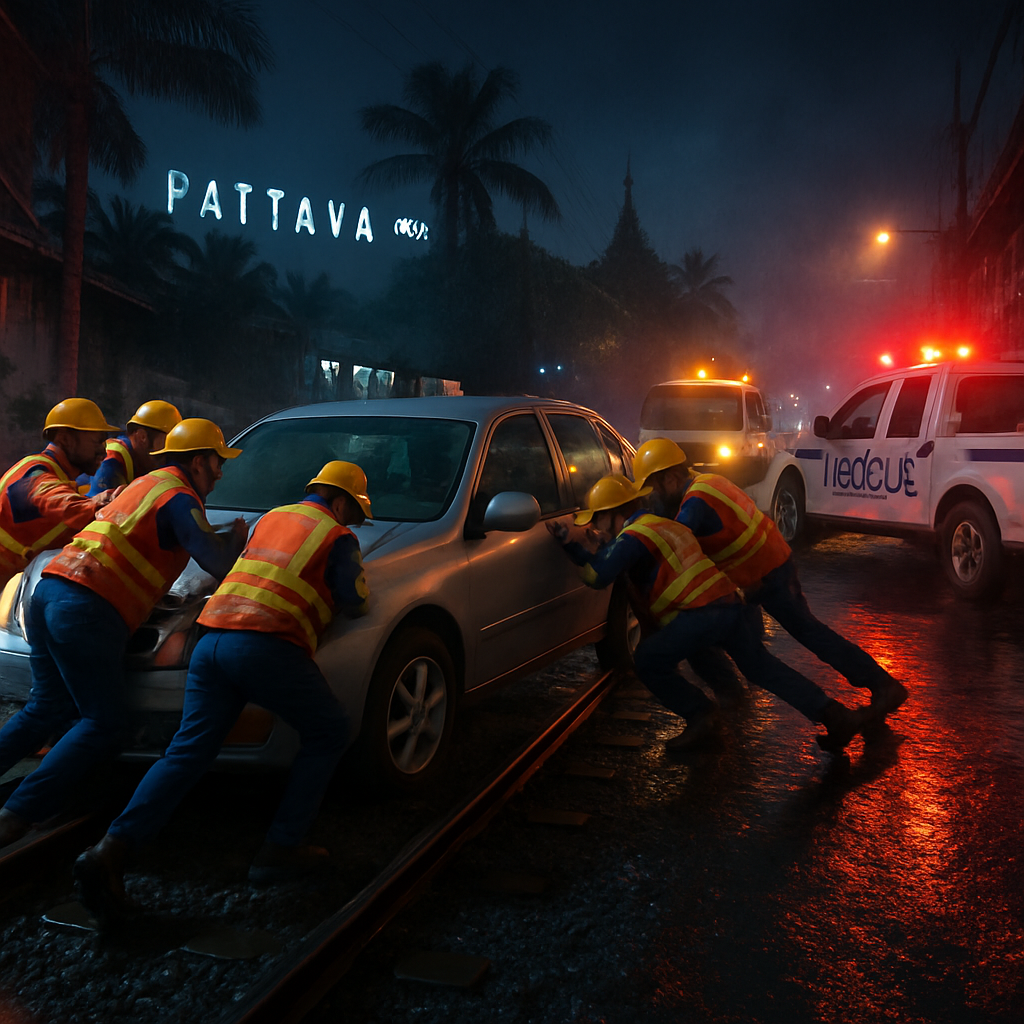
It was one of those midnight misadventures that could have ended in headlines nobody wants to read: a 54-year-old man, later identified as Saman, somehow found himself driving along an active railway track in Pattaya while under the influence. The drama unfolded in the quiet hours of December 8, when rescuers from the Sawang Borriboon Dhammasathan Pattaya Foundation were alerted to a car crawling perilously along the rails in Nong Prue sub-district, Bang Lamung district, at about 12:30 a.m.
Imagine the scene: the narrow strip of metal and gravel meant for locomotives became an accidental roadway, a sedan inching forward like a confused, exhausted snail. Trains don’t send text messages before they arrive—so the risk was immediate and grave. Rescuers arrived swiftly, found the vehicle immobile on the track, and sprang into action. They blocked the car’s path and signaled Saman to stop, a tense moment that could have tilted one way or another in a heartbeat.
Local residents and the rescue team pooled their strength, and what followed was a gritty, communal effort worthy of a human-interest broadcast. People pushed, lifted, and wrestled the car off the rails amid the cold hum of the early morning. It wasn’t elegant; it took grit and cooperation, but they did it. The vehicle was finally removed to safety—though not before an unpleasant discovery: a dead cat nearby, believed to have been struck by the car. Thankfully, Saman himself escaped uninjured.
Saman later explained to officers that he had been trying to get home after following what he thought was a shortcut. He’d seen a motorcyclist slip into a small side path and trailed the rider, only to realize too late that he had driven onto the railway line. His car became stuck, and despite attempts to move forward and reverse, it would not budge. In his own words he felt fortunate that vigilant locals noticed and intervened before the situation turned tragic.
Once the car was off the rails, the rescue team had to leave it beside the track. The scene’s layout and other obstacles meant a tow truck was needed to put the vehicle back onto the road—a reminder that sometimes the best rescue is a simple mechanical assist rather than brute force.
Incidents like this are a sobering reminder of how quickly ordinary moments can become dangerous. Thailand has seen several railway accidents in recent years, many stemming from motorists ignoring warning horns and signal lights or misjudging the approach of an oncoming train. The country’s rail network passes through busy and sometimes narrow communities, and when human error or poor judgment meets moving metal, the consequences can be fatal.
One particularly tragic case that resonated nationwide happened in December last year, when a TikToker in Ratchaburi reportedly sat on the tracks to film content and was struck by a train approaching from behind. That incident—and others like it—has sparked conversations about public awareness, platform responsibility, and the risks people take in pursuit of a viral moment or a perceived shortcut.
What makes the Pattaya incident stand out is not just the close call but the community response. Strangers worked together in the small hours to pull someone out of a perilous situation, showing how local vigilance can make the difference between a near miss and a catastrophe. It’s an example of ordinary people doing extraordinary things—in this case, lifting a car and a potential disaster off a would-be death path.
That said, there are a few takeaways everyone should note:
- Never attempt to drive under the influence. Impaired judgment and slower reaction times turn every risk into a gamble with other people’s lives.
- When following unfamiliar routes at night, be extra cautious. If something feels wrong—narrow tracks, unusual signage, or an unexpected dirt path—stop and reassess rather than following someone blindly.
- If you see a vehicle stuck on a railway, act fast but safely: block the line of travel if possible, alert emergency services, and seek local help rather than trying dangerous maneuvers alone.
The Pattaya episode could easily have ended very differently. Instead, residents and rescuers turned a potentially tragic story into a rescue anecdote—one that will likely be retold as a cautionary tale around Pattaya for some time. Let it be a reminder that roads are for cars, rails are for trains, and good judgment (plus a little community spirit) can pull us back from the edge when we need it most.


















We published this as a close call, but what really struck us was the community effort to remove the car from the tracks and possibly prevent a disaster.
Community heroics are great, but why was a 54-year-old drunk driving at midnight to begin with? That part bothers me more than the rescue.
Maybe he had no other way home or felt ashamed to ask help, Joe, but that does not excuse endangering lives.
No excuse. Drunk drivers are a public hazard and too often walk away with a lecture instead of real consequences.
We asked police about charges and they’re looking into it; often penalties are lighter here than people expect, which fuels frustration.
From a systems perspective, this incident reveals weak signage and poor nighttime routing as much as individual poor choices.
Signage or not, following a motorcyclist into the middle of tracks screams negligence. People need basic spatial awareness.
Spatial awareness fails when intoxication is involved, Mark. We should design environments that compensate for predictable human error.
Why are tracks so accessible to cars at all? This is a policy failure, not just a drunk driver’s mistake.
I was raised near the tracks and locals always warn kids to stay away, yet people still treat rails like shortcuts.
Cultural habits are hard to erase, but public education campaigns could help if they were sustained and serious.
Education is fine, but enforcement and consequences matter most. Namely, fines, suspensions, and maybe community service.
A campaign that shames people publicly will backfire. You need compassion mixed with firm penalties.
People overestimate their luck at night. The cat’s death in this story is tragic and shows collateral damage of one person’s poor choices.
The article mentions social media stunts. Blame platforms too — they incentivize risky behavior with likes.
I agree about platforms, but putting all blame on them is lazy. Users still choose to do stupid things for attention.
It’s both: platforms amplify incentives and humans make choices. Regulation of algorithms might reduce rewards for dangerous stunts.
If a tow truck was needed anyway, pushing by hand seems reckless. Why didn’t someone call for proper equipment immediately?
We called but it was late and close to a train schedule; we blocked and pushed to buy seconds. Sometimes brute force saves lives.
Respect for responders. I just worry about liability and people getting hurt trying to move cars.
If it comes down to a tow truck versus a train, I’ll take the ragtag human chain every time.
Why is there no mention of breathalyzer or arrest? If he was drunk he should face charges that deter others.
Procedures vary, but investigators often assess intent and condition before charging; public opinion can be harsh but evidence matters.
Fair, but transparency would help. People want to know the legal outcome so patterns can be tracked.
Transparency is double-edged. Naming and shaming can ruin lives, but accountability without spectacle is possible.
This is exactly why we need community patrols and stricter checkpoints at night. One idiot ruins safety for everyone.
Community patrols? Sounds like vigilante nonsense. Leave law enforcement to the police.
Not vigilantes, Joe. Organized neighborhood watches that coordinate with police can work and deter repeat offenders.
Neighborhood watches can help but only if they are trained and accountable, otherwise they escalate problems.
The death of the cat feels almost ignored in public discourse, but animals suffer due to human recklessness too.
True, people often focus on human drama and forget the victims that can’t speak. That feline deserves a mention and empathy.
Exactly. Small tragedies add up to broader moral rot when society tolerates irresponsibility.
I want to praise the rescuers, but where were train operators? Shouldn’t there be a system to detect obstructions on tracks?
Detection tech exists but retrofitting old lines is expensive. Low-traffic stretches are especially underfunded.
Underfunding gets people killed. Budget priorities need to reflect public safety, not politics.
Agreed, but solutions include low-cost barriers and community reporting systems too.
Can we stop calling it a misadventure and call it reckless endangerment? Language shapes perception and forgiveness.
Words matter, but empathy matters too. He could be struggling with addiction or a bad night; we can condemn actions and help people.
True, but accountability and support must go together. No more euphemisms that soften danger.
Tough love is fine as long as it funds treatment and prevention rather than just punishment.
Honestly this reads like the plot of a local drama; folks love stories where a village pulls together to save someone they barely know.
There’s a voyeuristic angle too. People love to record near-misses, then lecture afterward on social media.
Exactly. The same phones that capture heroism also amplify stupidity and sometimes incentivize it.
From a public health view, alcohol-related incidents are preventable tragedies. Policy levers like licensing hours and drink limits work.
Restricting hours will only push people to drink earlier or drive further, Anwar. Policies must be nuanced.
True, Tom, but coupled with improved transport options and enforcement, restrictions reduce harms significantly.
One last point: if you’re going somewhere unfamiliar at night, don’t follow strangers. That shortcut mentality kills.
Shortcuts are ingrained in human behavior though. The fix is better roads and clearer signs, not just lecturing drivers.
Both are needed. Infrastructure and culture change together reduce incidents.