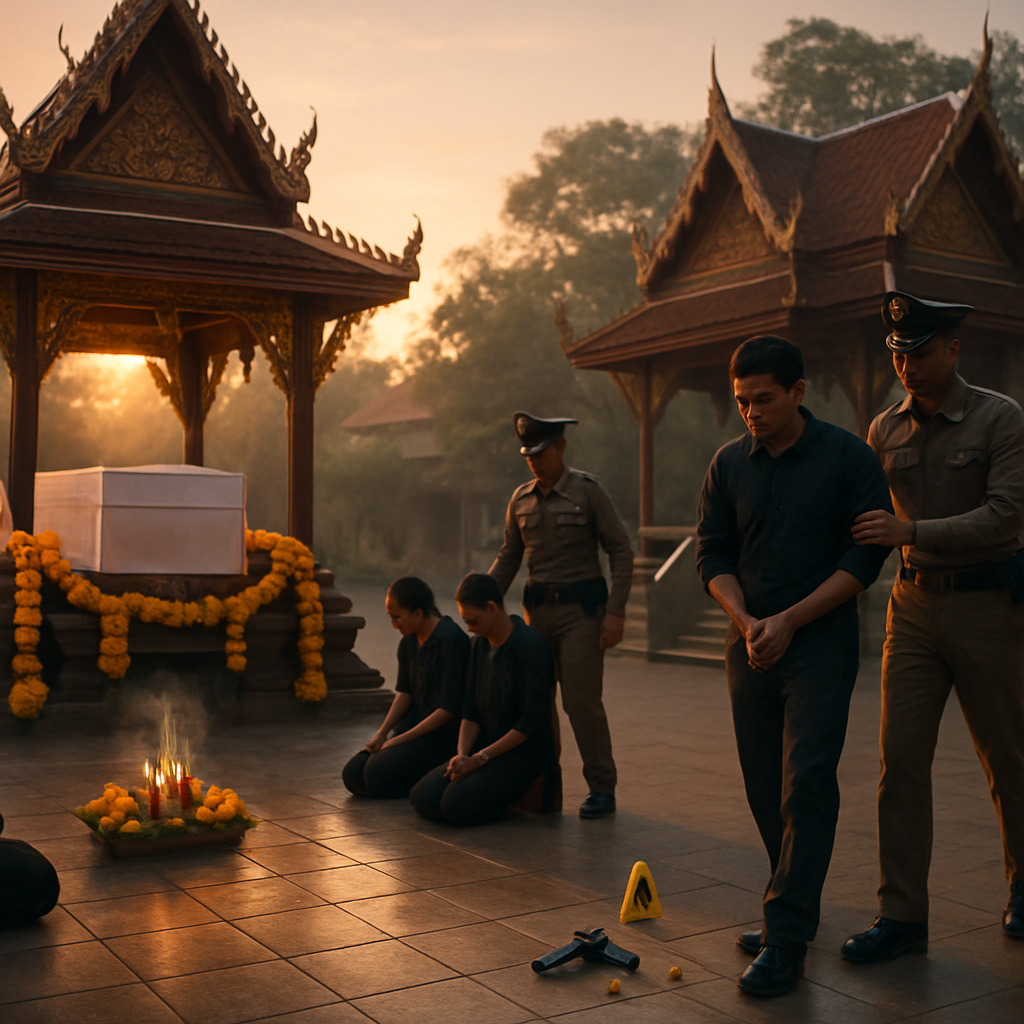
What began as a solemn farewell at a village temple in Phatthalung turned into a scene of tragedy in the small hours of January 17, 2026. A 21‑year‑old man, identified as Mr. Sittikorn, an aluminium and glass technician, was shot dead during a funeral ceremony at Wat Khuan Peng in Moo 10, Khok Sai subdistrict, Pa Bon district. By dawn, a 41‑year‑old man, Mr. Jare—also known by the nickname Ek—had surrendered to police and admitted to firing the fatal shots.
The fatal minutes
Police from Pa Bon Police Station were alerted shortly after midnight when reports of gunfire came from the temple grounds. Officers discovered Sittikorn’s body lying in front of the twin pavilions used for funeral rites. Medical examiners later recorded five gunshot wounds to his forehead, shoulder and neck. Spent bullet casings were scattered nearby, a grim punctuation to what should have been a quiet, respectful event.
A ceremony turned violent
The funeral had been in progress at Wat Khuan Peng since January 14 and was scheduled to continue through January 18, in keeping with local rites for a 93‑year‑old woman. Police say the deceased young man had been invited to the ceremony by relatives of the bereaved family. Witnesses told officers that an argument erupted during the event and escalated quickly before shots rang out and the victim collapsed.
Family members later told investigators that the dispute originally stemmed from a seemingly minor matter: a disagreement over a mobile phone charger. Sittikorn’s mother told reporters her son had not complained of any serious conflict and had messaged her earlier that night saying he was on his way home. Such small sparks can, tragically, ignite much larger fires.
The suspect’s account
Police mounted a search for the shooter overnight but did not locate him at the scene. At about 6:00 a.m. on January 17, Mr. Jare turned himself in at Pa Bon Police Station, handed over a .38‑calibre revolver and confessed to firing the shots, according to authorities.
Jare told investigators he became angry after the victim allegedly took photographs of him while he was sleeping near the coffin and then shared the images with others. He said he requested the pictures be deleted but was refused, which precipitated a confrontation. Officers have taken Jare for forensic examinations and impounded the firearm as part of the ongoing probe.
Charges and next steps
Police have charged the suspect with intentional homicide and illegal possession of a firearm. Formal legal proceedings are pending as investigators complete forensic testing and gather witness statements. The case was reported by Khaosod and has drawn attention locally for its setting: a temple, a place of mourning, where family and friends had gathered to pay their respects.
When grief and anger collide
This incident is a tragic reminder of how quickly disputes can explode, even in ritual spaces designed for reflection and closure. Funerals are meant to bring communities together, yet tensions—old grievances, misunderstandings over personal items, or the raw emotions of grief—can surface unexpectedly. In this case, a reported argument over photos and a charger escalated into violence that will haunt a small community.
Local residents and relatives of the dead have been left to reconcile the shock of the killing with the need to continue funeral rites for the elderly woman—grieving two losses at once: the family matriarch and the young man who attended her wake. The police investigation is ongoing, and the community is awaiting the next steps in the legal process.
Community response and safety questions
Authorities often urge calm and restraint after such incidents and remind the public about lawful channels for resolving disputes. Questions will likely be asked about how a firearm came to be present at a temple ceremony, and whether more could have been done to prevent the argument from escalating. For now, investigators are focused on collecting evidence and testimony to build their case.
As Phatthalung processes this violent breach of a sacred space, the hope is that the judicial system will provide clarity and that families can find a measure of peace. The loss of a young life in a place of mourning is a bitter irony; the search for answers and accountability is now underway.
Authorities continue to appeal to anyone with information about the events that night to come forward. The case—both a criminal investigation and a small community’s trauma—will likely remain a topic of local discussion for months to come.

















Unbelievable — a funeral should be the last place for violence. How did someone even bring a gun into a temple where families are mourning?
This is why we can’t be complacent about guns anywhere, even sacred spaces. If someone can bring a .38 into a wake, what hope do we have?
Blaming guns only is lazy thinking. People make choices, and communities need to enforce rules at events too.
Enforce rules? Easier said than done in rural areas where everyone thinks they know each other and normalizes carrying.
I get that culture matters, but there must be practical steps — metal detectors or volunteers at entrances during big ceremonies. Something should have stopped this.
Volunteers are fine, but when someone is determined, they find ways. It’s a system problem, not just one family.
It’s tragic on so many levels: a family grieving both an elder and suddenly a young man. The social trauma will last long after the legal case ends.
From a sociological perspective, ritual spaces reduce inhibitions around emotion, which can exacerbate conflicts. Grief and personal disputes combining is a volatile mix.
Exactly, and that emotional overload can make people act irrationally. The community needs counseling, not just criminal proceedings.
Counseling would help, but where will funding come from? Small districts rarely get resources after the initial media attention fades.
If he admitted it, lock him up for life. No excuses, no sympathy. Taking photos is not a murder sentence.
Why do people kill over small things? I am scared to go to big family events now.
We need to consider intent and provocation legally. Anger doesn’t erase culpability, but understanding context helps courts decide punishment.
Context or not, five shots to the head and neck look like cold-blooded murder. The law should reflect that.
This whole ‘he took pictures of me sleeping’ reason sounds thin. There must be history here we’re not seeing in the article.
Old grudges can resurface at wakes. People bring unresolved conflicts to these events, and alcohol sometimes is involved too.
Exactly — funerals aren’t neutral ground emotionally. Still, the shooter could have walked away instead of killing someone.
Maybe the person felt humiliated, but humiliation doesn’t equal permission to use a gun. It’s tragic all around.
Charged with intentional homicide and illegal firearm possession — will that mean a swift conviction? How strong is the evidence likely to be?
Confession and an impounded weapon are strong pieces of evidence, but courts will still require forensic linkage and witness testimony for a conviction beyond reasonable doubt.
Good point. Forensics will be key, especially ballistics and whether witnesses can corroborate the timeline.
Why are temples not safer? This should be a place of refuge, not a battleground. Local leaders must act.
Temples are community-run; they usually rely on volunteers. Expecting them to behave like secured venues is unrealistic without funds.
Then local administrations need to step in with support. Respect for sacred spaces should be enforced publicly.
This is the inevitable fallout when informal norms break down. People used to handle disputes face-to-face, now everything escalates fast.
Technology and social media turbocharge disputes — a snapped photo spreads in minutes and anonymity emboldens nastiness.
True, but the core issue is the lack of conflict resolution skills in communities. Education could prevent many of these incidents.
My heart goes out to both families. This is senseless loss and the elderly woman’s family is now doubly traumatized.
Imagine preparing rites for your ancestor and then losing a young attendee. It’s a nightmare that will follow them for life.
Communities should offer grief counseling and legal aid immediately. Silence and isolation will only make recovery harder.
From an investigative journalism stance, I’d want to know who else had access to the temple area and whether there were prior threats. This story smells of deeper social conflict.
Agreed. Interviews with regulars, temple volunteers, and family networks could reveal patterns of tension or previous incidents unreported.
I’ll dig into local records; these micro-level disputes often link back to property, long-standing feuds, or local power dynamics.
A charger and a phone photo leading to murder? This is peak social media paranoia and macho posturing in rural settings.
Don’t dismiss the role of humiliation. In tight-knit communities, a viral photo can feel like a social death sentence to some people.
True, but the correct response isn’t violence. We need community norms that shame escalation, not photos.
How do we protect ritual spaces without militarizing them? There’s a fine line between safety and turning temples into fortress zones.
Start small: posted rules, respectful volunteers, and clearer expectations for behavior at wakes. That’s not militarization, it’s common sense.
Fair point. Training volunteers in de-escalation could be a middle ground worth investing in.
Legally, confessions are powerful but can be retracted. The defense might argue provocation or temporary insanity given the emotional setting.
That defense could inflame public opinion. The family of the victim will understandably demand full accountability.
Public outrage can influence proceedings indirectly, but courts rely on evidence. Still, prosecutors may pursue harsher charges due to the setting.
I keep thinking about the mother who said her son messaged he was going home. That image of a son never making it will haunt her.
Those last messages are devastating. The community should rally to support the bereaved family practically and emotionally.
Small gestures matter — food, company, legal help. The public can do more than just talk on social media.
Witness statements will be messy: people in shock, conflicting memories. I worry the truth will be obscured by competing narratives.
Memory under stress is unreliable. That’s why forensic timelines and physical evidence like casings are crucial to reconstruct events accurately.
Why do adults fight so much? When I go to funerals, I just want to cry and remember, not argue about chargers.
Kids see the nonsense clearly. Adults carry grudges and stupid pride; it’s embarrassing.
There will be calls for temple security now and people will argue it’s an overreaction. But safety should trump tradition when lives are at stake.
Agreed. Traditions evolve after tragedies. This might be a painful but necessary moment for change.
The fact he surrendered and handed over the revolver is telling. Maybe remorse, or maybe a calculated move to mitigate charges.
Surrender can be strategic legally, but it also prevents a manhunt and further danger to the community. It’s the responsible thing after the fact.
I hope witnesses come forward. Fear of retribution can silence people and obstruct justice, especially in small towns.
That’s why anonymous tips and witness protection matter, even for local crimes. Journalists can push for community mechanisms to encourage testimony.
We need clearer laws on photos and consent at private rituals. Maybe a simple community agreement could deter people from taking intimate pictures.
Agreements help, but enforcement is the issue. People who feel disrespected may ignore rules, and that can trigger worse responses.
The national police should provide guidance to temples on conflict prevention. This isn’t just one village’s problem, it’s a pattern waiting to repeat.
Policy-level intervention could standardize safety protocols. Training monks and volunteers in mediation could reduce likelihood of violent escalation.
I worry about sensational media coverage making the village a spectacle rather than focusing on healing. Sensationalism can harm recovery.
Media attention sometimes helps accountability, though. It’s a double-edged sword: pressure for justice vs. intrusion into grief.
Whoever took and shared the photos should still face consequences if they intended to humiliate, but murder is a separate crime that requires full prosecution.
Yes, intent matters for both actions: revenge for being photographed is a moral wrong, but the legal system must separate provocation from premeditated homicide.
Local elders should mediate before things escalate. Is there a council or village mechanism that failed here?
Probably failed, or people ignored it. When pride gets involved, mediation can’t always compete with anger.
I want to know if alcohol was involved. It’s often the tipping point at funerals when tempers flare and judgment is impaired.
Article didn’t mention it, but it’s a common factor. Investigators will likely ask about substances during witness interviews.
We should avoid turning this into political fodder. Real people are grieving and using the case to push agendas would dishonor the dead.
Yet policy discussions are necessary to prevent recurrence. Not all politics is opportunism; some of it is prevention.