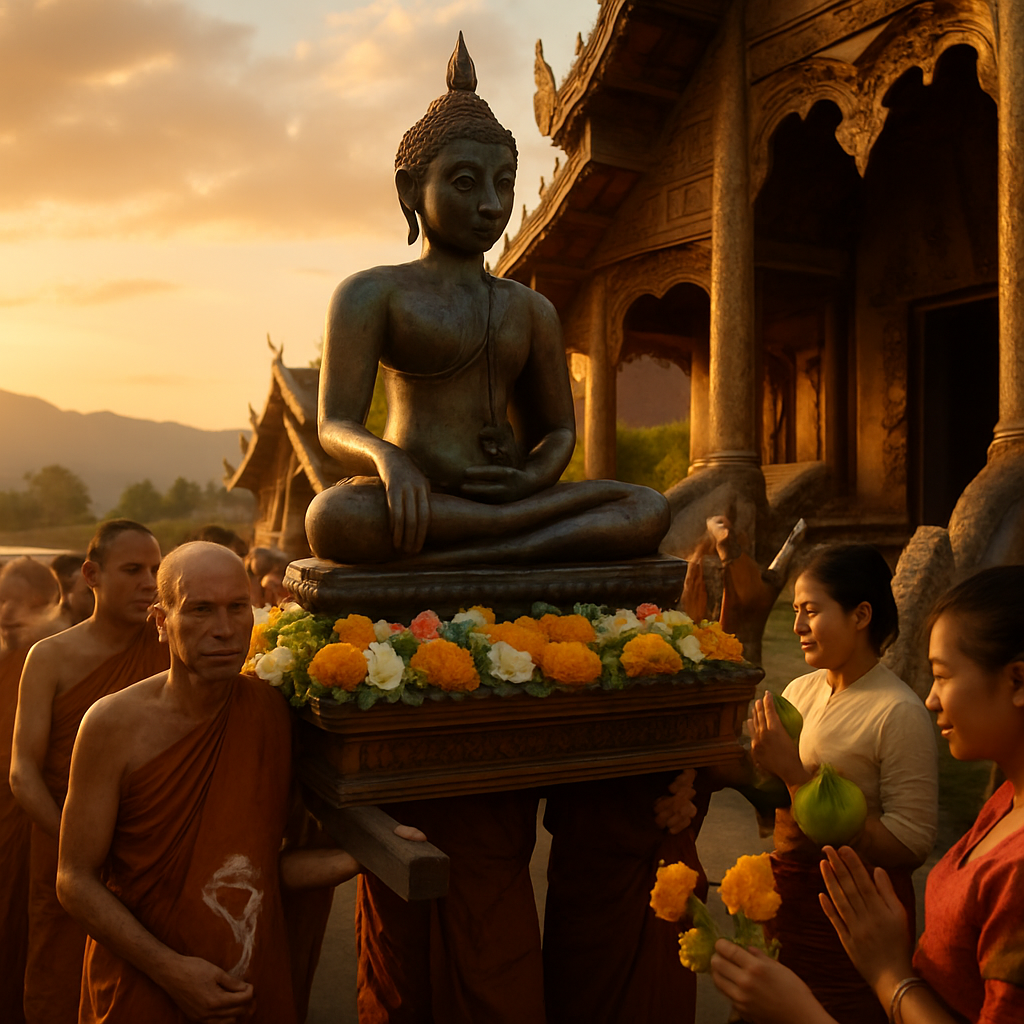
After 65 years missing, a beloved bronze Buddha has come home — and the return to Phayao felt less like news and more like a communal, long-awaited celebration. Phra Chao Tong Song Khruang, a historically important statue once housed at Wat Ban Tom in Mueang district, was ceremoniously brought back to its original place, stirring pride, relief and, perhaps unsurprisingly, a flurry of lottery fever.
A statue with stories to spare
Phra Chao Tong Song Khruang is no ordinary find. Cast in bronze and posed in the Maravijaya posture — the classic seated, cross-legged pose signifying the Buddha’s triumph over Mara — the statue’s restrained decoration and classical lines point to a refined aesthetic. Art historians classify it within the Phayao (or Pa Daeng) style, with clear influences from southern Buddhist traditions and Ayutthaya-era art. Believed to have been created in the 22nd Buddhist century, it was unearthed at an ancient temple site in Ban Tom in 1960, anchoring it firmly in the region’s layered past.
The uncanny rediscovery
The trail to rediscovery read like a detective story with a respectful, devotional twist. After careful provenance checks, officials found the statue in the hands of a well-known amulet collector in Bangkok’s Tha Phra Chan area. Collaborative work between Phayao province authorities and cultural organisations verified the statue’s origins beyond doubt. Rather than a courtroom drama or a headline-grabbing seizure, the collector chose a different route: voluntarily returning Phra Chao Tong Song Khruang to the people of Phayao as a New Year’s gift.
The gesture was met with widespread gratitude. Locals described the return as restoring more than metal and patina; it was a restoration of local identity and a reconnection with a tangible piece of living history. KhaoSod reported on the return, and photos of the arrival captured both reverence and relief — monks, devotees and curious onlookers lined the streets.
A community’s excited response
There was drama even in the logistics. Residents kept a close eye on the vehicle transporting the statue, taking note of the registration number 2920 and the symbolic fact that the statue had been absent for 65 years. In Thailand, where numbers and omens play a lively role in everyday life, those details caught on fast.
Naturally, the registration number and the “65 years” banner didn’t remain mere trivia. They became instant lottery favorites — tickets bearing those numbers flew off shelves, adding a playful, superstitious layer to the day’s solemnity. For many, it was the perfect mix of sacred and serendipitous: a long-lost Buddha returns, and the town gets a little extra sparkle to ring in the New Year.
More than an object: cultural restoration
Beyond the immediate excitement, the return has deeper implications. The statue’s reinstatement reconnects the present-day community with centuries-old artistic and religious traditions. The Phayao/Pa Daeng stylistic markers reflect regional artistic exchanges and historical continuities, and having the statue back in its original setting helps preserve those cultural threads — not as museum artifacts tucked away behind glass, but as active parts of local religious life.
The statue’s journey also highlights how responsible stewardship and cooperation can restore heritage without acrimony. The collector’s decision to return the statue voluntarily allowed for a dignified transition, avoiding prolonged legal tussles and emphasizing respect for provenance and community ties.
Looking forward
As Phra Chao Tong Song Khruang settles back into its spiritual home at Wat Ban Tom, the mood in Phayao is buoyant. Devotees have fresh reasons to gather, historians have another tangible artifact to study, and the wider public has a feel-good story that marries culture, mystery and community goodwill.
Whether the people who bought lottery tickets featuring 2920 or 65 will see a payoff remains to be seen — but for now, the real win is clear: a piece of Phayao’s history has been reclaimed, respectfully and joyfully, just in time for the New Year.
Photo credits: KhaoSod.












This is such a happy ending but also weird that it took 65 years; did the collector ever explain how he got it?
Maybe he bought it and thought it was safe, or maybe he didn’t know where it belonged, simple as that.
The voluntary return is commendable and spares the legal quagmire, but it raises deeper questions about provenance research practices in Thailand and how private collecting intersects with community heritage.
I get that, but for most people here the main point was the statue is back and the parade looked beautiful; sometimes the human story matters more than the paperwork.
Returning cultural property should be the norm, not a headline-grabbing exception, yet too often it only happens when museums or collectors get embarrassed.
Agreed, Larry, but there are cases where legal ownership is murky and communities need better resources to claim their heritage without getting into expensive fights.
Or maybe people should stop buying things they can’t prove came from a temple, seems obvious to me.
This case shows cooperation works, but how many private collectors would do the same without public pressure or recognition?
My grandma used to tell stories about that temple, so seeing the statue come back made me cry, plain and simple.
It’s touching how an object can carry memories; material things matter in rituals and identity, not just art history.
Exactly, Somchai — it’s like a missing family member returned, not an item for a catalogue.
From an art-historical standpoint, the Phayao or Pa Daeng stylistic markers offer valuable evidence of regional exchange between southern craftspeople and Ayutthaya-era aesthetics.
Yes, and returning the statue to its liturgical context allows scholars to study not just form but function — how it was venerated and integrated into local religious life.
Isn’t it risky though to keep it in a temple where humidity and hands can damage it? Museums preserve artifacts better.
Chi, preservation is important but so is living heritage; community stewardship and proper conservation training can balance reverence with protection.
The lottery angle drives me crazy, people mixing sacred things with superstitions is nothing new but it’s always a bit ironic.
I laughed when I read about people buying 2920 and 65 tickets; it’s harmless fun and part of local culture.
Harmless until it isn’t — commercialization can shift reverence to profit, and then traditions change fast.
I worry about copycat stories where collectors suddenly ‘donate’ artifacts to avoid scrutiny, could this set a precedent that benefits shady trade?
If someone has it and knows it’s stolen, better to return it anonymously than to risk a court case, but transparency matters too.
Whether anonymous or not, the community got their statue back and that’s the main thing for us.
I’m torn: kudos to the collector for returning it, but is praise discouraging proper legal processes that keep bad actors in check?
Legal processes can be slow and alienate small communities; pragmatic returns often restore goodwill much quicker than lawsuits.
Goodwill is important, but consistent policy prevents exploitation; we need both compassion and rules.
Seeing monks and locals celebrate felt genuine on the photos, not staged, which is rare for newsy repatriation stories.
Photos can be curated, but in small provinces like Phayao, events like this usually are heartfelt and spontaneous.
Maybe, but I still prefer a proper catalogue entry and conservation plan rather than just a parade.
As someone who researches museum ethics, I find the voluntary return exemplary but also a reminder we need better international standards for provenance transparency.
Absolutely — documenting acquisition histories and supporting community claims should be part of collecting practice worldwide.
If only more collectors would follow this model, many communities could recover lost heritage without legal battles.
Cool story, Buddha back home, people happy, numbers sold out in lottery shops — end of story.
I worry about encouraging more theft: will thieves now think old objects are worth quick cash because communities care so much?
That seems unlikely; most thefts are opportunistic, and better community awareness and documentation deter them more than fear of punishment.
Not every collector is a villain; sometimes pieces end up in collections through trades generations ago, and calling everyone a thief is lazy.
Sure, but that doesn’t remove the responsibility to check origins before buying or selling sacred objects.
Responsibility, yes. But let’s not crucify people who later try to make things right.
Repatriation without litigation can foster collaborative frameworks for future cases, but we should record the process in detail for legal precedent and scholarship.
Detailed records would help prevent disputes and could be the basis for a national registry of at-risk heritage, which many regions lack.
I went to Wat Ban Tom last year and felt something missing, now I know why; this return heals more than history books could explain.
Why didn’t authorities find it sooner? Beats me, but maybe there are too many artifacts floating around private markets to track.
The story almost reads like folklore now: lost for decades, found in the capital, returned at New Year — very poetic.
Poetic but also politically convenient; it’s easier to celebrate a happy ending than to ask who else is missing and why.
As a local tour guide, I expect more visitors now and that could help the community, but overtourism worries me.
Managed tourism could fund conservation and keep the temple lively, but it needs clear rules and local control.
People treating sacred objects like lottery talismans annoys me, but I also get it — humans look for meaning in numbers and signs.
The registration plate 2920 and 65 years becoming lottery numbers is classic Thai culture; superstition and devotion intertwined.
It’s harmless tradition, though outsiders may find it odd; culturally it’s just a way to include luck in communal joy.
I wish the article had more quotes from the collector; voluntary returns are powerful stories when we hear the motivation.
Scholars and journalists should indeed record motivations to better understand collector ethics and possibly encourage more restitutions.
Honestly, I’m just glad the monks are happy and the town had a celebration; sometimes that’s enough.
This case would make a good case study in ethics classes: private ownership, cultural heritage, community rights, and the role of the state.
Agreed. It encapsulates restitution, provenance, public engagement, and how non-adversarial solutions can be pedagogically rich.
If the statue helps revive local crafts and pride, then the return is worth any bureaucratic mess it might have caused.
Revival is great, but sustainable plans matter; pride without funding or protection fades quickly.
Short and sweet: Buddha home, people happy, temples richer in spirit if not in money.