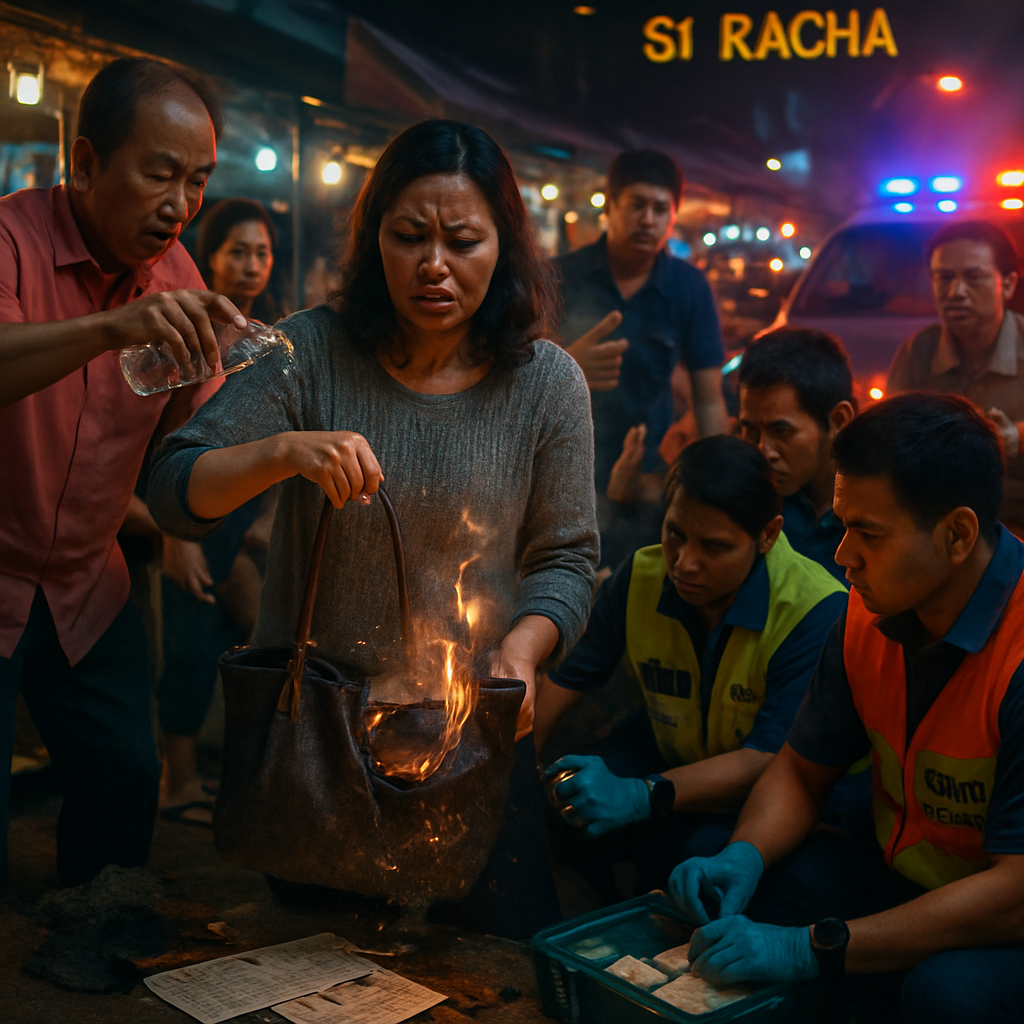
What began as an ordinary evening shopping trip in Si Racha turned into a frightening reminder about the hidden risks of portable batteries. At around 7:00 pm on January 3, 2026, in the Sahapat Airport area of Moo 5, Bueng subdistrict, a power bank connected to a woman’s mobile phone exploded inside her handbag, producing flames that burned her arms and face and set nearby items alight, rescue officials reported.
Members of the public called the Sawang Prateep Si Racha Rescue Radio Centre after seeing the woman in distress. Rescue teams arrived to find a chaotic scene: smoke, singed fabric and a distressed shopper with burn injuries. First responders treated her on site before she was rushed to Phyathai Hospital for further care. Officials later confirmed her injuries were not life-threatening, though she required continued observation and treatment.
Rescue personnel conducting an initial assessment said the explosion occurred while the power bank was charging the woman’s phone inside her bag. Oddly, the phone itself appeared undamaged. The culprit seemed to be the portable battery, which produced a flame hot enough to ignite the bag’s fabric, some nearby documents and the woman’s knitted clothing.
Witnesses described the moment with the kind of stunned specificity that only comes from watching something unexpected unfold. “Her clothes caught fire very fast,” said Suphang Kaewwan, 33, a market vendor who rushed to help. “She was panicked and in pain.”
“People nearby immediately poured water on her to stop the flames before rescue workers arrived,” Suphang added.
Kritsaphon Wisetnakorn, a 46-year-old beverage seller, also helped douse the flames with water and said the power bank inside the bag seemed to be the starting point. The swift action of bystanders likely prevented more serious injuries and stopped the blaze from spreading through the market.
Authorities suspect the explosion resulted from overheating or an internal failure of the power bank while it charged. At the time of the report the device’s brand and certification status were not disclosed, pending further examination. Officials used the incident as a cautionary tale, urging the public to be mindful of the batteries they buy and how they use them.
Why power banks can be dangerous
Portable batteries—especially low-cost, uncertified models—can pose real hazards. When internal cells are poorly manufactured, damaged, or exposed to heat, they can short-circuit, swell, overheat and, in rare cases, ignite or explode. Several such incidents have been reported across Thailand in recent years, usually tied to substandard batteries or improper charging habits.
Experts say the risk increases when devices are charged in enclosed spaces like handbags or pockets, where heat cannot dissipate. Knitted or synthetic fabrics can catch quickly, turning a small smolder into visible flames in seconds—exactly what witnesses described in Si Racha.
Simple steps to reduce the risk
Local rescue teams and safety officials recommend practical precautions to help avoid incidents like the one in Bueng subdistrict:
- Buy power banks from reputable brands and check for recognized safety certifications.
- Inspect batteries regularly—discard any that are swollen, cracked or unusually hot.
- Avoid charging devices in bags, pockets or other confined spaces where heat can build up.
- Never leave charging devices unattended for long periods, especially overnight.
- Use the correct cable and adapter recommended by the manufacturer to avoid overcurrent or overheating.
Officials stressed that a little vigilance goes a long way. “Monitor devices while they charge and stop using power banks that show signs of damage,” rescue sources advised. The Si Racha incident is a clear demonstration of how quickly a routine action—topping up a phone’s battery—can turn dangerous when equipment malfunctions.
For the woman who was burned, swift first aid and decisive action by bystanders made all the difference. Market vendors like Suphang and Kritsaphon didn’t hesitate to help, pouring water over burning clothing and holding the scene together until medical teams took over. Their response prevented a worse outcome and highlights the importance of immediate action in emergencies.
As investigators continue to examine the exploded power bank, the case will likely be a reminder for regulators and consumers alike: portable power is incredibly convenient, but it demands respect. Choosing quality products, using them sensibly and keeping an eye on charging devices can help turn a potentially dangerous situation into one that’s handled calmly—and safely.
If you or someone you know uses portable chargers regularly, consider this incident a nudge to check the batteries in your bag. A few minutes of inspection and some safer charging habits can keep an evening out from becoming a trip to the emergency room.


















This is terrifying and exactly why I only buy certified chargers now.
Certified or not, people leave things charging in bags like it’s nothing and expect miracles.
Exactly — I check mine every time and never charge in a pocket or bag.
Also, pouring water on a chemical fire can be risky if the battery is lithium-based, but in panic you do what you can.
Sounds like a cheap Chinese fake power bank to me, and regulators are always two steps behind.
Blaming ‘cheap’ generally ignores that even branded devices can fail due to damage or misuse.
True, but quality and certification statistically reduce these incidents a lot.
As someone who sells things online, I see so many counterfeit power banks. People want a dollar saved and risk burns.
Why are people still carrying power banks in crowded markets? Leave them at home if you don’t need them.
This makes me paranoid; I always keep mine in my bag while charging because I’m rushing around.
Simple fix: buy one with overcharge protection and never charge in tight enclosed spaces.
Thanks, DrBob — can you recommend a reputable label or certification mark to look for?
Look for CE, UL, or other national certifications and read reviews; marketing often lies but safety marks are harder to fake.
From an engineering standpoint, thermal runaway in lithium-ion cells is well understood and preventable with proper management systems.
Then why are these still happening so often in consumer devices?
Because cost-cutting, poor manufacturing controls, and damage during use can defeat those protections over time.
The crowd pouring water likely saved her life, but we should teach first aid for burns better in schools.
Totally — quick cooling under clean running water is actually recommended for many burns.
Regulators love issuing warnings after incidents instead of proactive inspections; this is policy failure, not just user error.
Regulation is expensive and slow, but maybe we need spot checks and import controls for electronics.
Exactly — spot checks, better customs screening, and stiffer penalties for counterfeit goods.
And public awareness campaigns; people treat chargers like disposable toys until something goes wrong.
I used to carry a big battery too, but I stopped after reading about swelling cells. Not worth it.
Chemically, lithium batteries can vent flammable electrolyte and ignite if internal separators fail, so containment and battery management are crucial.
Why do phones often survive while the power bank goes up? The article said the phone was undamaged.
Phones have different cell constructions and safety circuits; a failing external pack can send a burst of heat or flame that doesn’t necessarily damage the phone immediately.
I read you shouldn’t use cheap cables either; a bad cable can overheat and cause sparks.
Cables are underrated hazards; using unknown adapters can push too much current into a battery.
People need to stop buying ‘as-seen-on-internet’ batteries from street stalls, even if they’re temptingly cheap.
Some of those are totally unregulated, but telling poor people to stop buying cheap stuff isn’t a policy solution.
This is a public health issue: small burns add up to healthcare costs and trauma for victims.
And psychological effects too; trauma from fire scares people away from public markets they rely on.
Right, so prevention via education and product safety is cheaper than treating injuries later.
Not to sound harsh, but people who keep charging overnight in bags deserve some blame; it’s negligent behavior.
Blame is fine but it’s better to change systems — safer designs, stronger imports control, and clearer labels.
Could the vendor be liable if they sold the faulty bank? I want sellers held accountable when it’s defective.
In many places sellers can be sued, but proving the chain of custody for a tiny power bank is hard and expensive.
I voted with my wallet and stopped buying unfamiliar brands, but friends still buy the cheapest ones for their kids.
Kids and teens often don’t get safety training; schools should have short modules on device safety and charging habits.
A quick, low-cost public service campaign could change habits: posters in markets, QR codes to safety lists, and retailer checklists.
I disagree with the idea that just ‘buying certified’ is the silver bullet; counterfeiters fake labels, and certifications vary by country.
Counterfeits are an issue, but transparency in supply chains and random lab testing would reduce fakes markedly.
If the battery was damaged before use, the user might not know; handling and drops can start internal faults that show up later.
For everyone: inspect your battery for bulging, cracking, or heat, and toss it safely if you see damage.
Also, store batteries away from flammable materials and consider a small fire-retardant pouch for travel.
I still think manufacturers should design safer chemistries; we rely on lithium because it’s energy-dense but risky.
Research into solid-state batteries may reduce such fires in the long term, but adoption takes years and regulatory hurdles.
Until then, common sense: don’t charge in your bag, check devices, and report suspicious products to authorities.
And demand better enforcement; complaints on forums rarely substitute for government action.