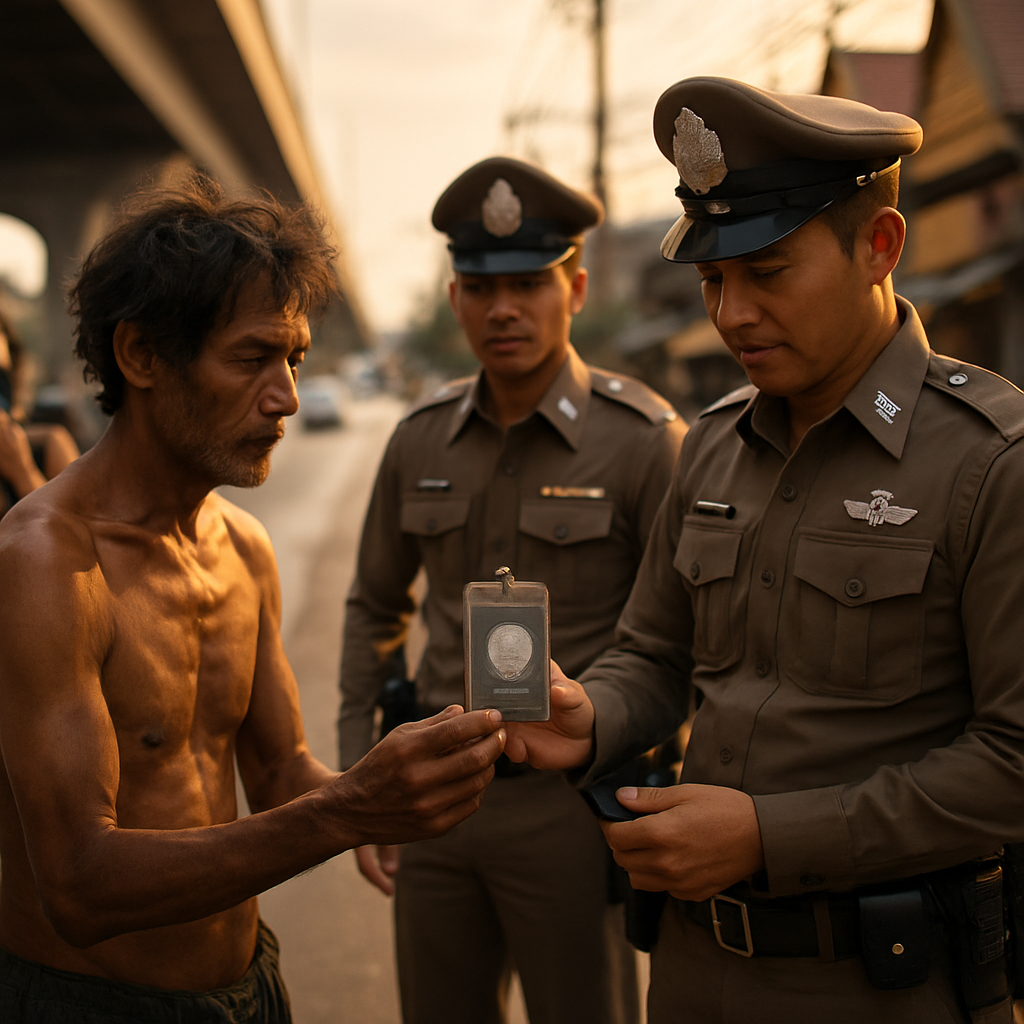
In a scene that sounds like it was lifted straight from a low-budget crime caper — shirtless stranger, tousled hair, bare feet and a government-issued police ID flashing the rank of Police Captain — Prawet Police Station officers found themselves scratching their heads during a routine patrol along a motorway frontage road in Bangkok’s Prawet district on January 20.
Officers initially thought they’d encountered a homeless man. He looked the part: unkempt, barefoot and wandering in a community area where people often pass through without drawing much attention. But when they asked for identification, the situation flipped from ordinary to eyebrow-raising. The man calmly produced what appeared to be an official police ID card proclaiming him a commissioned officer at the rank of Police Captain. With almost cinematic confidence he told the officers he wasn’t homeless at all but an undercover cop on a secret assignment, out to gather local intelligence.
Prawet Police Station’s social media team couldn’t resist a bit of humor. Their light-hearted Facebook post gently teased the mystery: was this an extremely dedicated undercover officer willing to sacrifice appearances for the greater good, or someone experiencing serious instability? The question — delivered with a wink — captured public imagination and the post quickly went viral across Thai social platforms. People loved the mix of mystery, comedy and humanity: a man who looked like he’d slept under a bridge claiming the gravitas of a captain.
Then came the follow-up, served with a side of reality. On January 21 TV presenter Sorayuth Suthassanachinda revealed that, despite the convincing card and the confident claim, the man was not a serving officer. Pol. Col. Tossaphol Amphaipipatkul, superintendent of Prawet Police Station, confirmed that the man was, in fact, homeless. The ID card, investigators believe, likely belonged to a Metropolitan Police Bureau officer — an old or lost badge that someone else had apparently found and kept.
Officers treated the situation with the mix of procedure and compassion it deserved. They documented the man’s details, checked the card’s authenticity and then set about tracing any possible family ties or support networks. The goal was not a sensational arrest but to get the man the help and connection he might need. After all, the line between a social media curiosity and a human being in need is thin, and local officers appeared mindful of that distinction.
The incident wasn’t entirely without precedent. Last May, Bangkok drivers were baffled when a man — also thought to be homeless — suddenly broke into what looked like a martial-arts dance in the middle of a busy road. Eyewitnesses initially feared he might be armed; it turned out the “weapon” was an umbrella. Both episodes underscore how quickly public assumptions form and how easily a stranger’s unusual behavior can become a viral headline.
What made the Prawet incident uniquely compelling was the interplay of image and identity. A plastic card, a confident explanation, and a disheveled appearance combined to create a narrative people couldn’t help but share. The story tapped into something universal: that moment of cognitive dissonance when the badge says one thing and the shoes tell another. It also illustrated how small items — a lost ID, an old badge — can acquire new stories when they fall into different hands.
Social media users reacted in true internet fashion: with a mixture of amusement, skepticism and empathy. Some joked that the man deserved an undercover Oscar; others raised more serious questions about the safety nets available to vulnerable people in Bangkok and beyond. The Prawet Police’s own playful tone in their Facebook post likely helped steer the conversation away from judgment and toward curiosity, making it easier for many to laugh without losing sight of the underlying human story.
For the officers involved, the episode will likely be a memorable patrol — not because of danger or drama, but because it highlights the unpredictable nature of community policing. One moment you’re checking plates on a motorway frontage road; the next you’re fielding existential questions about identity and appearances. And in between the chuckles and the headlines, there’s work: verifying documents, establishing facts, and, where needed, connecting people with family or social services.
In the end, the Prawet “police captain” episode is both a comic anecdote and a small social lesson. It reminds us that a piece of plastic can masquerade as authority, that confidence can be convincing, and that viral stories often have human threads worth following through. Whether the man was a would-be imposter, an empathetic holder of a lost badge, or simply a person trying to make sense of difficult circumstances, the real takeaway is a simple one: beneath every quirky headline is a person whose story is rarely as clear-cut as it first appears.
And for those tempted to write their own detective novel after reading this — remember, truth can be stranger and far more human than fiction. Prawet’s little mystery had a humorous twist, but it also nudged a city to pause, smile and, perhaps most importantly, take a moment to care.


















This reads like a movie bit, but the ID problem worries me. Who loses a police card and why does someone keep it? Either way, it’s a sign the system is sloppy.
Maybe it’s nothing more than salvage culture — people pick up lost items and keep them. Or maybe it’s a deliberate ploy to get perks. Hard to know from a viral post.
Fair points — I just think there should be clearer protocols for dealing with found IDs. This could be used for petty fraud or worse.
My heart goes out to the man. Viral jokes are fun but they can dehumanize people in need. We should be asking how social services failed him rather than laughing.
Totally disagree on the tone policing. Social media made this light-hearted and it helped the police connect and check on him. Not every viral story needs a policy lecture.
Connecting is good, but tone matters when someone’s dignity is at stake. A laugh plus a check-in is best, not just a punchline.
This is a compact example of symbolic interaction: the badge conveys authority regardless of wearer. It shows how social objects reassign identity. Also, the police response is an interesting case of institutional PR meeting street-level compassion.
That’s a big wordy take but I get it — a card can make people think someone is important. Strange world.
Exactly, Ben — small cues change perception rapidly, which has implications for policing and public trust.
I’m suspicious. What stopped cops from checking whether the badge number matched a real officer? Feels like a cover-up or lazy policing to me. Viral posts distract from accountability.
Conspiracy aside, the piece says they checked the card and traced family ties. Maybe give them a minute before accusing cover-ups.
I did see that, but headlines shape public memory. Next time the facts will be buried under the jokes unless people keep asking.
Police social media teams are walking PR engines now. It’s clever to use humor but is it appropriate when the subject may be mentally unwell? Tone policing matters when real humans are involved.
If the police used humor to diffuse stigma and then helped him, that’s a win. Why assume malice from a Facebook post?
Because humor can normalize ignoring deeper causes. I want to see follow-up about assistance, not just laughs and shares.
Honestly, I laughed then felt bad. It’s a human story wrapped in internet culture. Hope he gets help and not just memes.
From a civilian oversight angle, it’s fine for cops to have a lighter touch, but transparency about the man’s outcome would build trust. Did social services engage?
Yes — that’s what I want to know too. The article hints at support but doesn’t give a follow-up, which is frustrating.
If he honestly thought he was undercover maybe he was protective of himself. Homelessness and delusion sometimes mix and need care, not mockery.
I just want the police to help him find family or housing. Viral fame won’t keep him warm.
I appreciate the Prawet station’s follow-up, but insensitive posts can backfire. Agencies should include resources and helplines in such posts. Accountability first, winks later.
Also, auditors should track how these social posts translate into real interventions; otherwise it’s PR theater.
This proves people judge books by covers. A shabby appearance leads to assumptions, and that has policy consequences when services are allocated.
I think it’s funny but sad. The umbrella martial-arts man and this show how Bangkok loves a quirky street story. Still, policy questions remain.
Seen this before. Many folks living on streets wear pieces of former lives. Lost badges, old uniforms — it’s common and heartbreaking.
Why are we surprised? Authority symbols carry weight, but society should carry people. Troubling that we needed a viral post for an intervention.
Could have been dangerous if he actually impersonated officers in other scenarios. This highlights risks of fake IDs floating around.
The police did the right thing by treating him with compassion. Not every interaction needs to be criminalized or politicized.
Media loves the quirky angle because it’s clickable. Let’s not forget systemic issues like housing and mental health that make these stories repeat.
There’s a lesson in civic trust: a plastic card shouldn’t be all it takes to command respect. Verification systems need improvements.
I joked about the ‘undercover captain’ line but the empathy part stuck. Good on the cops for checking his wellbeing rather than arresting him.