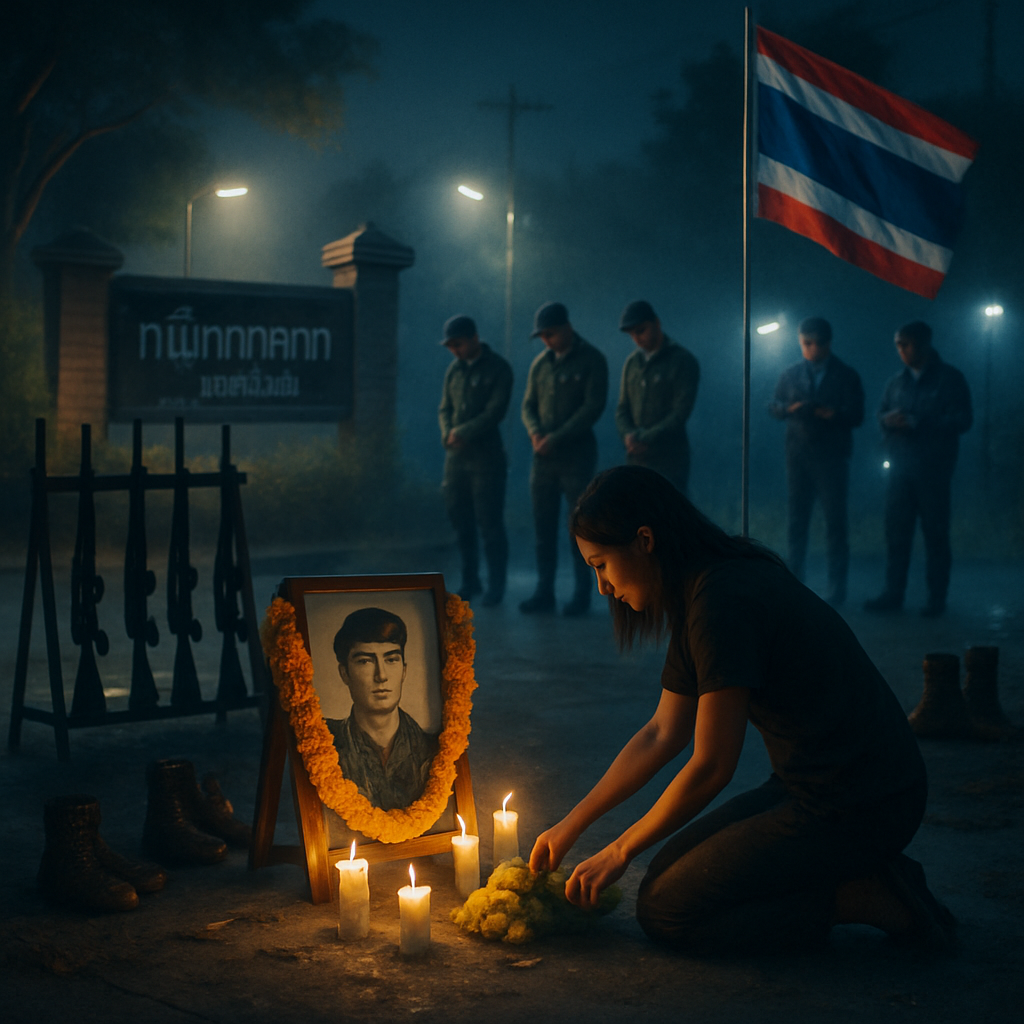
A tragedy at Sura Dham Pithak Military Camp in Nakhon Ratchasima has jolted Thailand this week, after the Royal Thai Army publicly acknowledged that eight soldiers physically assaulted three conscripts — an attack that left 21-year-old Private Krittanon Phonchantuek fatally injured.
The case burst into the public eye when a family member, believed to be Krittanon’s aunt, posted his photo on social media with a heartbreakingly simple message: “He (Krittanon) became a soldier to serve the nation. No one expected him to encounter danger in the military premises. How do you dare to do this? This is cruel. This happened too suddenly. The family still can’t accept the loss.” That post spread rapidly, stirring outrage and prompting demands for answers about discipline and safety inside military facilities.
Army admits wrongdoing — and promises action
On January 14, the Army Spoke Team’s official Facebook page released a statement confirming wrongdoing by army personnel. According to the statement, the assault took place between January 9 and 10. Eight soldiers attacked three conscripts, including Krittanon, after accusing them of violating military rules. Krittanon sustained severe injuries and later died in hospital; the two other conscripts remain under close medical supervision.
The Royal Thai Army said the soldiers involved had consumed alcohol prior to the assault — a fact the statement described as a “serious breach of military discipline” and an action that also violated Thai criminal law. The RTA added that legal action would be taken against those involved, and that all implicated soldiers were expected to be removed from government service while a special investigation committee conducts a thorough inquiry.
Local news outlets published images related to the case, and the footage and posts shared on social networks fanned public anger. For many, the scandal rekindled long-standing concerns about hazing, abuse and the limits of accountability in rigid hierarchical institutions.
Echoes of a previous incident
The army’s admission came only a day after it addressed another case of violence within its ranks. In October, a widely circulated video showed a confrontation at a military facility in Prachuap Khiri Khan. According to the Army Spoke Team, Sergeant Major Phitpibun Wiang-in tried to intervene in a dispute between conscripts but ended up physically assaulting one private. The army’s disciplinary response was swift on paper: 45 days of imprisonment under military regulations and loss of pension for Phitpibun.
However, the RTA did not clarify whether the sergeant major would also face prosecution under Thai criminal law for that incident. That omission provoked additional questions from the public and rights groups about whether military discipline alone is enough, or if criminal courts should be involved when serious harm occurs.
Why this matters
Beyond the grim headlines, this case touches on fundamental issues: the duty of care institutions owe to conscripts, the lines between military discipline and criminal violence, and how transparently authorities handle allegations against their own members. The fact that alcohol was reportedly involved intensifies those concerns — showing that abusive behavior can flourish when oversight lapses.
Families and civil society groups have been vocal. For them, a promise of “legal action” and the formation of a special investigation committee are necessary first steps, but hardly the end of the story. Observers are watching to see whether prosecutions will proceed in civilian courts where appropriate, whether those disciplined are truly removed from service, and whether institutional reforms will be proposed to prevent repeats.
Next steps and public expectations
The army’s announcement signals an acknowledgment of responsibility, but many in Thailand expect more: transparent publishing of investigation findings, clear timelines for prosecutions (if warranted), and measures to protect conscripts from hazing and abuse. Trust is fragile, and the public backlash demonstrates a strong appetite for accountability.
For Krittanon’s family, any official action may offer only partial solace. The aunt’s post — shared by hundreds and commented on by thousands — keeps the human cost visible: a young life lost, a grieving family, and a community demanding answers.
As the special committee begins its work and legal processes move forward, the broader debate will likely continue: how to balance military order with human rights, and how to ensure that service to the nation does not become a cover for violence. Until the full facts are laid bare and those responsible are held to account, this episode will remain a painful reminder of the stakes involved when institutions fail the people in their care.
Reports indicate that more details will emerge as investigations proceed. For now, the case of Private Krittanon Phonchantuek has become a catalyst for scrutiny, sparking renewed calls for reform and accountability in the Royal Thai Army.
















This is horrifying and I want the soldiers prosecuted in civilian court, not just kicked out and forgotten. Military discipline cannot be an excuse for murder. If the army wants public trust it must show transparent, criminal accountability.
Agree completely, Joe, civilian courts are the only place that can deliver real justice and restore faith. Military tribunals are usually too protective of their own. The family deserves full transparency.
Thanks Maya, the army statement feels like damage control to me and there’s been a pattern of vague punishments in the past. We need independent oversight, not internal committees deciding the outcome.
Hold on, are we sure about the facts yet, or are we trying them on social media? I get anger, but rushing to call for civilian trials while the investigation is ongoing might be premature.
This is tragic, but also predictable when hierarchies mix alcohol and unchecked power. The army admitting wrongdoing is a start, but I doubt it will stop unless laws change. How many similar cases have we seen before?
As someone from a military family, I feel ashamed. The culture of hazing needs legal deterrents and education, not just internal discipline. Change must be structural and swift.
Good point, Somsak, cultural change is hard but essential. Maybe mandatory external monitoring and anonymous reporting systems could help catch abuses early.
External monitoring sounds nice but who pays for it and who runs it without political bias? I worry reforms will be symbolic rather than effective.
I think social media outrage is doing more harm than good by creating mobs. Let the special investigation do its job before everyone judges. False accusations can ruin lives too.
That stance protects institutions over victims. There are dozens of videos and eyewitnesses already; this looks pretty solid and not like a witch hunt.
I get your anger, Ploy, but due process matters for everyone involved. Demand justice, but also demand evidence presented in a court where rights are observed.
This makes me terrified for anyone joining the military. If service means risking your life to colleagues not enemies, that is unacceptable. Families should be allowed to sue the institution.
The army said alcohol was involved; that alone shows negligence in supervision. Someone in command should be held accountable, not just the perpetrators on the ground.
Systemic responsibility is a valid legal concept; commanding officers can be culpable for failing to enforce discipline. International law also recognizes institutional liability in some contexts.
Exactly, Dr. Nguyen, that’s what people are missing when they focus only on the attackers. Leadership failures enable this behavior.
I cried when I read the aunt’s post; small human moments like that make the scale of institutional failure feel real. But public grief should push concrete reforms, not just hashtags. How do we make sure reforms stick?
Start with law changes requiring civilian oversight and mandatory reporting, plus mental health support for conscripts. Also, independent investigations with published timelines and results.
Yes Ken, concrete laws and published timelines would help rebuild trust. Victims’ families should have access to legal aid paid by the state to pursue justice.
Public legal aid is key, but don’t forget protective measures so whistleblowers aren’t punished for speaking up. Culture and law must change together.
From a legal perspective, the omission of whether past offenders faced criminal charges raises red flags about accountability. Military regimes often resolve things internally to avoid political fallout. That undermines human rights norms and rule of law.
Isn’t it possible the army genuinely wants reform but lacks mechanisms? I am skeptical of framing everything as cover-up immediately.
Skepticism is healthy, Larry D, but statistics on prior cases show a pattern where internal discipline predominates over court prosecutions. Patterns matter when assessing institutional will.
Maybe we should abolish conscription and move to an all-volunteer force to reduce abuses from forced recruits. Conscription creates power imbalances that breed hazing. It is time for policy debate, not only outrage.
Abolishing conscription might reduce some problems but could also have broader societal impacts and be expensive. We need to weigh trade-offs carefully instead of quick fixes.
Fair point, Piya, but we can’t keep rationalizing deaths as collateral damage of tradition. Reform must include reassessing who serves and how.
I want the eight soldiers publicly named and prosecuted. Secrecy only protects abusers. Families deserve closure and the public needs to see justice served.
I served briefly and saw how small abuses escalate without accountability. This case doesn’t surprise me. Reforms require transparency, independent investigators, and civilian judges in severe cases.
As a retired NCO I worry about blanket condemnation; most soldiers are decent people following orders. But that doesn’t excuse any crime, and leaders should be stricter about alcohol and discipline.
Agreed chief87, veterans shouldn’t be demonized but systems that enable a few must be fixed. Balance accountability with support for good personnel.
I think the army’s immediate removal of implicated soldiers is appropriate but not sufficient. The rejoining OPs should ensure the military cooperates with civilian prosecutors and publishes findings.
Publicizing findings is delicate because premature leaks can taint legal processes, but a balance is necessary to maintain public trust. Maybe a timeline with redacted details at first?
Yes, grower134, redacted reports and a clear schedule would be better than silence, and it helps curb conspiracy theories while protecting legal integrity.
Kids at conscription age deserve protection, not bullying and death. This is a human rights issue, not just internal discipline. International bodies should monitor if domestic remedies fail.