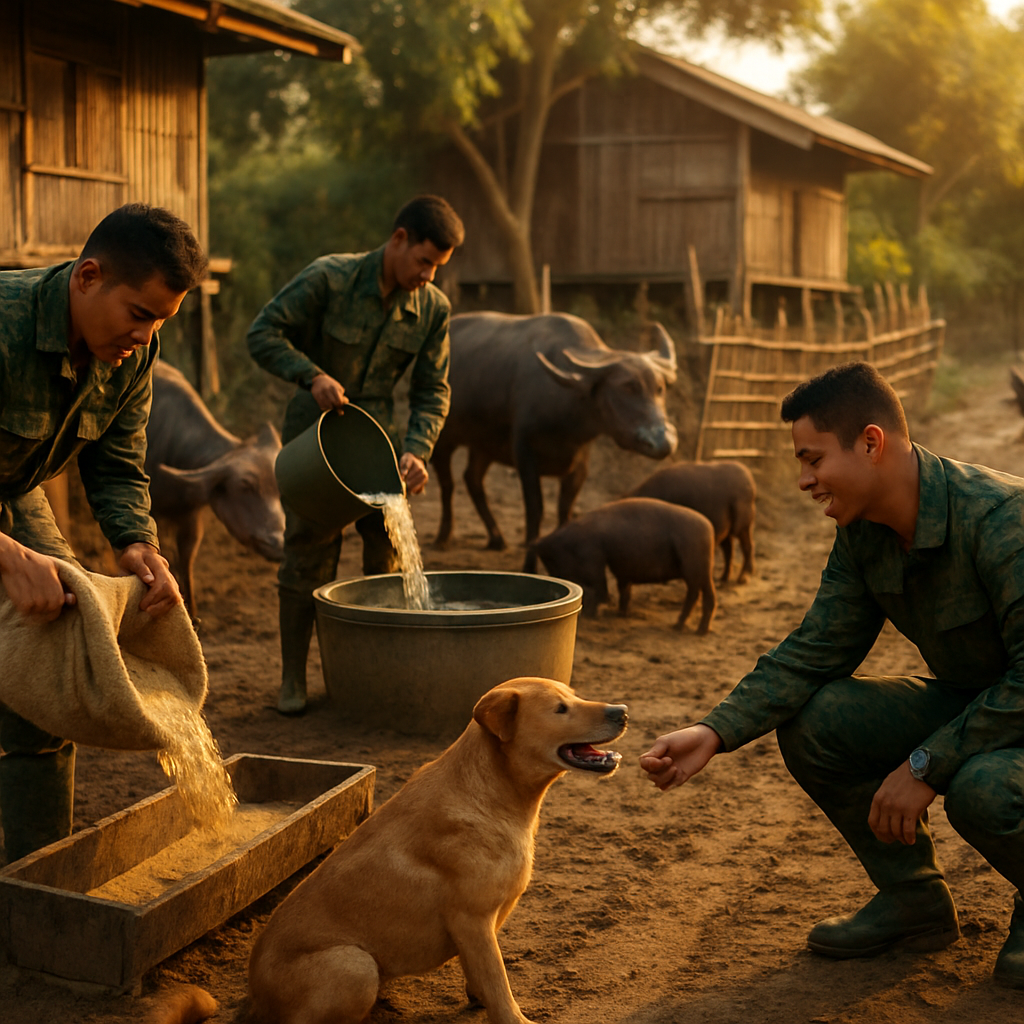
When the guns spoke along the Thai-Cambodian border, many families in Sa Kaeo province packed what they could and fled — leaving behind homes, memories, and, in too many cases, the creatures that are part of daily life. What followed was not just a military operation but a quietly compassionate mission: soldiers from the Burapa Task Force, operating through the Ta Phraya Special Task Force in Ta Phraya district, stepped into a role that isn’t often captured in headlines — caretaker.
On December 19, as residents evacuated high-risk zones amid ongoing clashes, Burapa officers fanned out across villages to check on animals left behind. These weren’t glamorous rescues. They were practical, humane, and sometimes humorous rounds of care: delivering sacks of feed, topping up water troughs, and making sure the village dogs, cattle, buffalo and pigs were not forgotten as their owners sought safety.
The Ta Phraya Special Task Force framed the effort squarely within civil assistance policy — the military’s longer-term commitment to reduce hardship and reassure communities disrupted by security concerns. In plain terms: while soldiers secure the perimeter, they’re also watching the barnyard. They’re making sure that when evacuees are able to return, their animals haven’t been abandoned to hunger or thirst.
Reports and photos circulated via Thairath show officers visiting multiple villages across the district, dropping off food and water and inspecting conditions. The list of beneficiaries read like a small-town farm census: cattle and buffalo ambled up to biscuit-like rations, pigs rooted appreciatively, and packs of dogs wagged and accepted treats like old friends reunited. Task force spokespeople said monitoring would continue for as long as necessary, blending security patrols with rounds of animal welfare checks.
There’s an element of simple good sense to the idea. Livestock represent livelihoods. Dogs and cats represent family members. Left unattended, animals can suffer and cause cascading problems for returning families. Caring for animals during evacuations reduces suffering, preserves livelihoods, and reassures people that someone is looking after what matters while they wait for calm.
Not every act of kindness came from uniformed soldiers on a formal mission. A short, surprisingly warm CCTV clip that surfaced a few days earlier added a human, slightly comic, touch to the story. Two border patrol police officers were filmed feeding dogs left at a remote house in Sa Kaeo during a recent evacuation. One officer spoke directly to the camera and said, “I’m giving food to the dogs, okay?” then performed a salute and rode off on a motorcycle. The dog owner later admitted she hadn’t expected anyone to come by — she lives in a remote area — and was overwhelmed by the gesture.
Small scenes like that cut through the tension. They remind us that in the fog of conflict, acts of decency persist: someone fills a water trough, someone shovels feed into a trough, someone salutes a camera and rides away. For evacuees, such actions can be the difference between returning to a living farm and returning to a tragedy.
But this operation is about more than bags of feed. The Burapa Task Force reiterated that their dual mission continues: safeguard civilians and sustain public confidence. Soldiers will remain on the ground in Ta Phraya district to maintain security until the situation stabilises and people can safely return. In the meantime, the task force’s animal welfare patrols provide a tangible expression of that assurance.
For community members watching events unfold on the border, these gestures are more than logistics — they’re a message. In the midst of an unsettling evacuation, when homes are shuttered and fields grow quiet, the sight of soldiers caring for cattle and dogs sends a simple signal: you are not alone, and what you leave behind will be looked after.
As the situation around the Thai-Cambodian border evolves, the story of Sa Kaeo’s animal guardianship offers a quieter side of military engagement. It’s a reminder that security work sometimes wears rubber boots and carries feed sacks. The Burapa and Ta Phraya units are doing both the heavy lifting of protection and the small, humane acts that stitch a community back together.
When peace returns and evacuees step back into their yards, they may find muddy hoofprints and wagging tails — and a little less worry about what happened while they were away. That, in the end, might be the most important part of any operation: not only returning people to their homes, but returning dignity to the everyday lives that make a place worth defending.














I read this and felt proud and uneasy at the same time; it’s heartwarming that soldiers fed the animals, but why is it always the military filling a gap that local agencies should handle?
Exactly — it’s compassionate, yes, but also raises questions about militarized civil assistance and whether this sets a precedent for soldiers doing long-term social services.
From a governance perspective, in fragile periods the military often steps in because it can mobilize quickly; the trade-off is civilian oversight and ensuring these acts don’t become a tool for political control.
I agree, Dr. Priya — speedy help matters, but transparency and handover plans to civilian vets or NGOs should be explicit so it doesn’t become permanent military responsibility.
As a farmer, I’d rather the soldiers help than see my buffalos starve. Practical help is practical, even if it’s the army doing it.
That’s a blunt but fair point — people need their livelihoods saved now, not debates about jurisdiction.
Also, small acts like feeding dogs can rebuild trust between locals and security forces. That social capital is worth something.
Dogs wag tails, people smile, peace starts with small things.
Soldiers feeding puppies? Cute. I want to see more of that video.
The CCTV clip is viral for a reason — it humanizes soldiers in a tense situation, but some will call it PR.
It’s obviously PR. That salute to the camera was staged-level cheesy, but who cares if animals get fed?
A highly educated take: this operation is a textbook case of civil-military cooperation, but it must be governed by protocols for animal welfare, disease control, and coordination with vets.
Protocols are fine on paper, Doc, but out here we need sacks of feed. Protocols sometimes mean delays.
True, but combining speed with minimal health screening reduces the risk of spreading livestock diseases back into communities.
This reads like a PR campaign: ‘soldiers in rubber boots’ — lovely phrase, but where’s the money spent on proper disaster planning?
As someone from Ta Phraya, I say thank you to the soldiers. Planning helps, but when shells fly the boots on the ground matter more than budget spreadsheets.
I hear you, Lek — frontline help is essential, but we should push for both: immediate assistance and better funded civilian response systems for the long term.
Who is responsible for vaccinations and disease control of animals left behind? Feeding is fine, but stray animals can spread sickness.
Good point: monitoring should include veterinary checks, especially for livestock returning to markets, to avoid outbreaks that affect livelihoods and public health.
If an animal becomes infected and spreads to cattle across a region, that would be catastrophic economically, so vets must be part of the patrol.
Sixth grader view: soldiers are like pet sitters. That makes me happy because puppies don’t have to be hungry.
That’s sweet. Kids see the humane side first, and sometimes adults overcomplicate what is simply kind.
Internationally, this is soft power — showing civilians that the state cares. It helps legitimacy, but we must ensure it’s not used to justify military governance.
Legitimacy-building is fine if it’s genuine. If it’s just optics, then it’s shallow and possibly manipulative.
Soft power or not, saving a family’s livestock is tangible. Critics should propose faster alternatives before condemning these gestures.
Why not formalize this into a civilian-military rapid response team with vets and feed supply chains? Scale the good idea instead of ad hoc kindness.
That’s workable: formal teams, standard operating procedures, and a clear handoff to local authorities once security permits.
I worry about dependency: if communities expect soldiers to care for animals every clash, who trains farmers to manage emergency herds or evacuate animals properly?
Training is useful but in the moment you can’t herd a buffalo down a narrow road with five minutes’ notice. Help first, training later.
Not every act by the military is sinister. Some are exactly what they look like: people helping animals. Why be so suspicious all the time?
Skepticism isn’t the same as denial — we can accept kindness while asking for accountability and civilian oversight.
The little story about the officer saluting the camera made me laugh and cry at once. Funny and human.
It also shows how social media magnifies tiny gestures into big narratives, for better or worse.
If the army keeps feeding our animals, hey, fine. But what about payment for their labor, and who reimburses the cost of feed? We need clarity.
There should be clear accounting, Nop. If it’s government-funded assistance, records and reimbursements to farmers should be part of the program to avoid confusion.
Emotional take: for evacuees, that wagging tail when they return would be everything. Small acts really do restore dignity.
Yes, dignity matters as much as food or shelter. Soldiers feeding pets is a way of protecting that dignity.
Sentiment is nice, but don’t let it blind you to structural problems like landmines, infrastructure damage, and economic recovery needs.
Who trained the soldiers to recognize animal health issues? Feeding is easy; spotting sick animals is different and necessary.
Short training modules for troops on basic animal welfare and disease indicators would be low-cost and high-impact; partners like vets or NGOs can help.
Even simple checklists help. Soldiers don’t have to be vets, but they can flag problems for specialists.
People calling it noble should also ask about resource allocation: feed, fuel, security — are we diverting from human aid?
You can’t separate them fully; animals are economic assets and family. Helping them is helping people too.
Agreed on the need for balance — integrate animal care into humanitarian plans so it’s not a zero-sum choice.
Side note: next time, bring sturdy ropes and cages for stray dogs. Feeding helps, but some animals need secure holding for transport.
That’s practical. Logistics matter; good equipment prevents chaos when evacuations happen fast.
I also wonder about psychological impact on soldiers doing these tasks — does it change their view of civilians and ease tensions?
Contact theory suggests positive interactions like these can reduce distrust, but it depends on frequency and reciprocity, not one-off gestures.
This is a reminder that security isn’t only about guns; it’s about preserving the everyday. I’m glad someone thought of the animals.
Nicely put. Practical security includes livelihoods and normalcy, which these acts help protect.
6th grader conspiracy: maybe the dogs were spies. Kidding! I just like the happy ending story.
Spy dogs would get extra biscuits, obviously.
We should document these missions, create case studies, and teach other regions how to integrate animal welfare in evacuations.
Yes, documentation would help others replicate effective parts while avoiding militarization of humanitarian roles.
Final thought: it’s a mix of genuine kindness and image-making. Both can coexist; the test is whether communities are better off long-term.
If families return and their animals are alive and healthy, that’s a pretty clear short-term win at least.
Agreed — let’s judge the action by outcomes and push for transparency and sustainability so the kindness scales without creating problematic dependencies.