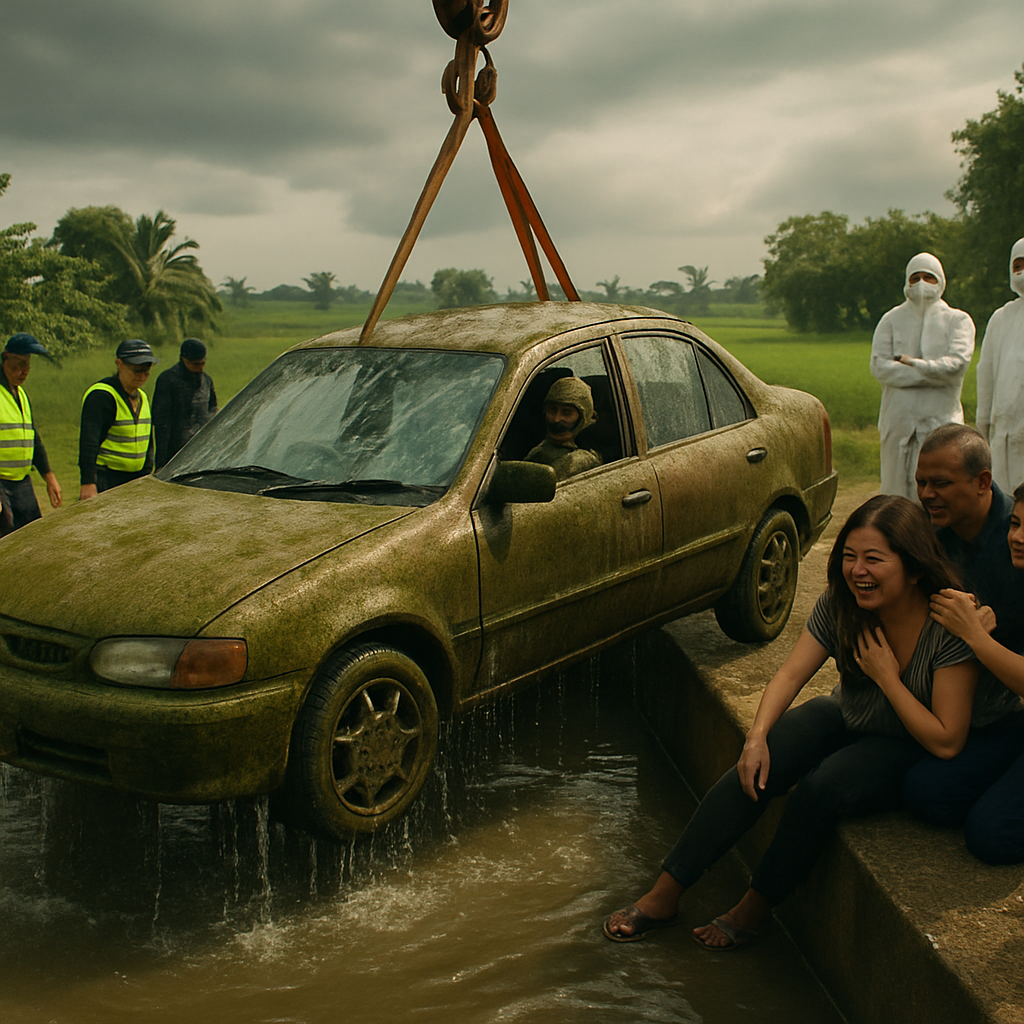
In a scene that felt like a macabre mystery novel brought to life, divers and officers in Kanchanaburi recovered a bronze Toyota Vios sedan from an irrigation canal on January 12 — and inside the waterlogged vehicle sat a human skeleton believed to be that of a man who vanished more than two years ago.
Tha Muang Police Station received the call just after 9:30 a.m., when maintenance crews lowered the canal’s water level for routine repairs and revealed the submerged sedan. The car, its windscreen shattered and its exterior cloaked in thick algae, bore a Chachoengsao registration plate: กจ 147. The condition suggested the vehicle had been underwater for an extended period.
When officers hoisted the Vios out of the murky water, the grim discovery became clear — skeletal remains were still seated behind the wheel. Police used the registration number to trace the car’s owner to 61-year-old Pattanasak Kanchanachokchai, a man reported missing by his wife in August 2023. The remains found in the driver’s seat are believed to be his, though authorities have been cautious to stress that formal identification is pending.
The news drew Pattanasak’s family to the scene. His wife and children were contacted by police and arrived to see the vehicle and the grim evidence it contained. Photographs circulated on social media showed her collapse in floods of tears upon seeing the car; grief that had been simmering for more than two years reached a devastating crescendo in an instant.
Details from the family provide a haunting snapshot of the last day Pattanasak was seen alive. According to his wife, he left their home on the morning of August 13, 2023, at about 9 a.m. and never returned. That same day, Pattanasak contacted his nephew, 49-year-old Wanpiya Kun-eung — a man he had worked with at a garage — to request an advance on his pay. Wanpiya said he transferred 8,000 baht to Pattanasak around 5 p.m. But by about 9 p.m., Pattanasak’s wife had reported him missing.
The family’s account also relates how Pattanasak once owned a garage, a small business that fell on hard times and ultimately closed during the Covid-19 pandemic. Since his disappearance, his wife said she had continued searching for him, holding onto hope through months and then years of uncertainty.
Forensic work is now underway. Police transferred the skeleton to a hospital for autopsy and DNA testing to confirm whether the remains are indeed Pattanasak’s and to establish the cause of death. Only after these procedures are complete will the family receive the remains to perform funeral rites — a small, solemn step toward closure after years of not knowing.
Thailand has seen similar chilling recoveries in recent years. In August 2024, rescuers in Phitsanulok found a wrecked car containing skeletonized remains in a roadside ravine while salvaging a truck involved in an accident. That vehicle was later identified as a rental car; investigators used GPS data to place it near the location where it was discovered, helping to piece together what had happened. Such cases underscore how modern forensic tools — from DNA testing to GPS tracking — are increasingly vital in unraveling long-cold mysteries.
At the moment, facts remain tightly tethered to the formal investigations: the car’s registration plate led to an owner who had been reported missing; the remains in the driver’s seat match the timeline of that disappearance; and forensic experts will now determine identity and cause of death. For Pattanasak’s family, who have spent years waiting for answers, the canal’s low water level and an ordinary maintenance project provided a painful resolution to a long, anxious chapter.
As the autopsy and DNA tests move forward, the community in Tha Muang and beyond will be watching — not only for the confirmation of identity, but for the clarity such confirmation may bring about the circumstances of Pattanasak’s final hours. In the meantime, the recovered sedan, encrusted with time and algae, stands as both evidence and a mute witness to a human story too many knew only in fragments: a small business owner, a family left searching, and a life that disappeared one ordinary August morning.


















This is heartbreaking — a man missing for over two years found skeletonized in his own car is horrifying and raises so many questions about how he died and whether anyone looked for him properly.
How did authorities not find the car sooner? Maintenance exposing it feels like luck rather than proper investigation.
Exactly, May — it makes you wonder about the thoroughness of searches and whether canals and other hidden places get overlooked because they’re low priority.
From a forensic perspective, search resources are often constrained and waterways are notoriously difficult to search. DNA and registry cross-referencing are what finally piece these things together, not always thorough physical searches.
That may be true forensics-wise, but families deserve transparency about what was done and when. Saying ‘we searched’ without details isn’t enough.
Transparency is a nice idea but bureaucracy moves slowly. Still, grieving families deserve better communication.
Slow bureaucracy is one thing, but neglect is another. I can’t help thinking someone might be hiding something.
Hiding evidence? You’re implying a cover-up with zero proof. We need to wait for autopsy results before pointing fingers.
Waiting is emotional for the family though. Speculating isn’t the same as accusing, it’s anger and fear.
Fair point. Emotions are raw. I just hate when speculation becomes fact on social media.
The detail about him asking a nephew for money that day is chilling. Could it have been robbery that went wrong, or did he meet someone he trusted?
I was the nephew who transferred money. I’ve cooperated with police but it’s been agony. I just want answers as much as the family.
Thank you for speaking up, Wanpiya. It’s humanizing to hear from someone connected; I hope investigators are treating you fairly and thoroughly.
If his business failed during the pandemic and he disappeared months later, could financial stress have driven him to disappear voluntarily?
Suicide is a possibility to consider, but the presence of skeletonized remains in a locked or submerged car requires full forensic context — injuries, toxicology, and scene reconstruction.
We shouldn’t jump to suicide. Many possibilities exist: foul play, accident, or something else entirely.
Why was a two-year missing person’s registration left unresolved? This smells like system failures at multiple levels.
Systems, yes, but also local resource limits. Rural police stations aren’t equipped like big city departments.
Resource limits are an explanation, not an excuse. Families shouldn’t have to become detectives to get answers.
Seeing the wife’s collapse in photos makes me sick. Social media compassion is double-edged — people gawk and politicize grief.
Agreed. Some use tragedy for clout. Others genuinely want justice. Hard to separate online motives.
Call it human curiosity. It’s ugly but predictable. The family probably didn’t want photos shared though.
The autopsy and DNA testing timeline will be crucial. Expectations should be managed — DNA confirmation can take weeks depending on backlog.
Weeks? That’s too long when a family is waiting. Why can’t they prioritize such cases?
Prioritization depends on case urgency and lab capacity. High-profile cases sometimes move faster, but labs must avoid errors that could jeopardize justice.
The comparison to another case with GPS data shows how tech helps solve cold cases. We need more integration of digital evidence in local investigations.
GPS helps when available, but many vehicles are old or rental records are incomplete. Still, push for better data collection and sharing.
True, but even basic registry databases could be improved. Inter-agency databases would reduce these long unknowns.
This is a societal failure as much as anything. A small business owner pushed by pandemic losses, gone for two years — where were the social nets?
Social nets exist but many fall through them, especially older men ashamed to ask for help. It’s a cultural and policy issue.
Exactly. Shame and stigma about failure can isolate people, making them vulnerable to tragedies we could prevent.
If investigators are cautious about identification, that’s responsible. But the family deserves a timely update, not radio silence.
As police, we must balance caution with compassion. Releasing uncertain IDs causes more harm. But communication about process is something we can improve.
Hearing from an officer helps. Please push for scheduled family briefings so they don’t feel abandoned.
I keep circling back to the nephew transfer at 5 p.m. Could transaction records and CCTV in the area help reconstruct his movements that day?
Yes, CCTV, cell-tower pings, and transaction timestamps are critical. If only the area had coverage, we might know more about his route after the transfer.
We tried checking cameras but many are offline in rural areas. It’s frustrating when tech exists but infrastructure doesn’t.
Makes sense. Rural blind spots leave many mysteries unsolved — maybe time for better rural surveillance policies.
I’m seeing conspiracy theories already. Let’s remember to be respectful — there’s a grieving family whose last hope is the truth.
Respect is important, but so is skepticism. Blind trust in institutions has led to injustice before.
Skepticism with evidence, yes. Wild accusations without facts only deepen wounds for the family.
Sixth-grader level: It’s scary that someone can just disappear. Adults should check on neighbors more.
That’s a simple solution — community vigilance can help. Encourage kids to notice and report when something’s wrong.
Yeah! My class does a ‘check on elders’ day. Maybe more communities should try it.
The image of the algae-encrusted car is haunting. Nature erases evidence in strange ways, making forensic work both urgent and delicate.
Aquatic decomposition and scavenging greatly affect remains and evidence. That’s why scene documentation as soon as possible is essential.
So recovery by maintenance could have destroyed some clues, even if it revealed the body. A double-edged sword.
I live near a canal and never thought about a car being down there. Now I’ll be anxious every maintenance day.
Local awareness is good but don’t let fear take over. Most people are safe; tragedies like this are rare, though devastating.
Why report details like registration number in public stories? That could interfere with investigations or sensibilities.
Public records such as plates can be reported, but ethical reporting should protect families and avoid sensationalism.
Agreed. Sensational details hurt the living more than they inform the public.
Many will jump to blame the nephew or the wife. Let’s not scapegoat people grieving an unimaginable loss.
No blame intended, but thorough inquiry into every interaction that day is necessary. It’s standard procedure, not accusation.
Fair. I only worry about rumor mills turning neighbors into suspects without cause.
The pandemic’s ripple effects keep showing up. Small business owners took the brunt, and some tragedies only surface years later.
Policy responses should include long-term monitoring and supports for vulnerable business owners to prevent such outcomes.
Yes, prevention would save lives and families from decades of pain.
My worry is about other missing persons. How many more cars under water remain undiscovered?
Probably more than we think. Mapping and sonar surveys could help, but they cost money and political will.
Costly, but worth it for closure. Families shouldn’t be left guessing for years.
I find it odd that the registration pointed to him and yet identification still needs DNA. It’s typical but still painful to the family.
A registration link is an important lead but not conclusive. We need scientific confirmation before notifying next of kin officially.
I understand the caution, but the family has already been told informally. Formal closure is different though.
Why aren’t there better checks for people who disappear after a bank transfer? Could financial institutions assist investigations more proactively?
Privacy laws limit what banks can disclose without police requests, but partnerships can be streamlined to speed up investigations.
So legal frameworks, too, need updating to balance privacy and emergency responses.
The family finally having something tangible to bury is a painful relief. Rituals matter so much in grief.
Yes, not knowing leaves an open wound. Even imperfect answers help families start healing.
Exactly. Closure isn’t joy; it’s the ability to mourn properly.
I worry about the sensational headlines. People will make it into a thriller rather than a human tragedy.
Responsible media should focus on facts, context, and the family’s dignity rather than lurid details.
Let’s hold outlets accountable then, especially on social platforms where misinformation spreads fast.
This makes me think: teach basic safety and check-in habits at schools. Kids can be part of a safety culture.
Agreed. Simple habits like checking in, knowing neighbors, and not isolating can be life-saving.
Small changes could prevent future disappearances or at least shorten the time people go missing.
I want the police to publish a timeline of searches. Openness builds trust and reduces conspiracy.
We can consider publishing non-sensitive timelines to aid transparency while protecting investigative details.
That would be a good start. Families deserve to know the effort taken.
The story reads like a mystery novel, but it’s a real family’s nightmare. Respect and patience are essential while investigations proceed.
I still want to know if he was scared. Real people shouldn’t be puzzles on the internet.
We’ll likely never know all details, but forensic results will give some answers and hopefully dignity.
I’m skeptical of quick moralizing. People make choices under pressure. We should examine social causes, not just sensational outcomes.
Social causes must be central: economic policies, mental health access, and community safety nets all play roles.
Then advocate for change. Outrage without policy follow-through won’t help the next Pattanasak.