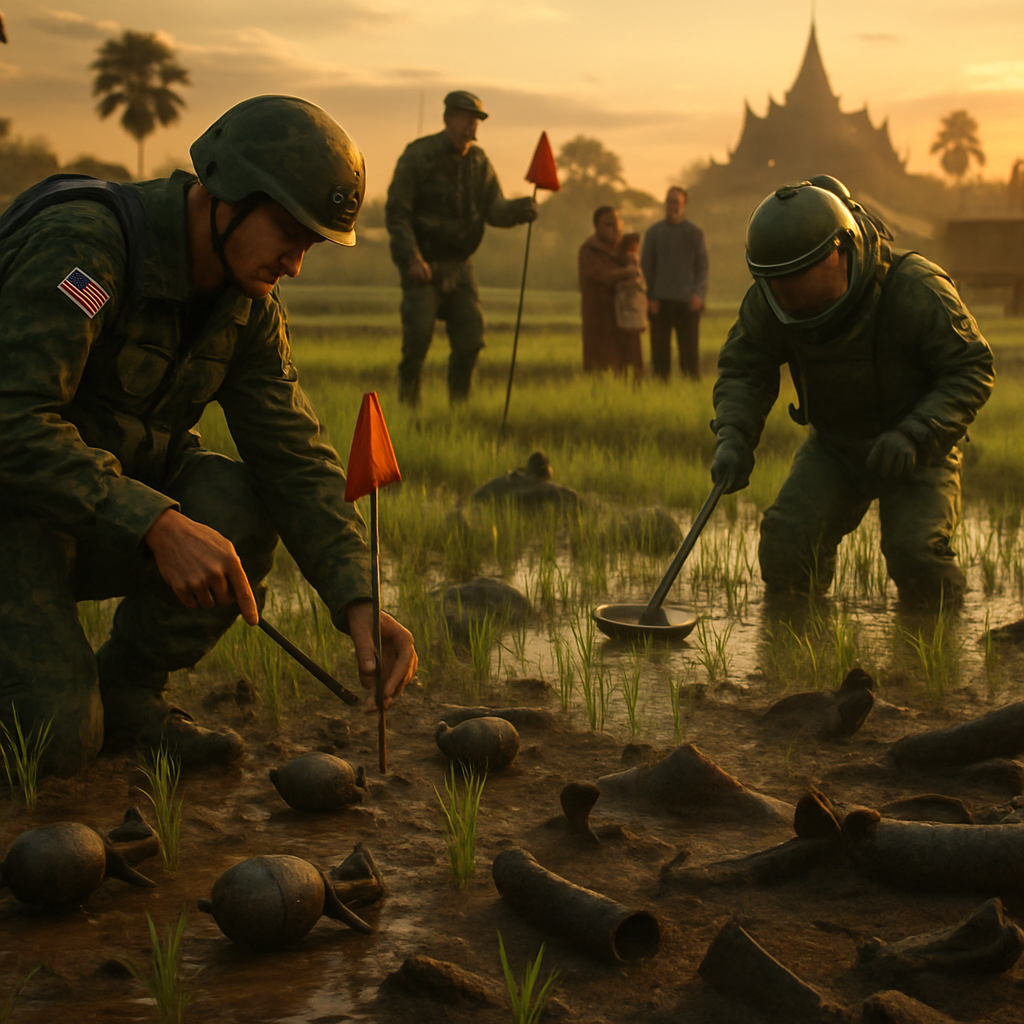
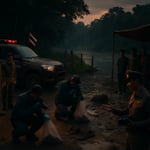
On December 24, what began as a flurry of sharp accusations between neighbors turned into a public back-and-forth that read like a diplomatic courtroom drama. Cambodia’s government released photos and statements alleging that Thai forces had used M-46 cluster munitions in recent clashes — weapons, Cambodian officials warned, that can scatter lethal fragments across fields, forests and villages and remain a long-term risk to civilians, especially children.
The Royal Thai Army fired back the same day through spokesperson Winthai Suvaree, insisting the images and claims were misleading. Winthai said the munitions in question were dual-purpose artillery shells intended strictly for military targets. According to him, the submunitions inside the shells detonate successively on impact, rather than lying dormant like anti-personnel landmines that can later maim or kill noncombatants.
Two versions of the same scene
On one side, Cambodia’s Ministry of Information and Ly Thuch — vice-president of the Cambodian Mine Action and Victim Assistance Authority — painted a grim picture: unexploded bomblets strewn over countryside and villages, “traps” that could continue to threaten civilians long after the shooting stops. Those images and warnings resonated with humanitarian concerns about cluster munitions around the world.
On the other, Thailand’s official line was firm and legalistic. Winthai rejected the notion that the shells are tantamount to banned cluster weapons or that they behave like traditional landmines. He emphasized that the munitions “do not remain hidden in the ground” and are not designed to be anti-personnel devices. He accused Cambodian authorities of distorting facts and urged international observers to consider the full context of the incidents.
Where international law fits in
Legal questions bubbled to the surface. Winthai pointed out that the Convention on Cluster Munitions (CCM), which outright bans the use, production and stockpiling of cluster munitions, has no legal force over either country — Thailand and Cambodia are not signatories. That detail does not settle the ethical debate, but it does frame why both sides emphasize differing interpretations of legality and military necessity.
Thailand also framed its actions within the language of international humanitarian law, invoking principles such as proportionality and operational necessity. “Thai forces,” Winthai said, “operate in strict accordance with international humanitarian law,” adding that the country stands ready to clarify facts openly to protect its sovereignty and security.
Accusations go both ways
Diplomacy aside, the exchange quickly broadened into reciprocal allegations. The Royal Thai Army accused Cambodia of firing BM-21 rocket systems, using PMN-2 landmines, and deploying firearms and improvised devices that have struck into Thai territory — claims that shifted the story from a single weapon type to a larger pattern of cross‑border hostilities.
Both sides, therefore, are asking the international community to look closely — Thailand to vindicate its conduct, and Cambodia to highlight the humanitarian risks it says cluster-like weapons pose. For observers and residents along the border, the immediate concern remains practical and human: ensuring civilians are safe from unexploded ordnance and that the facts on the ground are investigated transparently.
Beyond the headlines
Amid the serious diplomatic sparring, life continued in quieter, solemn ways. In Kalasin province, a royal cremation was held for Army Nurse Sergeant Apisit “Tee” Bunnak, 33, at Wat Pa Phutthaphawan — a reminder that behind every strategic briefing and political statement are individual human stories of service, loss and ritual.
The December 24 exchange shows how quickly military incidents can escalate into international controversy, where images, terminology and legal nuances carry heavy weight. For now, both Bangkok and Phnom Penh are pitching their narratives to the global audience: Cambodia warns of lingering danger to civilians, while Thailand insists its munitions are targeted, not indiscriminate, and that it follows the law.
What happens next is likely to depend on independent investigations, humanitarian assessments, and whether neutral parties can gain access to border areas to verify the condition and nature of any unexploded ordnance. Until then, the diplomatic volley will continue — part statement, part appeal, and part search for a shared reality in a tense region where every allegation demands scrutiny and every casualty a sober pause.
Note: This account summarizes statements released by the Royal Thai Army and Cambodian authorities on December 24. Both sides have called for international review; impartial clearance and on-the-ground surveys will be essential for resolving disputed claims about weapon types and civilian risk.














This reads like a classic he-said-she-said with civilians stuck in the middle, and images being used as weapons by both sides. If investigations are blocked, the truth will never come out and people will keep dying.
As a Thai veteran I find the Cambodian claims exaggerated and timed for political effect, and those shells are standard artillery, not banned cluster munitions.
I get the defense perspective, but saying ‘standard’ doesn’t address the humanitarian risk of unexploded submunitions near villages. Words on uniforms don’t replace clearance teams.
Legally the absence of CCM ratification complicates censure, but principles of distinction and proportionality under international humanitarian law still apply. Independent forensic assessment of the ordnance fragments could clarify whether these are DPICM-style submunitions or sequential-detonating rounds, and those findings would shape both legal and humanitarian responses.
Pictures of bomblets scattered by farms are terrifying to me, treaty or no treaty — kids play in those fields. Somebody should bring metal detectors and calm this down fast.
As someone who lives near a border, I can tell you fear spreads faster than facts. If those things don’t explode now they might later, and that’s on both governments.
So blame both equally — classic middle-of-the-road stance. But global norms exist for a reason, and states trying to wiggle out because they didn’t sign a treaty is cowardly.
I’m not defending anyone; I’m saying my neighbors are terrified and politicians play rules while people collect shrapnel in fields. Treaties help but so does actual clearance and compensation.
Neutral monitors should be allowed in now. Evidence collection and transparent ordnance mapping are exactly what prevent politicization of these incidents.
Weapons that scatter small bomblets are bad, end of story. Why are we even debating whether kids should be safe?
Because war is ugly and not every weapon use fits neatly into a ban box, Maya. Still, that doesn’t mean we shouldn’t push for more precaution and cleanup.
I know war is ugly, but calling something ‘not a landmine’ doesn’t make it safe. People lose limbs and homes either way.
From a legal standpoint, the distinction officials draw between sequential-detonation submunitions and traditional cluster munitions matters, but it may be semantic if both produce indiscriminate civilian harm. Law is about effects as much as technical categories.
So are you saying legal loopholes let countries skirt responsibility? That sounds unhealthy for international norms.
Loopholes exist, but jurisprudence evolves. If evidence shows civilian harm disproportionate to military advantage, customary international law and state practice could apply pressure even absent treaty membership.
Exactly; accountability isn’t only treaty-driven. Independent fact-finding and pressure from humanitarian actors can convert technical legal debates into policy changes.
Isn’t it suspicious that both sides immediately release photos and statements? Sounds like a PR war to me.
Every conflict is a PR war now. Photos without chain-of-custody are weak evidence, which is why international investigators must see the scene themselves.
Chain-of-custody — yes, that should be the headline. Let the neutral teams in before headlines harden into accepted fact.
The Thai statement about complying with international humanitarian law rings hollow when people are found picking unexploded bomblets. Compliance requires both prevention and remediation.
Remediation costs time and money; who pays? The same governments that argue sovereignty when asked to let outsiders in should fund demining right away.
Agree — immediate, funded clearance and victim assistance are the bare minimum if either side claims to care about civilians.
Technical identification of munitions is essential: whether the submunitions are bomblets or sequentially exploding DPICM variants affects both legal classification and clearance technique. Militaries shouldn’t be arbiters of forensic truth.
Forensic teams need unimpeded access, but geopolitics often blocks them. Who mediates access when both states accuse each other of hostile acts?
Neutral actors like the ICRC or a UN-mandated team can mediate, though that requires both governments to consent — which is the political rub in these cases.
As someone from the region, I see both governments posturing for domestic audiences. Nationalism fuels escalation more than evidence does.
So they care more about waving flags than clearing fields? That’s grossly irresponsible.
Yes, and while leaders score points, families clear unexploded ordnance with sticks and risk everything — that human cost is the real story.
Why didn’t either country sign the Convention on Cluster Munitions? That omission matters more than the press release language.
International treaties are a start, but real change comes from local demining programs and survivor support, not just diplomatic condemnations.
True, but treaties create the standards that funders and NGOs rely on when prioritizing those programs. Both levels matter.
Agreed — we need both legal pressure and boots-on-the-ground aid, and the sooner the better for border communities.