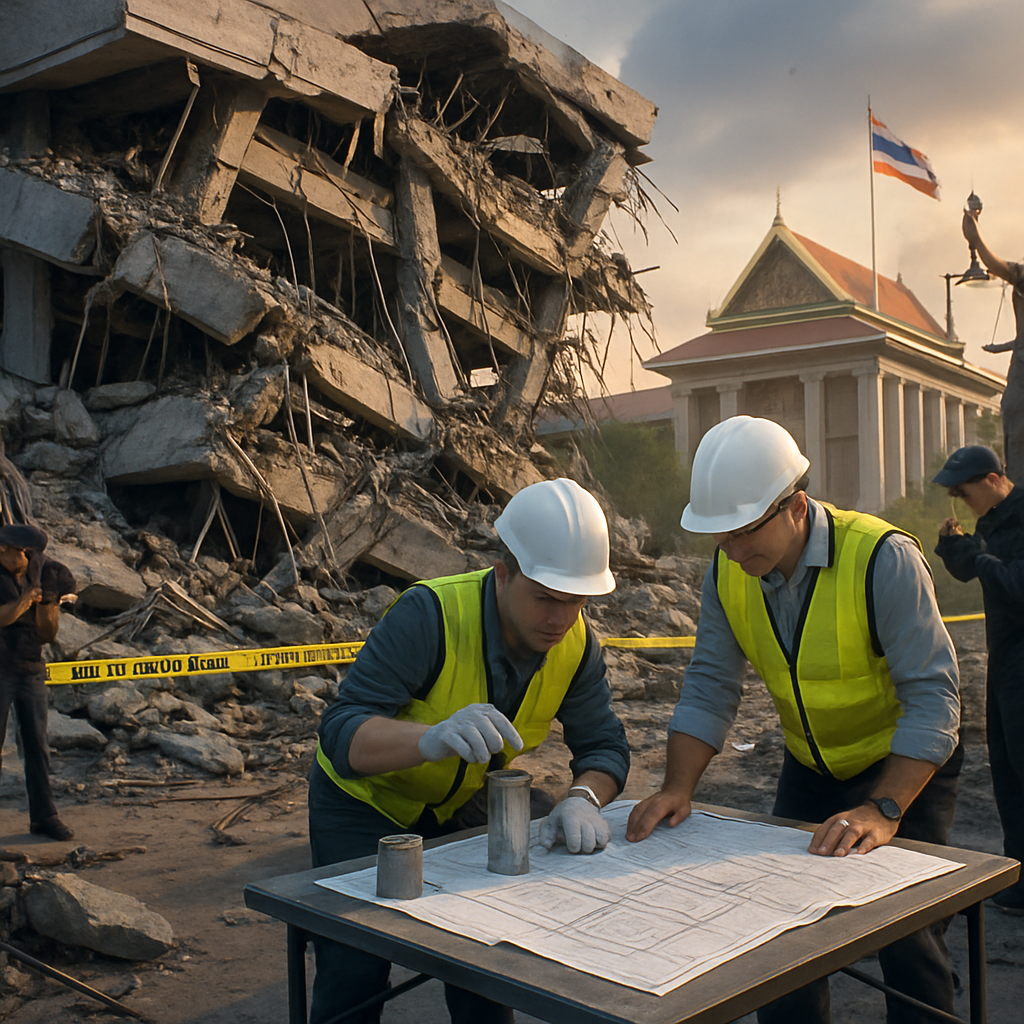
Thailand’s long, slow unspooling of accountability in the wake of the devastating collapse of the new Office of the Auditor General (OAG) building took a sharp turn on December 26, 2025, when prosecutors accepted police recommendations to indict 23 individuals and corporate entities. The case — born from the tragic March 28, 2025 collapse that cost lives and shook public confidence — has now been forwarded to the Criminal Court, setting the stage for courtroom drama that could reshape how the country builds and governs public projects.
From the ground up: what investigators found
The official fact-finding committee’s reconstruction of the collapse reads like a forensic engineering thriller, and none of its findings are flattering. The failure began low and fast: the collapse initiated at floors one through four, where investigators determined that earthquake-related shear forces overwhelmed shear walls that simply didn’t meet required engineering standards. In plain terms, the structural elements meant to resist lateral forces were too weak — and the building paid the ultimate price.
Concrete samples taken from the site tested below Thailand’s legal strength thresholds. Construction drawings, too, failed to comply with building control laws: the paperwork didn’t match the safety requirements on the books, meaning the structure couldn’t legally or safely carry the loads the law demands. Adding to the catalogue of defects, reinforcing steel in several areas was cut—or installed—shorter than legally mandated, weakening vital connections and undermining the building’s integrity.
Charges and broad-reaching investigations
Bang Sue Metropolitan Police Station has completed the criminal case file and recommended indictments that reach across the full lifecycle of the project: designers, supervisors, contractors, and corporate actors. The charges are serious and multifaceted, including negligence causing death, conspiracy, forgery and use of forged documents, and violations of building control regulations and public procurement laws. In short, investigators aren’t just pointing fingers at construction crews — they’re implicating the entire system that allowed this project to proceed.
Meanwhile, the Department of Special Investigation (DSI) has urged prosecutors to approve additional indictments tied to alleged nominee arrangements under the Alien Business Act and suspected bid-rigging in government contracts. Those lines of inquiry suggest the probe may expose not only technical failures but alleged financial and regulatory manipulation that could involve domestic and foreign business relationships.
Separate probes, shared consequences
Allegations that state officials may have committed misconduct have been forwarded to the National Anti-Corruption Commission for further review, while the Comptroller General’s Department launched a parallel audit to examine procurement and contract compliance. The net being cast is wide: criminal liability, anti-corruption scrutiny, and financial audits are all running in parallel. For victims’ families and citizens who watched the building’s collapse live on television, the overlapping investigations represent the possibility of systemic accountability rather than a single scapegoat.
The OAG’s response
The Office of the Auditor General has repeatedly stated that it has cooperated fully with investigators, supplying documents, technical records, and clarifications as requested. The OAG emphasized its support for a transparent legal process and vowed to take action against any officials found to have committed wrongdoing. In its statements, the agency stressed that accountability is essential to restoring public trust — a trust badly eroded by both the loss of life and the apparent failures revealed by the investigations.
Why this matters beyond one collapsed building
At stake is more than criminal liability for those directly involved; the indictments highlight vulnerabilities in Thailand’s public procurement, construction oversight, and enforcement of engineering standards. When structural elements, concrete mixes, or reinforcement details don’t match laws or drawings, the risk is existential. The OAG building collapse has become a high-profile case study on how shortcuts, falsified documents, or lax supervision can translate into human tragedy.
For the public, the next chapter will be watched closely: will the courts and oversight bodies deliver accountability that’s meaningful rather than symbolic? Will procurement reforms and enforcement tighten to prevent future failures? Will families of victims see justice? The 23 recommended indictments mark a significant step in answering those questions — but they’re only the beginning of a process that many hope will lead to long-term reform.
As the Criminal Court prepares to take up the case, Thailand faces both a legal reckoning and a reputational test. The collapse was a painful reminder that construction safety is a public trust; the indictments are an early signal that authorities intend to pursue that breach of trust through the courts. Whether that pursuit results in systemic change — and restored confidence — remains the outcome everyone now waits for.
















This is outrageous — 23 indictments and still feels like only the tip of the iceberg, they must go after every corrupt official involved.
Going after officials is necessary, but trials can take years and families need answers now; arrests alone won’t fix systemic procurement weaknesses.
I agree trials are slow, but public pressure and media attention can speed reform if prosecutors follow through with tough charges.
Public pressure rarely changes bureaucracy overnight; institutional reform requires new laws and independent oversight, not just indictments.
Why were concrete samples allowed to fail standards? Someone fudged the paperwork and cut corners, plain and simple.
As a layperson, I can’t help but wonder how drawings could differ so much from the actual structure — isn’t there a final inspection before opening?
Inspections exist but can be perfunctory, and if inspectors are bribed or documents forged the system collapses with the building.
That’s terrifying to think about; trust in public projects is completely shattered if inspectors can be bought.
Technically the mismatch suggests either catastrophic design noncompliance or deliberate falsification; both point to regulatory capture at some level.
From an engineering standpoint, shear wall failure on lower floors leading to progressive collapse is a textbook vulnerability amplified by substandard materials.
Exactly — this wasn’t an unpredictable natural event, it was preventable with basic adherence to codes and peer review of structural calculations.
Peer review would have caught short reinforcing bars and improper mix ratios, but that requires independent oversight that appears absent here.
Why doesn’t the government make third-party audits mandatory for big public works? Seems obvious and cheap compared to lives lost.
People keep saying ‘systemic failure’ but who’s actually going to jail? Names, not just companies, should be front and center.
Indicting individuals is symbolic unless prosecutors win convictions and penalties are meaningful; otherwise it’s just spectacle.
Spectacle or not, the families deserve to see officials held personally accountable, even if it takes years.
The mention of nominee arrangements and bid-rigging suggests corruption ran through the procurement process; this could implicate foreign-linked firms too.
If foreign firms used local nominees to bypass rules, then legal reforms must target those loopholes, not just punish a few middle managers.
Reforms to close nominee loopholes and harsher penalties for corporate malfeasance would help prevent repeat scandals.
From construction law perspective, proving nominee arrangements is complex but would expose how contracts were manipulated for profit.
As someone in the field, I can tell you corner-cutting usually starts with schedule pressure and low bids, then quality follows the money.
So the problem is the bidding process that rewards the cheapest bidder rather than the most competent one, right?
Exactly, procurement must factor in past performance and technical capability, not just price; life-safety projects should mandate performance bonds and independent testing.
Performance bonds sound good but are often under-enforced; also who will pay for independent testing if budget is drained by corrupt practice?
I’ve lost a friend in the collapse and watching slow indictments feels like salt in the wound; we need swift justice and reform to stop this happening again.
I’m sorry for your loss, Kanya, but the court process must be thorough to avoid wrongful convictions and ensure the right people are punished.
Thorough yes, but not a cover for delay; victims need accountability in a timeframe that brings closure.
Will the OAG itself face consequences if internal oversight failed, or will it just claim cooperation and move on?
Organizations rarely self-punish; independent audits and possible restructuring of the OAG are needed, otherwise trust won’t return.
Restructuring could help but it must come with transparency measures, public reporting, and real penalties for negligence.
This is what happens when governments prioritize speed over safety; endless talk until another tragedy forces change.
I’m worried for everyday people — if public buildings can’t be trusted, where can we feel safe? The families need help now.
Can the courts even handle a case this big without political interference? I’m skeptical but hopeful.
Judicial independence is the linchpin; if the Criminal Court operates without undue influence this could be a turning point for rule of law.
I hope people will watch and hold the judiciary accountable if they falter.
Concrete testing below legal thresholds is prosecutable evidence, but prosecution must connect lab results to decision-makers, not just builders.
Proving a chain of command is difficult but audits and procurement records will show who signed off on designs and materials.
Exactly, paper trails are key — unless those papers were forged, in which case forensic document examiners become critical.
Why hasn’t there been a nationwide review of other public projects? This one collapse suggests a broader risk if no action is taken.
A prioritized audit program targeting high-risk structures, retrofits, and procurement records would be an evidence-based response.
I want harsh sentences for those responsible; lenient fines won’t stop future tragedies.
Harsh sentences might deter, but systemic reforms, clear standards, and enforced inspections are what will truly prevent repeats.
Deterrence and reform should go hand in hand; both are necessary.
Media coverage will matter — sustained reporting can keep pressure on investigators and courts to act transparently.
True, but media can also sensationalize and push for quick outcomes that undermine fair trials; responsible journalism is crucial.
Forensic engineering details in the report are damning; professional bodies should suspend licenses pending investigations.
License suspensions are appropriate in clear cases of negligence, but the process must be fair and evidence-based to avoid scapegoating.
Families shouldn’t just get compensation; they deserve systemic reforms and public memorials to honor victims.
Compensation and memorials are important, but long-term safety measures will be the real memorial that prevents future loss.
I smell big business protecting itself; when profit motives meet public procurement, the public always loses.
We need whistleblower protections so engineers and inspectors can report misuse without fear, that would expose corruption early.
The DSI’s involvement is promising; they have the mandate for complex financial crime, which this clearly looks like.
Yes, DSI involvement could reveal the money trail — that’s where the real architects of corruption usually hide.
International firms should also be scrutinized if they were involved; global standards must be enforced locally.
Cross-border accountability is tough, but mutual legal assistance treaties can help if foreign entities are implicated.
Can tech like blockchain help make procurement transparent? Seems like a long-term fix worth exploring.
Technology can improve traceability but won’t replace governance; it should complement reforms, not be seen as a silver bullet.