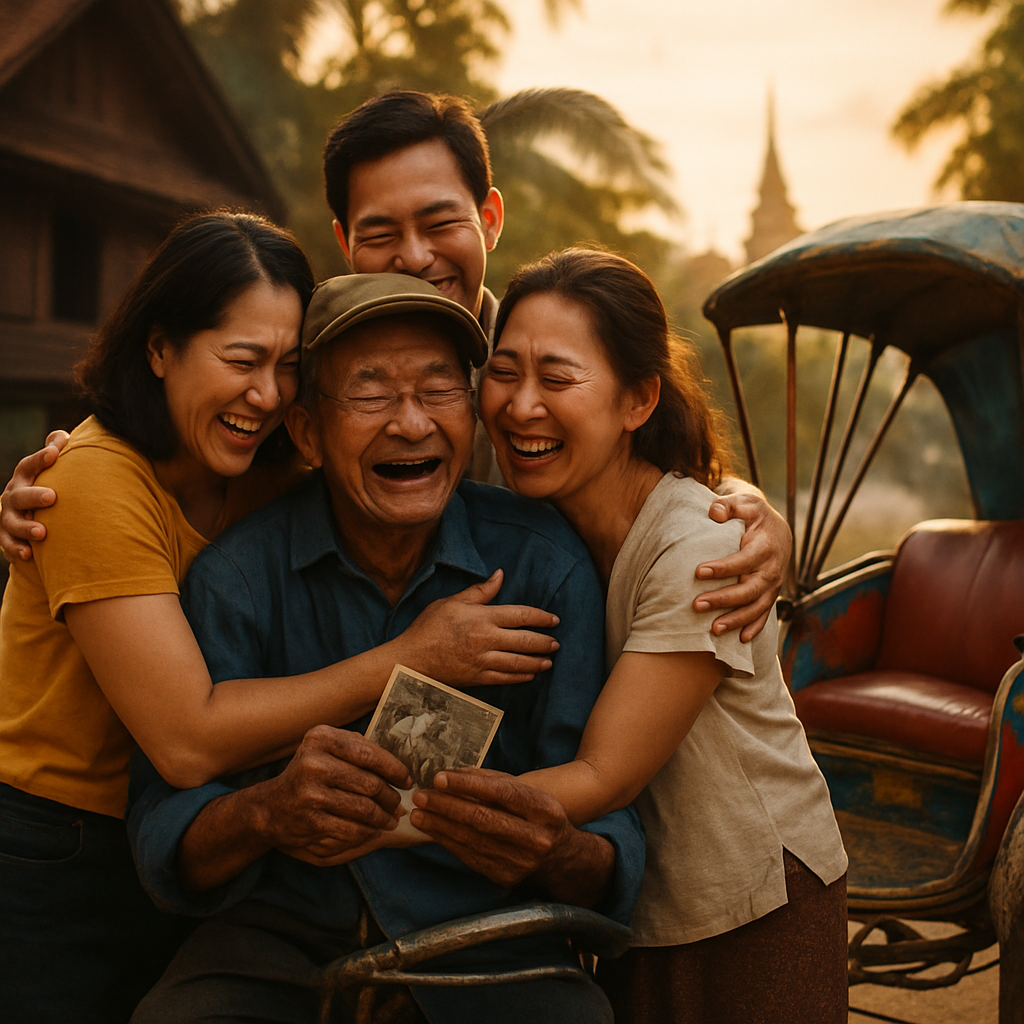
There are reunions that make you smile and reunions that make you reach for tissues — and then there’s the extraordinary scene that unfolded in Ubon Ratchathani this week, where three adults flew across continents to thank a tricycle driver who tended to them more than five decades ago. What began as a short Facebook appeal quickly turned into an emotional pilgrimage, a little bit of detective work, and a powerful reminder of how small acts of kindness can echo for a lifetime.
On Monday, December 8, Facebook user Siw Pittaya Chaisongkhram posted a video appeal that tugged at thousands of online hearts. Siw explained that three siblings — two men and a woman — had grown up in Thailand as young children while their father worked in the country as a soldier. They were roughly five years old at the time and were cared for, at least for short periods, by a local tricycle driver they remembered fondly as Poon Pong-aree.
The family’s time in Thailand took place during a turbulent regional period when American military and communications personnel were active across Southeast Asia. The trio’s mother explained in the clip that their father had worked in broadcasting, relaying information from the United States — a detail suggesting the family was part of the American presence in Thailand around the era of the Laotian Civil War and related regional tensions. Siw’s short appeal was simple: they wanted to find the man who had been a gentle, steady presence in their earliest memories.
What followed was a modern-day search that felt part memory lane, part community sleuthing. The name Poon Pong-aree resonated locally: Dr Bow, a Ubon-based physician, recognized the name from Siw’s appeal and reached out. That small connection set the wheels in motion. On December 9, one of the men — identified as Mark — was undergoing knee surgery. Siw visited him in the hospital carrying old photographs of a man believed to be Poon. The moment Mark saw the images, the long-buried recollection snapped into place. “That’s him,” the story reports he said immediately — a quiet, unmistakable confirmation after decades of wondering.
The very next day, December 10, Siw accompanied the siblings to meet the now-elderly Poon in Ubon Ratchathani. The meeting was everything you’d hope for in a cinematic reunion: hugs, tears, laughter, and a flurry of memory fragments falling into place. The three adults expressed deep gratitude for the care they’d received as children — a care that had clearly shaped their earliest sense of safety and belonging despite the uncertainty of those years.
This heartfelt tale did not stay a private moment for long. The popular Facebook page Drama-addict reshared Siw’s updates, and the reunion quickly spread across social platforms. Thousands of comments poured in, many celebrating the persistence of childhood memory and the enduring impact of small acts of kindness. For a lot of people watching from afar, the story was a reminder that compassion doesn’t always arrive with fanfare — sometimes it arrives via a tricycle driver who offers comfort in a time of need.
What stands out in this reunion is not just the happy ending but the journey to reach it: a mix of digital appeals, local recognition, and timely coincidence (like Mark’s hospital visit) that came together to make reconnection possible. It’s also a small case study in how social media — when used with intent and care — can reunite people across decades and continents. Siw said the three siblings had traveled specifically to Thailand for this purpose, turning hope into action and uncertainty into resolution.
Photographs from the first visit—shared by Paul Saripan and others—capture the warmth and astonishment of that first afternoon back together. They show not only faces lined by time but the luminous, unchanged quality of human connection: surprise, recognition, and gratitude. For Poon, who worked as both a driver and, once, as a boxer in his younger days, the reunion was a testament that the echoes of compassion can circle back long after memories seemed buried.
In a world that often focuses on grand gestures, this quiet reunion in Ubon Ratchathani reminds us how the small things matter. A shared snack, a folded shirt, an extra minute of attention — those are the memories that can carry a child through uncertainty and that can draw adults home again many years later. And for anyone who has ever wondered whether a single act of kindness makes a difference, the answer arrived in a small province in northeastern Thailand: it absolutely does.
As the online responses rolled in — or as Dr Bow’s message bridged the gap — the story became more than nostalgia. It became proof that kindness, memory, and a little bit of modern connectivity can reunite lives. For the three siblings and Poon Pong-aree, the reunion closed a circle that had been open for fifty years. For the thousands who saw the story, it offered hope that some stories do have happy endings, and that sometimes all it takes is one person to ask the simple question: “Do you remember me?”

















I posted the video because I believed they deserved to say thank you in person. The moment they hugged Poon felt like a storybook come to life. Thank you to everyone who helped spread the post and to Dr Bow for connecting the dots.
Social media made it happen, sure, but I worry about people turning every private moment into public spectacle. Was consent properly considered before photos were shared widely?
We asked Poon and everyone agreed to share the photos; the siblings wanted the world to see their gratitude. I understand the concern about privacy and we tried to be respectful. The reunion felt like closure, not a show.
As a local, I can say most folks in Ubon were touched and careful. People here still remember Poon fondly and were happy he was reunited. It warmed the whole community.
Thank you, Thida — your community’s kindness made this possible. The siblings keep asking about the small shop owners who remembered Poon. They feel welcomed already.
Seeing his face in the photos was like unlocking something inside me I had forgotten for decades. I never imagined I’d travel back to Thailand at my age to say thank you. Poon gave us comfort when we didn’t have much else, and I wanted to tell him that.
Memory can be deceptive, though; faces blend with time and emotion. How confident are you it was really him and not someone your brain filled in? Nostalgia sometimes edits reality.
I know memories shift, Larry, but the moment I saw the picture in hospital I knew without doubt. It wasn’t just a feeling — it was recognition, posture, a scar on his ear I remembered. That certainty is what drove me to make the trip.
This made me cry happy tears. It’s like the past hugged the present and everything was okay for a minute. Small acts matter a lot.
I recognized the name from local history and thought I should reach out. Medical work keeps you close to stories like this, and it’s rare to see such a heartfelt closure. Grateful to have played a small role.
This illustrates social capital in tight-knit communities: informal networks often outmaneuver formal institutions in reconnecting dispersed individuals. It’s a useful case study for diaspora research and the ethics of mediated memory.
I appreciate that perspective, Professor. The informal web of relationships here is indeed powerful and deserves study, but also protection for people’s dignity.
This is so cool. I want someone who helped me when I was little to know I remember them. Why don’t more people try to find their childhood helpers?
Because most of us aren’t celebrities and the internet doesn’t care about small stories unless they’re packaged as ‘feel-good’ content. There’s a profit motive now behind every tearjerker post.
Maybe, but if people can reconnect it seems worth it even if some pages share it. Not everything has to be about money.
This is beautiful, but it also sits within a geopolitical history people gloss over. The siblings’ father worked amid the complex American presence in Southeast Asia, and that context shaped their displacement. Gratitude is sincere, but we should also critique the broader structures that made such separations common.
As the one who shared the photographs, I felt the weight of that history while posting. The images show human connection rather than politics, but your point is valid and adds necessary depth.
So are we supposed to thank systems or individuals? I think folks confuse sympathy with analysis and then do neither properly.
We can do both: honor individual kindness and analyze historical forces. They aren’t mutually exclusive. Remembering the geopolitics doesn’t diminish Poon’s humanity; it frames why these gestures mattered so much.
I’m happy they reunited, but I feel uneasy about turning a private reunion into viral content. There’s a line between sharing joy and exploiting people for clicks. Who benefits most from these stories?
Locals benefited by seeing someone they love reunited and by community pride. Not every share was exploitative; many were sincere and helpful.
That’s fair, Thida, and I respect the local support. I just want future sharers to pause and ask consent before posting tears and faces online.
Photos trigger memory but also construct it. People should be cautious about asserting certainty after decades. That said, the emotional truth of thanks remains meaningful whether every detail is exact or not.
Memory studies support this: episodic recall is reconstructive. Yet reconstructive memory often preserves affective accuracy, which can be more important for relational closure than literal factual recall.
Exactly. I’m not trying to undermine anyone’s feelings, only to remind readers that memory and history are complicated partners.
I cried watching the video. It shows that small kindnesses leave big marks on people. I hope Poon knows how much his actions meant.
He does now, Sophie, and saying it changed both him and us. I wish everyone could experience that kind of healing. It felt like a scar finally getting sunlight.
Thank you for sharing that, Mark. It’s important to hear that the thanks reached him and mattered.
The photos captured those moments and I was careful to get consent before sharing widely. The images felt like witnessing quiet history.
I uploaded a few pictures because the scene felt historically significant and deeply human. I wanted to show the genuine surprise and warmth on everyone’s faces. The response was overwhelming but mostly kind.
Paul, thank you for sharing the photos; they helped people understand why the trip mattered. Your care with consent was appreciated by the siblings and Poon alike.
You’re welcome, Siw — glad it helped. I hope the images encourage more people to reconnect where they can.
People here still remember Poon’s younger boxing days and how gentle he was with kids. The town rallied a bit when the story surfaced and everyone felt proud. It reminded me of how connected our small places can be.
That’s so cool, Thida. Small towns have big hearts. I want my town to do something like that too.
It just takes one person to ask and people step up. The siblings’ bravery came from wanting to close a chapter, and we were happy to help.
This reunion is a compact narrative about memory, migration, and the role of local intermediaries in diasporic reconnections. It also raises methodological questions for oral historians using social media traces. Fascinating material for study and ethical reflection.
I agree, Professor. The case could be used to discuss consent, archival responsibility, and the commodification of memory in digital spaces.
Exactly; if pursued carefully it could inform guidelines for ethically archiving and presenting such encounters without exploiting participants.
All this ‘heartwarming’ noise masks a simpler truth: power imbalances created the situation in the first place. Don’t romanticize the aftermath without acknowledging who made it necessary. A tricycle driver patched a system that failed these kids.
I hear you, but acknowledging systemic harm doesn’t have to stop us from celebrating human kindness. Both things can be true at once.
We don’t deny the larger context, rebelM, but Poon’s kindness was real to us and changed our lives. Critique and gratitude can coexist.
It’s a useful tension to hold: appreciation for individual acts and scrutiny of historical forces. Good conversations come from that friction.
Fair, but I worry that viral sentiment dilutes the urgency of structural critique. Stories like this can be trotted out to soothe conscience rather than spur change.
From the local view, we don’t want to be lectured out of our joy. We can both reflect critically and celebrate someone who cared for kids when others were absent.
I’m not trying to take away joy, Thida. I’m asking we don’t let joy be an anesthetic for accountability.
I appreciate the debate — it’s important. Our intention was never to ignore history; we wanted to thank a man who helped our family. If this spurs deeper conversation, that’s meaningful too.