Ranong-Chennai Sea Link Cuts Thai Cargo Time to India
Thailand has opened a direct Ranong-Chennai container route aboard MV TCI Surya, cutting Bay of Bengal transit times from up to 16 days to roughly five under BIMSTEC.
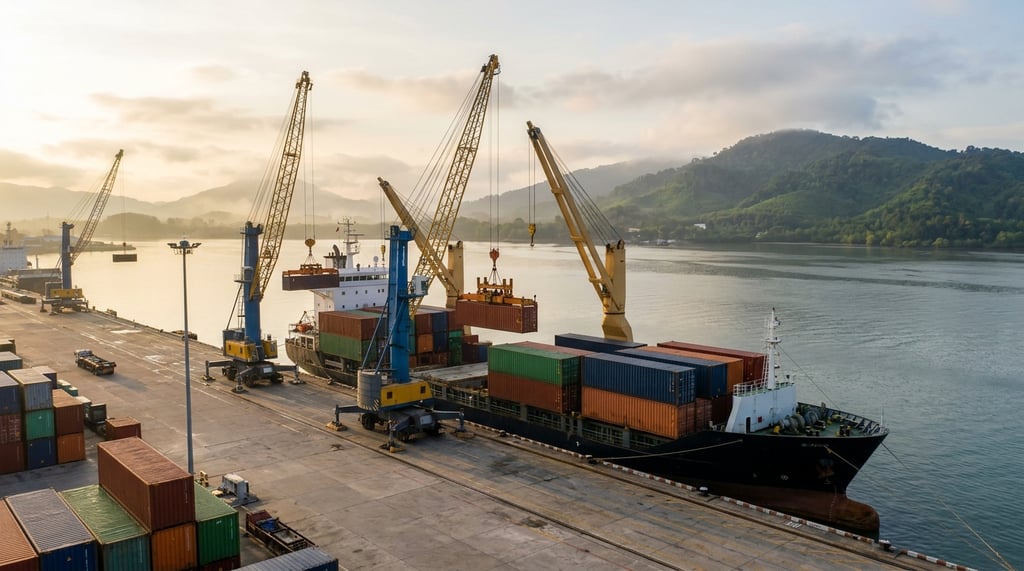
Thailand has inaugurated a direct container shipping service between Ranong Port on its Andaman coast and Chennai Port on India's eastern seaboard, cutting sea transit times between the two countries by more than 60 percent. The inaugural sailing aboard the Indian-operated vessel MV TCI Surya departed Ranong on November 29, 2026 with roughly 200 twenty-foot equivalent units (TEUs) of southern Thai cargo and is scheduled to reach Chennai on December 5.
For Thai exporters accustomed to routing India-bound goods southward through Bangkok or Laem Chabang and across the congested Strait of Malacca via transshipment hubs in Singapore or Malaysia, the new corridor removes up to ten days of sailing and port-handling time. Shipments that previously required 14 to 16 days to reach eastern India can now cross the Bay of Bengal in roughly five to six days, lowering freight exposure and improving shelf life for agricultural and industrial shipments alike.
From 2019 Port Pact to Commercial Reality
The launch brings to fruition a maritime cooperation framework that took seven years to move from diplomatic paperwork to scheduled container sailings. Port Authority of Thailand (PAT) officials and the Chennai Port Authority originally signed a Memorandum of Understanding on November 7, 2019 during the first Bay of Bengal Initiative for Multi-Sectoral Technical and Economic Cooperation (BIMSTEC) Conclave of Ports in Visakhapatnam. That agreement committed both port operators to building direct sea links, sharing logistics data, and encouraging private carriers to test Andaman-Bay of Bengal feeder routes.
At the November 28-29 launch ceremony in Ranong, led by PAT Director-General Jirapong Theppithak alongside Ranong Governor Rachan Meenoi and Indian Embassy representative Tarun Mangal, maritime operators including TCI Seaways, J.M. Baxi, and DP World Logistics Solutions outlined an initial three-month rollout running every two weeks. The sailing marks the first commercial call by an Indian container ship at Ranong under the BIMSTEC maritime transport initiative, and PAT has confirmed it holds parallel strategic pacts with six regional ports across the Bay of Bengal, including Visakhapatnam and Kolkata, leaving room for multi-port loops if cargo volume holds.
Operational data from PAT indicates that Ranong Port already had momentum before the Chennai service arrived. During the first nine months of Thailand's 2026 fiscal year (October 2025 through June 2026), container throughput at Ranong climbed by more than 80 percent compared with the prior year, while vessel calls rose roughly 50 percent. Sustaining biweekly 200-TEU sailings will depend on securing reliable return cargo from southern India so vessels do not sail eastbound half-empty.
Which Thai Export Sectors Stand to Gain
The maiden cargo manifest highlights where immediate commercial demand sits. Containers loaded onto MV TCI Surya originated primarily from southern provinces including Chumphon, Surat Thani, and Songkhla, carrying rubberwood, natural rubber, palm oil, and canned food. For agro-processors and timber suppliers in Thailand's southern peninsula, trucking goods west to Ranong avoids the long northbound haul to Bangkok or Laem Chabang before doubling back south around the Malay Peninsula.
Beyond southern commodities, trade officials in Bangkok and New Delhi expect faster maritime turnaround to support higher-value manufacturing supply chains. According to records from the 14th India-Thailand Joint Trade Committee published by India's Press Information Bureau, bilateral trade expanded 12.6 percent in FY 2025-26 to US$21.49 billion, making Thailand India's third-largest trading partner within ASEAN with a 16.7 percent share of India-ASEAN commerce. Both governments have singled out electronics, semiconductors, automotive parts, electric vehicle components, chemicals, and industrial machinery as priority growth corridors.
Chennai's industrial hinterland makes the pairing particularly practical. Tamil Nadu is one of India's largest automotive and electronics manufacturing clusters, housing major vehicle assembly plants and component suppliers that already source precision parts from Thailand's Eastern Seaboard. Faster sea delivery reduces working-capital lockup and inventory buffers for tier-one suppliers operating across both countries, while parallel talks to modernize the ASEAN-India Trade in Goods Agreement (AITIGA) and ease sanitary and phytosanitary bottlenecks aim to trim customs friction at the border.
Diversifying Beyond the United States and China
The timing of the Ranong-Chennai corridor reflects a broader recalibration in Thai trade policy. Exporters in Bangkok and the Eastern Economic Corridor have spent the past year managing US tariff pressures, slowing Chinese domestic demand, and heightened shipping risks across global maritime chokepoints. Expanding direct access to India's fast-growing consumer and industrial base gives Thai manufacturers a hedge against over-reliance on traditional Western and East Asian buyers.
Officials at Thailand's Ministry of Commerce and transport planners also frame the route within the wider BIMSTEC market, which spans Bangladesh, Bhutan, India, Myanmar, Nepal, Sri Lanka, and Thailand and represents an estimated US$3.5 trillion combined economy. Positioning Ranong as Thailand's western trade gateway allows goods from the Eastern Economic Corridor, and potentially rail-linked cargo moving south from Kunming through Laos and Nong Khai, to reach Bay of Bengal ports without competing for berths in the Malacca Strait.
Infrastructure Limits After the Land Bridge Retreat
Even with a five-day crossing now operating, Ranong Port faces clear physical constraints that will determine whether the service remains a niche regional feeder or scales into a major commercial artery. As Deputy Transport Minister Sanphet Boonyamanee outlined in parliament following the Thai Cabinet's decision to cancel the earlier 1-trillion-baht Chumphon-Ranong Land Bridge megaproject, Ranong's current navigation channel is restricted to an eight-meter draft and bordered by protected forest areas that limit large-scale terminal expansion.
Rather than reviving a speculative deep-sea transshipment megaproject, the Ministry of Transport has pivoted toward a phased Ranong Gateway strategy. The State Railway of Thailand has been tasked with reviewing detailed engineering designs for a Chumphon-Ranong railway link and upgrading existing southern double-track rail corridors, including bypass routes around Bangkok via Suphan Buri and Nakhon Pathom. If rail freight can feed containers reliably from central and eastern Thailand to the Andaman coast, Ranong's feeder network to Chennai, Visakhapatnam, and Kolkata could attract larger volumes without requiring mega-vessel berths.
What This Means for Expats and Travelers in Thailand
While the Ranong-Chennai line is strictly a commercial container service rather than a passenger ferry, its expansion carries tangible knock-on effects for foreign residents, entrepreneurs, and long-stay visitors in Thailand:
- Faster regional sourcing for SMEs and hospitality operators: Foreign-owned food importers, manufacturing consultants, and restaurant groups sourcing Indian spices, packaging, textiles, or industrial components can expect shorter lead times and fewer transshipment delays as biweekly sailings stabilize.
- Improved southern infrastructure momentum: Renewed Transport Ministry focus on the Chumphon-Ranong rail study and highway links stands to improve overland connectivity for travelers heading to Ranong, Koh Phayam, and the upper Andaman coast.
- Stronger India-Thailand business and payment links: Alongside maritime shipping, bilateral trade committees are advancing talks on linking Thailand's PromptPay with India's Unified Payments Interface (UPI), which would simplify cross-border transfers and everyday spending for Indian visitors and Thailand-based businesses alike.
Comment verification
Step 1 of 3
Verify your email once to publish your comment. Your email is never shown publicly.
Enter the 6-digit code sent to .
Choose the display name shown next to your comments.