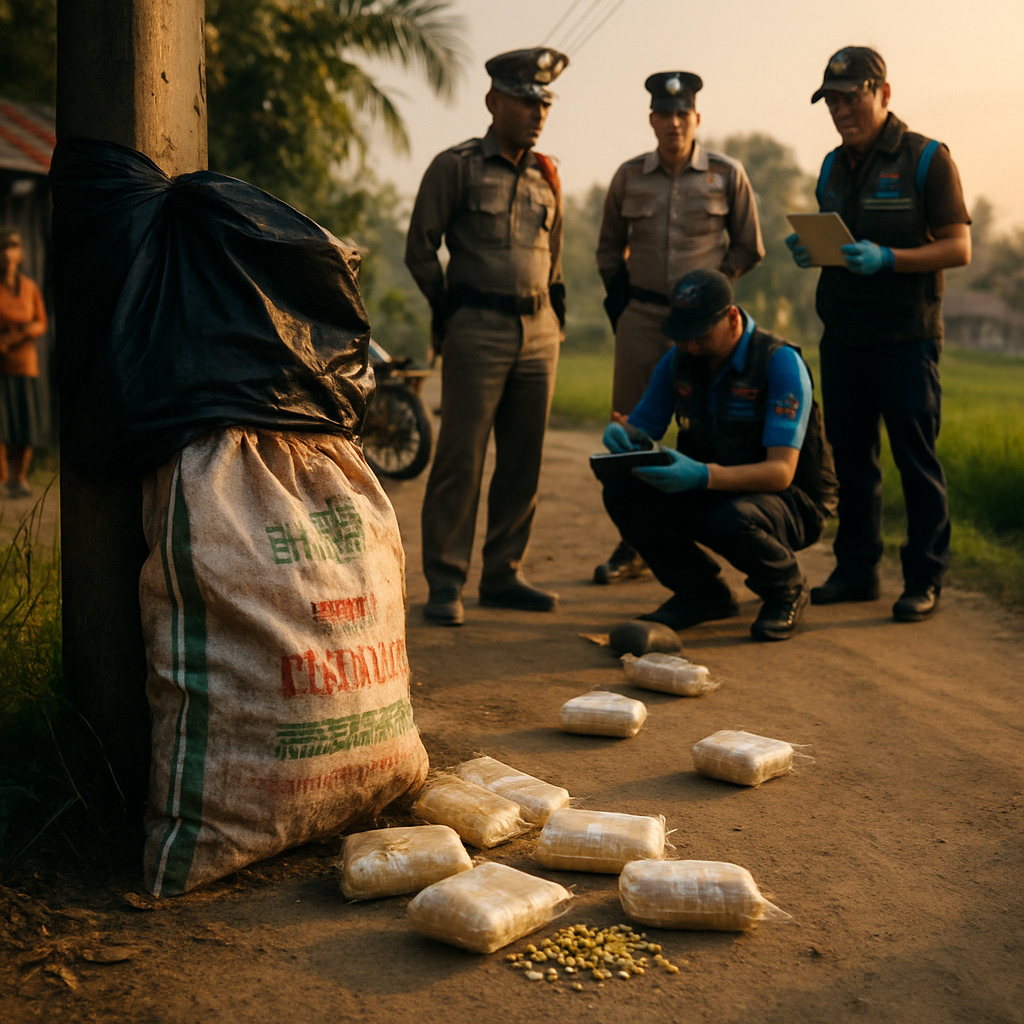
It started as a small, ordinary mystery on a quiet alley in Chachoengsao province — a nondescript sack tucked at the base of an electric pole that, at first glance, could have been trash. By late morning on 25 January 2026, that ordinary sight had been revealed as something far more alarming: roughly 230,000 methamphetamine pills wrapped in plastic and hidden inside a fertiliser sack, abandoned where villagers walk and drive every day.
Residents of Moo 8, Ban Song subdistrict in Phanom Sarakham district were the ones who spotted the suspicious parcel at around 11:00 am. They noticed a black bin bag draped over what looked like a fertiliser sack beside the roadside alley — a thoroughfare used regularly by people coming and going from the community. Concerned that the package might contain something hazardous, they called local authorities rather than taking a closer look themselves.
Pol. Lt. Col. Wisarut Rittisriboon of Phanom Sarakham Police Station responded to the scene, arriving with patrol officers and an investigative team. What they found upended the quiet ordinary day: six large plastic-wrapped bundles inside the sack, each packed with small yellow pills stamped with a five-star symbol and the number “999.” Police estimated the haul at approximately 230,000 methamphetamine pills — a stash large enough to fuel a serious criminal operation or flood local streets with dangerous drugs.
The alley where the drugs were left is not some hidden backlot; it’s a path with frequent pedestrian and vehicle traffic. That fact made the discovery all the more chilling for residents, who now realize the stash was abandoned in an area frequented by children, vendors and commuters. No one on the spot could say who had placed the sack there or when it had been deposited. There were no eyewitnesses to point investigators toward a perpetrator.
After securing the scene, the Chachoengsao Provincial Forensic Unit was called in to collect evidence and document the find. The drugs were sealed and taken into custody for forensic examination while officers launched a broader inquiry to trace where the shipment came from. Investigators are mapping potential transport routes, reviewing local surveillance footage and canvassing the surrounding area for clues that might expose the chain of custody for the illicit cargo.
Police have not yet identified any suspects, and as of 2:10 pm on 25 January 2026 no arrests had been made. Authorities say the seized pills will be retained as evidence while the investigation proceeds. Local media outlet Khaosod reported the initial details, relaying information provided by police following the discovery.
For villagers of Moo 8, the discovery raised practical concerns and uncomfortable questions. How long had the sack been sitting there? Had anyone inadvertently brushed past it without realizing what was inside? The fact that the contraband was abandoned in such a public place suggests the drop-off was hurried, calculated, or perhaps part of a larger smuggling operation that misfired — leaving a dangerous payload for an unsuspecting community to find.
Investigators face a familiar puzzle when evidence appears abandoned in public spaces: the origin of the shipment could be local, regional or part of a cross-border trafficking network. By retracing transport routes, poring over CCTV footage from nearby homes and shops, and interviewing residents, police hope to identify vehicles or individuals connected to the drop. Forensic analysis of the pills may also provide leads — linking the batch to other seizures by the five-star “999” stamp or matching packaging and chemical profiles to known suppliers.
While the investigation continues, the episode served as a reminder of the community role in spotting and reporting suspicious items. In this case, cautious residents contacted authorities instead of handling the package themselves, potentially averting a harm that could have been worse had the sack been tampered with or moved into more populated areas.
Authorities in Chachoengsao have pledged to follow every lead in the effort to track down those responsible for abandoning such a large quantity of methamphetamine in a residential area. Until the investigation yields arrests or further information, the dumped stash remains evidence in an ongoing case — and a startling signal of how easily illicit substances can appear in ordinary places.
As the inquiry advances, police are asking anyone with information or who may have seen suspicious activity in the area around Moo 8, Ban Song subdistrict on the morning of 25 January to come forward. Small details — a passing vehicle, a person acting oddly, or unusual foot traffic — could be the missing piece that helps unravel how a sack by a lamppost turned into one of the largest roadside drug discoveries in the district.


















I walk that alley sometimes and this is terrifying news. Who would dump 230,000 pills where kids play and sellers walk? The police need to explain how such a large shipment was abandoned without anyone noticing.
Sounds like organized crime testing their drop points or panicking after a bust nearby. Either way it points to serious smuggling routes running through our provinces.
Do you really think organized groups would leave that much in the open? That seems sloppy, unless it was a hurried transfer gone wrong.
Sloppy or staged — I don’t trust quick police statements. Maybe someone wanted the cops to find it to shift attention somewhere else.
Staged finds are conspiracy fodder. Most likely a courier ditched it after seeing patrols. We shouldn’t jump to secret-plot conclusions without evidence.
If it was a courier dumping it, then why such obvious packaging with the five-star 999 stamp? That stamp will link it to other seizures and someone will get caught eventually.
From a forensic standpoint the branding and pill composition can indeed trace supply chains, but that requires rapid lab work and cross-referencing with past seizures. Intelligence sharing between provinces and countries is often the missing piece, not just lab results.
So you mean international cooperation? That takes ages and politics gets in the way. Meanwhile, communities deal with the fallout.
Yes, politics and jurisdictions complicate things, but a focused interagency task force can shorten timelines if there is will and resources.
I say we need harsher punishments and more patrols on rural roads. Let smugglers feel the heat. Soft punishments won’t stop them.
Harsher punishments alone won’t fix demand or poverty that drives trafficking. Prevention and economic options matter too.
Demand reduction takes decades. Border control is immediate and cheaper politically. Start there.
Both are needed. I just can’t stand seeing kids at risk because of smugglers and slow government action.
Does this mean my school is in danger? Pills on the road are scary. Why would adults do this?
This is what happens when corruption meets geography. Thailand’s roads are transparent to smugglers because someone lets them be.
As a retired officer I’ll say: the community did right by calling police. But there are too many similar cases where evidence is handled poorly and leads vanish.
Can retired cops be more vocal? We need whistleblowers to pressure reforms in evidence handling and chain-of-custody protocols.
Whistleblowing risks careers and safety. Reforms usually come after high-profile embarrassments, not quietly.
I’m skeptical of the ‘abandoned’ narrative. Would criminal networks really leave such a huge amount where they could be easily found? Maybe a handoff failed or someone double-crossed.
Residents did the right thing, but authorities must improve CCTV coverage and local reporting hotlines. Prevention beats reaction.
Local media already cover this — but follow-up is weak. We hear the seizure, then silence about arrests or policy changes.
Exactly. Transparency and regular updates would rebuild trust so people keep reporting suspicious finds.
Why is nobody asking who owns nearby pickup trucks or motorbikes that pass at odd hours? That kind of canvassing finds patterns fast.
The story is missing context: Where else has the ‘999’ stamp appeared? Has anyone linked it to cross-border labs or local gangs?
Publicly, labs might not disclose chemical profiles to avoid revealing methods. But law enforcement databases usually track stamps and packaging; they can and should release aggregated trends.
I hope they check shop CCTV too. Someone must have driven past and seen the drop-off time. That alone could expose a vehicle registration.
People always say ‘check CCTV’ as if every shopkeeper keeps footage. Many delete old tapes to save storage or fear police.
Community cooperation is vital then. If neighbours share footage voluntarily, patterns emerge. Fear of retribution is the real barrier.
And we should pressure local councils for public camera networks in high-footfall alleys to deter these drops in the future.