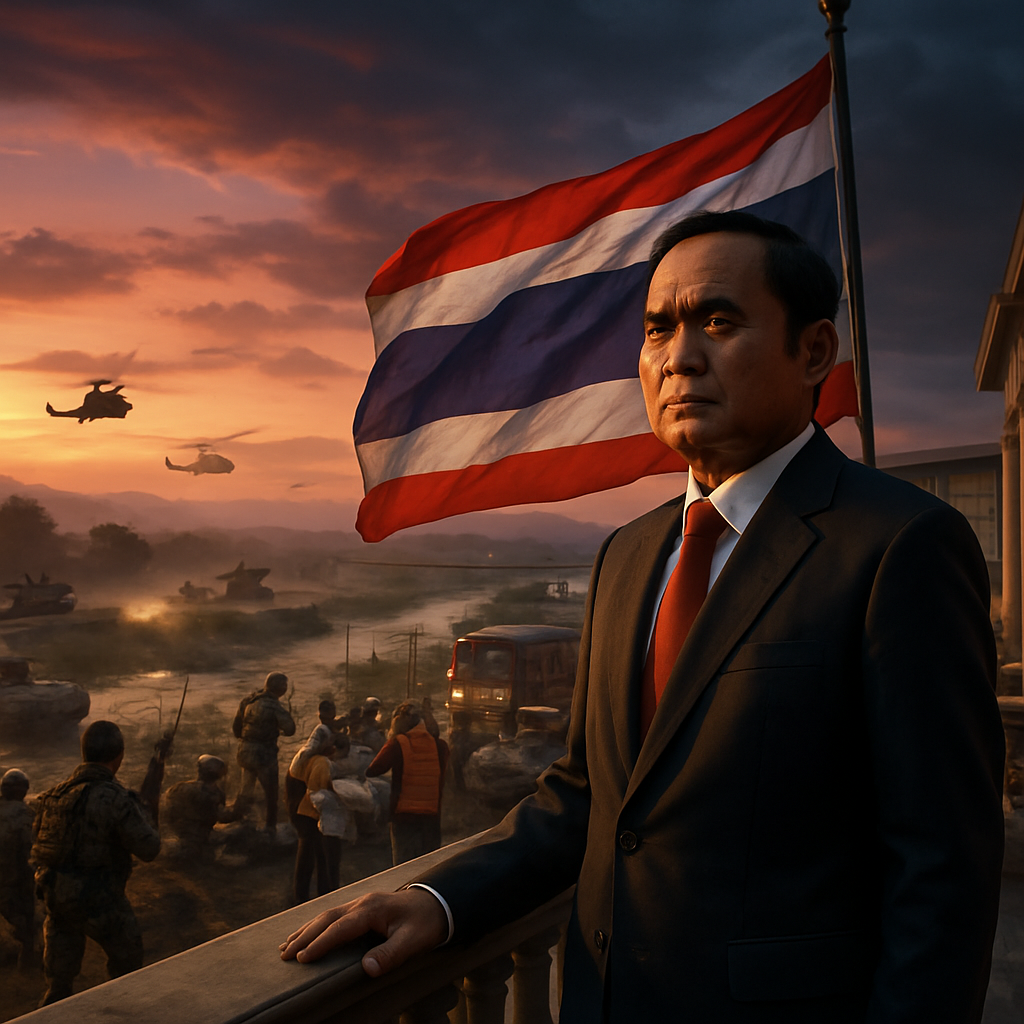
Prime Minister Anutin Charnvirakul delivered a flat, unambiguous message this week: Thailand is no longer interested in haggling at the negotiating table with Cambodia. In a statement that mixed steely resolve with a dash of defiance, he said Bangkok has shifted fully into a defensive posture — troop deployments and contingency plans are in motion, though he kept the operational playbook under wraps.
“We have activated full defensive measures,” Anutin told reporters, stopping short of details he said would compromise national security. “If anyone crosses our border, our forces will meet them with force.” That blunt line was meant to reassure a nervous public that sovereignty and citizen safety are the government’s non-negotiables.
So why shut down diplomacy now? According to the prime minister, Thailand has already answered what it calls Cambodian aggression and has no appetite for further talks until Phnom Penh meets conditions set by Bangkok. Put simply: negotiations are suspended until Cambodia respects the red lines Thailand says it has established.
At home, the government has gone into practical survival mode. Every governor in border provinces has been ordered to activate high‑level evacuation protocols and to use emergency budgets to support residents in danger zones. Local officials have been told to prioritize people over paperwork — food, shelter, medical care and transport are the immediate goals.
Anutin also pushed back hard against international headlines claiming Thailand started the violence. He said Thai authorities have submitted evidence of provocation to multiple international organisations and insisted Thailand did not fire the first shot. “The world must believe Thailand,” he said, urging citizens and foreign observers alike to trust the account given by Thai officials and the armed forces.
When asked how long the military would remain on heightened alert, the prime minister declined to provide a timeline. “I cannot say,” he explained, warning that discussing strategic plans publicly would jeopardize national safety. That lack of specifics has left room for speculation — but it’s a standard line in times of tension: operational secrecy is framed as strategic necessity.
Political pushback? Expect the chorus. Opposition figures have already been hinted at as possible sources of censure motions or ethics complaints, trying to exploit the crisis for political advantage. Anutin was curt: his responsibility is protecting Thailand’s dignity and sovereignty, and he will use legal authority to block any interference that undermines that mission. In short, no internal political games are welcome while the country is at risk, he said.
On the diplomatic front, Anutin categorically ruled out continuing the earlier joint declaration between the two countries, saying it effectively no longer exists and he could not recall its specific terms. He also confirmed he had not spoken with US President Donald Trump or Malaysian Prime Minister Anwar Ibrahim about the border situation — despite some foreign speculation that the incident could spill over into trade talks or wider geopolitics. On that score, he was confident the dispute would not derail the so‑called Trump tax agreement or other ongoing negotiations.
That didn’t stop him from taking a swipe at a recent social media post by Malaysia’s Anwar Ibrahim expressing concern. Anutin dismissed it as irrelevant and said anyone urging Thailand to act should first ask Cambodia to halt provocations. The message was clear: external sympathy counts for little when, in Bangkok’s view, the provocation must stop first.
Perhaps most striking was Anutin’s challenge to critics and foreign media alleging Thai aggression. He urged Thai citizens to trust their own armed forces over outside accusations, framing the debate as one between national truth and international rumor. With evidence submitted to international bodies, Anutin signalled that Thailand is trying to win not only the battle on the ground but also the narrative war.
For residents living near the border — particularly in Buriram and other northern and eastern provinces mentioned in regional reports — the situation feels immediate. Airports have raised security levels, village chiefs have been mobilised, and local politicians are juggling emergency logistics while trying not to inflame tensions. In the capital, the government is trying to balance firmness with reassurance: keep the nation safe without tipping into open escalation.
Whether the hard line will produce a swift de‑escalation or protract the standoff depends on multiple moving parts: how Cambodia responds, how international actors react, and whether the Thai public accepts the government’s narrative. For now, Anutin’s mantra is clear — Thailand will defend itself, it has the evidence to back its claim, and it won’t be negotiating until conditions are met.
In a world where border disputes often begin with a whisper and balloon into wider crises, Bangkok’s message is designed to be unmistakable: the negotiation window is closed, the defence line is drawn, and Thailand’s forces stand ready. Whether that firmness leads to calm or conflict remains the story to watch.














This article reads like a powder keg — shutting down talks and moving troops feels reckless, even if the PM says it’s defensive. I worry this will escalate instead of solve anything and hurt civilians most of all. Diplomacy should be the default, not a last-minute option.
As someone from a border province, I can tell you people are terrified and confused. We need clear evacuation plans and real help, not speeches.
Military types forget civilians fast; evacuation orders are fine but budgets often never reach the villages. Watch the paperwork fail us again.
Totally agree, Petch — local action matters more than national rhetoric right now. If funds don’t reach people, the political claims mean nothing.
This looks like classic brinkmanship to me: strong words for domestic audiences while avoiding real confrontation. The PM’s refusal to recall the joint declaration is oddly convenient and smells like posturing.
Brinkmanship is a plausible interpretation, but we should consider the evidence claim too; if Thailand submitted provocation evidence to international bodies, that complicates the simple ‘bluster’ narrative. Still, strategic ambiguity helps rally nationalist support and placate hardliners in the ministry of defence.
Fair point, Professor, but evidence submitted publicly or privately matters — secrecy about it won’t convince foreigners and will likely inflame critics at home.
Why are leaders always shouting about war? I just want my farm to be safe.
The narrative war is as important as the kinetic one; Anutin framing trust in domestic forces over foreign media is an attempt to delegitimise external scrutiny. That said, closing negotiation channels removes peaceful mechanisms and increases miscalculation risk. International mediation could still be effective if both sides agree to terms of reference.
International actors will be reluctant to pick sides, but silence helps no one. ASEAN or the UN should push for verification mechanisms to prevent localized incidents from becoming bigger.
Verification is great, but where are the humanitarian contingency plans? That’s the part getting ignored in diplomatic back-and-forth.
Agreed, Nina; verification without humanitarian access is hollow. Aid corridors and neutral observers should be immediate priorities if civilians are at risk.
This feels like a politician trying to look tough on TV. I’m worried younger people will get swept up in nationalism. Where’s the accountability?
Accountability often follows the guns, not the talks. Once troops move, scrutiny goes silent.
Exactly — and social media can’t replace proper institutions or transparent courts.
We should analyze the domestic incentives: the government may be consolidating power and managing dissent by invoking external threat. That dynamic has historical precedents in the region. However, we mustn’t discount genuine security concerns at the border.
So it’s both real and political — that checks out. Politicians weaponize fear every election cycle.
Exactly, Min; dual dynamics are common. The international community should pressure for transparency to temper both.
I live near Buriram and people here woke up to soldiers and checkpoints. Kids can’t go to school, and nobody explained how long this will last. It’s scary and unfair to families.
Somchai, that’s heartbreaking. Local leaders should get direct lines to provinces for fast support, not just PR statements.
We called the governor but got a canned response; action is slower than the headlines suggest.
Any suspension of diplomacy should come with confidence-building measures; otherwise, it’s a recipe for misread signals and accidents. Closing the negotiation window is worrying in that sense.
Confidence-building is a buzzword; who will monitor it and who pays for it? That’s always the snag.
Sofia, international partners can help fund monitoring but only if both governments consent, which seems unlikely right now.
I support protecting the border, but I’m not sure this media strategy helps. People deserve honest briefings, not slogans.
Closing talks is short-term theatre. History shows negotiations reopen when both sides see pain, not pride. Hope cooler heads win before guns talk.
Cooler heads don’t always exist in politics; sometimes it’s the generals who set the tempo.
If generals set the tempo, civilians lose. That’s the cycle we must avoid.
From an international law perspective, the claim that Thailand ‘did not fire the first shot’ and has submitted evidence is important, but transparency about that evidence is crucial for credibility. Simply asserting national truth without independent verification risks alienating allies. Multilateral inspections or neutral archives could help adjudicate claims.
Good point; neutral verification prevents narrative wars. But will Bangkok allow external inspectors while armed contingency plans are active?
That is the key dilemma, AnwarFan — security concerns are cited to block scrutiny, but scrutiny is what can prevent escalation.
This might be a show for domestic politics, but if soldiers clash across the border, who pays? The poor always do. We should demand better oversight.
We pay with crops, kids, and worry. Not fair.
Exactly — the cost is borne by ordinary people, not the policymakers.