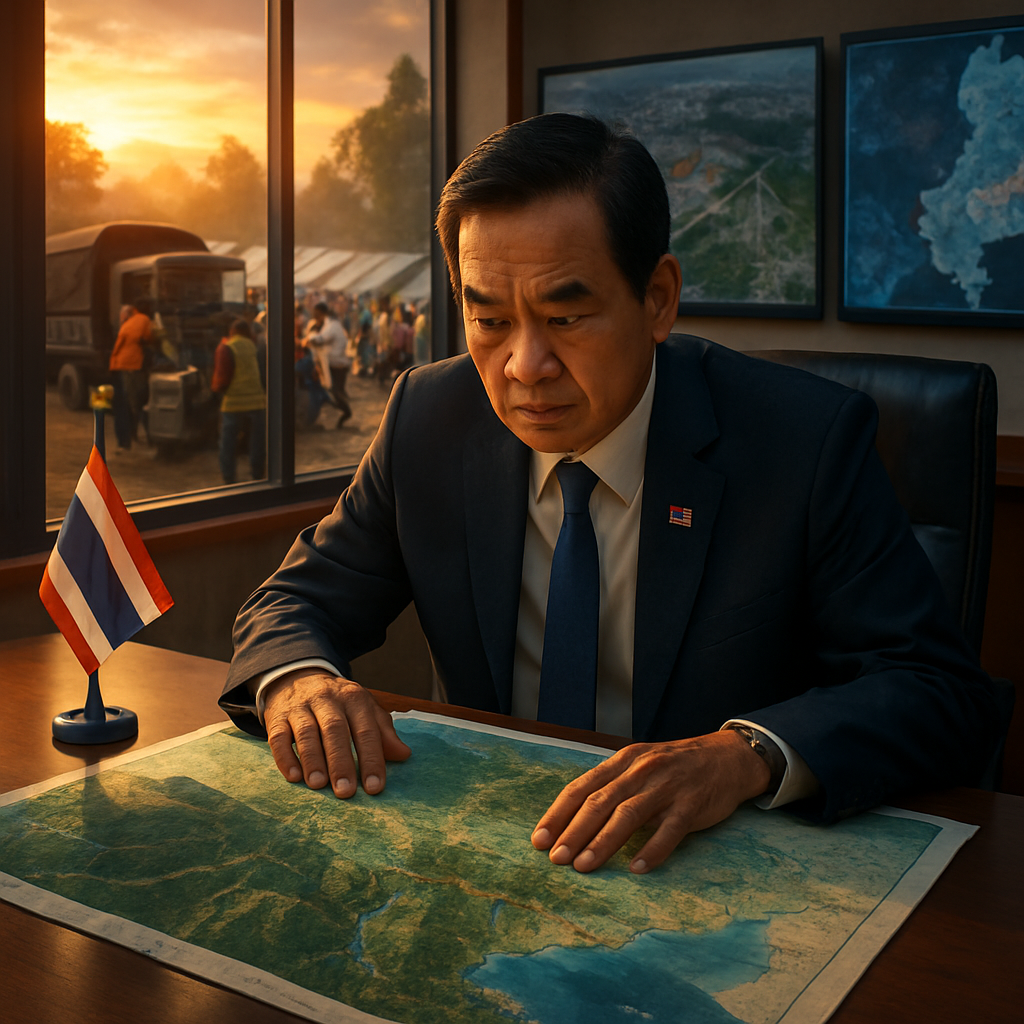
The Association of Southeast Asian Nations (ASEAN) convenes in Kuala Lumpur on Monday for what many hope will be a turning point in an increasingly dangerous standoff along the Thailand–Cambodia border. After weeks of renewed fighting that has killed at least 40 people and driven more than half a million civilians from their homes, regional foreign ministers are gathering in a bid to stop the violence from spiraling further.
This session in Malaysia is notable for one simple, urgent fact: it marks the first direct, face-to-face engagement between Thai and Cambodian government representatives since clashes flared up again on December 8. With Kuala Lumpur currently chairing ASEAN, Prime Minister Anwar Ibrahim has cast a cautiously optimistic shadow over the talks, saying both Bangkok and Phnom Penh have signaled willingness to pursue a peaceful way out.
The conflict’s footprint
The fighting has spread across multiple flashpoints along an 817-kilometre border that runs from mountainous, forested areas near Laos down to coastal provinces to the south. Heavy artillery, rocket barrages and even air operations have been reported in long-disputed zones, raising fears that the violence could become entrenched rather than episodic. Civilians in border communities have borne the brunt: entire towns have emptied, markets have closed, and daily life has been disrupted on an alarming scale.
Earlier this year a fragile truce — brokered in July with Malaysia and support from the United States — briefly calmed the situation. That agreement, however, collapsed amid mutual accusations of violations and provocations, and December’s resurgence of hostilities has since tested regional patience and diplomatic bandwidth.
What’s on the table in Kuala Lumpur
Malaysia’s foreign ministry says the meeting, chaired by Foreign Minister Mohamad Hasan, will explore concrete steps ASEAN can take to de-escalate tensions and restore stability. An ASEAN monitoring team is expected to present field findings and satellite-derived evidence, including imagery and analysis supplied by the United States, aimed at mapping incidents and clarifying competing claims.
Those presentations could be pivotal. In a conflict where each side points to different flashpoints and different triggers, independent observations — boots on the ground and eyes in the sky — may be the only way to create a shared baseline for negotiations.
Outside players and unilateral moves
The diplomatic choreography extends beyond the ASEAN table. Both the United States and China have launched separate initiatives to calm the situation, though neither effort has yet produced a durable halt to the fighting. ASEAN’s meeting in Kuala Lumpur will therefore be watched closely to see if regional mechanisms can complement or amplify those external efforts.
Meanwhile, the military actions have continued. Thai forces have reported airstrikes on Cambodian positions and announced a suspension of fuel shipments routed through a Laotian border checkpoint, alleging the supplies were being diverted to Cambodian forces. The Thai army has accused Cambodia of deploying drones to drop explosives on Thai bases and of firing rockets into civilian areas. Cambodia has denied those allegations and accused Thailand of violating Cambodian sovereignty. With each side publicly trading claims and denials, trust is in short supply.
Humanitarian alarm bells
Beyond battlefield maneuvers, the humanitarian situation is dire. More than 500,000 people have been displaced, many packed into temporary shelters or living with relatives farther inland. Local economies have been disrupted, schools remain closed in affected districts, and medical facilities are struggling to keep pace with urgent needs. For ASEAN ministers, balancing security measures with a clear, coordinated humanitarian response will be part of the calculus — and a real test of the bloc’s ability to act swiftly in a crisis.
Why this meeting matters
Monday’s talks are being framed as a crucial test of ASEAN’s conflict-management credentials. Can a regional bloc built on consensus and non-interference broker a meaningful de-escalation when two member states are at loggerheads? For Malaysia’s Anwar Ibrahim, who described himself as “cautiously optimistic,” the hope is that the presence of senior officials — including Thailand’s caretaker prime minister Anutin Charnvirakul and Cambodia’s Prime Minister Hun Manet — will translate political will into immediate, verifiable steps on the ground.
Practical measures the meeting might consider include a renewed ceasefire framework, clearer rules for verification and monitoring, the temporary establishment of buffer zones, humanitarian corridors for the displaced, and regular reporting from the ASEAN monitoring team. Whether those measures will be accepted, implemented and enforced is another question entirely.
Looking ahead
As diplomats prepare to negotiate in Kuala Lumpur, the stakes are uncomfortably high. A failure to slow the fighting risks deeper entrenchment, more civilian suffering and a regional security crisis that could draw in external powers more directly. A successful outcome, by contrast, would bolster ASEAN’s role as a first responder in Southeast Asia and offer reprieve to hundreds of thousands caught in the crossfire.
In short, this is not just another summit. It is an urgent, high-stakes moment for regional diplomacy — and for the people who live along a border that has suddenly become a frontline. The world will be watching to see whether ASEAN’s blend of quiet diplomacy and growing regional muscle can turn cautious optimism into concrete peace.

















Finally some face-to-face talks, but I doubt ASEAN can force a ceasefire — they don’t have teeth. If foreign powers keep nudging both sides, this could stabilize, but maybe it’ll just be another paused fight. Half a million displaced should be the headline, not diplomatic posturing.
ASEAN’s consensus model is slow, true, but it’s also the only regional framework both Thailand and Cambodia will accept without foreign strings attached.
Only framework? Sounds naive. When civilians are dying you need enforcement, not polite meetings that end in statements.
Exactly — meetings are fine, but without independent monitors on the ground with real authority, claims and counterclaims will keep fueling the violence.
But who gives those monitors authority? ASEAN members would have to agree to limits on sovereignty, and that’s politically toxic here.
The satellite evidence could be a game-changer if presented transparently, yet I’m skeptical someone won’t politicize the imagery. International tech provides clarity, but both governments could cherry-pick data. This meeting should demand access for humanitarian agencies first.
As someone who studies conflict verification, I can say satellite data is powerful but not definitive; context is needed and on-the-ground observers are essential to interpret what the sensors show.
Totally — I wasn’t dismissing the tech, just warning that images need corroboration with interviews and timestamps, which is hard when journalists can’t access hotspots.
Journalists should be allowed, but both sides accuse reporters of bias, so access will be limited unless ASEAN creates secure corridors quickly.
Secure corridors sound great in theory, but who patrols them? You need a neutral force and nobody in the region wants foreign boots back.
Half a million displaced is criminal negligence by both states. People need food and shelter, not diplomatic speeches. ASEAN should prioritize humanitarian relief over grand gestures.
Agreed, but relief logistics are hard when roads are shelled and checkpoints are suspicious. Humanitarian corridors are essential but dangerous to implement.
Dangerous, yes, but that’s precisely why ASEAN should step in with neutral logistics teams and tracking. Waiting makes it worse.
Sometimes I wonder if the leaders care at all — their rhetoric is performative while families suffer.
This is a regional test of credibility. If ASEAN fails, external powers will feel they have license to intervene more openly, and that’s the last thing we need.
But isn’t it already happening? The US and China are both meddling with initiatives. ASEAN might be trying to stay relevant while others pull strings.
Intervention is subtle — funding, backdoor diplomacy, public posturing; ASEAN has to show it can coordinate before others rewrite the playbook.
Coordination without enforcement is just PR. ASEAN needs clear verification rules and consequences for violations, or it’s smoke and mirrors.
We also need to consider historical grievances over cartographic ambiguities. Border demarcation has long been contested, and modern weaponry amplifies old disputes into humanitarian crises. A technical commission could calm misunderstandings if it’s truly impartial.
A technical commission is sensible, but who selects the experts? Perceived neutrality is everything, and even scientists can be accused of bias.
Internationally recognized academies and multiple-nation teams reduce bias risk. Transparency in methodology is equally important to build trust.
From a humanitarian view, temporary buffer zones are a lifeline if enforced. But the moment one side claims it as strategic depth, the zone becomes a target. Enforcement is the central paradox.
So we’re stuck: either vulnerable people get protected by zones or zones invite militarization. Is there a middle path that’s realistic?
The middle path is regular inspections by trusted third parties and clear, time-limited rules tying assistance to compliance. It’s messy but workable.
Trust but verify — the classic line. But verification needs real consequences otherwise it’s just checking boxes.
Consequences sound good, but when both sides are backed diplomatically, sanctions are politically fraught.
I’m a simple guy: don’t bomb civilians and stop using drones on villages. If leaders can’t agree on that, then international courts should start counting evidence now.
Courts are slow and require jurisdiction and cooperation, which may not come. Immediate local measures matter more to prevent more deaths.
Immediate measures need political cover; ASEAN’s moral authority is limited but could be used to pressure both parties into temporary restraint.
China and the US both talking to the parties is risky — their agendas differ and this competition can harden positions. ASEAN should insist on regional-led solutions, not previews of great-power rivalry.
But regional-led without great-power support may lack leverage. It’s a tightrope: accept outside help and lose autonomy, or keep it local and risk impotence.
True, yet the more ASEAN frames solutions as regional, the easier it is to get external actors to support the outcome without overshadowing it.
Children out of school and hospitals overloaded — this is a humanitarian disaster, not just a diplomatic puzzle. ASEAN ministers need to speak with displaced people, not just generals.
Absolutely. Human stories change the tone of negotiations; statistics don’t. Ministers visiting camps would create political momentum.
I fear that both Bangkok and Phnom Penh will accept vague frameworks and then interpret them differently. Monitoring without enforcement is toothless, and that’s what many expect from this meeting.
Can someone explain why borders that have existed sort of peacefully are suddenly boiling over? I don’t get it.
Nationalist rhetoric, shifting domestic politics, and resource grabs near coasts and forests often trigger these spikes. It’s rarely just old maps; new stakes matter.