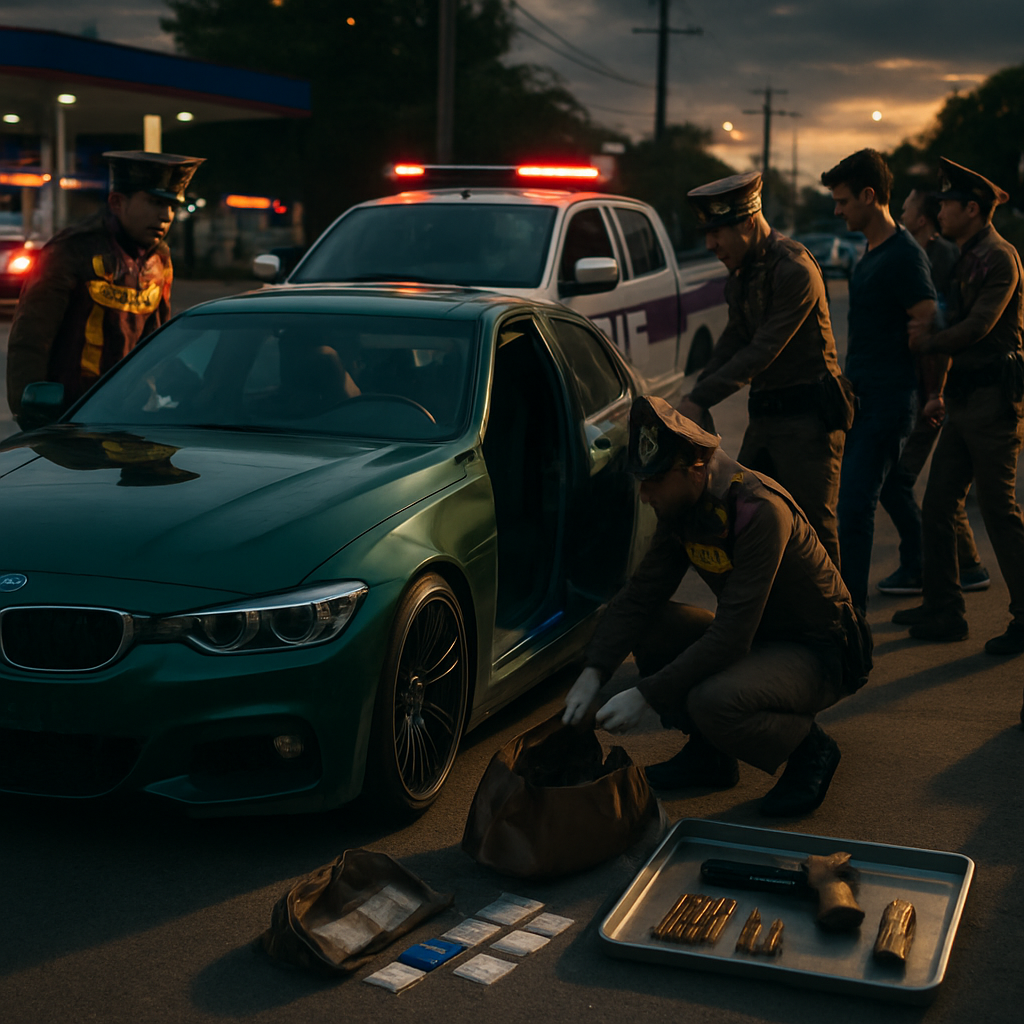
What began as a routine traffic and drink-driving checkpoint in Bangkok quickly turned into a dramatic afternoon bust, leaving a green BMW, three detained men and a heavy load of guns and drugs in the hands of traffic police. The incident unfolded at about 1:40pm on January 17, 2026, on Pracha Uthit Road in Phlapphla subdistrict, Wang Thonglang district — a stretch of road that, until that moment, had been simply doing its civic duty: slowing drivers down and testing breath alcohol levels.
The checkpoint was led by Pol Lt Col Suebsak Phansueb, deputy superintendent of traffic police at Wang Thonglang Police Station. Officers were carrying out the usual checks in front of a petrol station when a green BMW approached from the Meng Jai intersection — but something wasn’t right. The vehicle had no front licence plate and the occupants behaved in a way the officers described as suspicious. That combination was enough to prompt a stop.
Inside the car were three Vietnamese nationals. A search that followed turned routine policing into a major evidence seizure: officers found two handguns and a cache of narcotics concealed in various parts of the vehicle. The firearms included a .38 calibre handgun loaded with six rounds and a .32 calibre pistol loaded with three rounds. Drugs recovered during the search painted a worrying picture of organized distribution rather than casual possession.
The haul included approximately 9 grams of crystal methamphetamine hidden in the centre console, plus two bags containing a total of 250 methamphetamine pills — a quantity that strongly suggests intent to supply. In addition, officers found ketamine packaged in multiple parcels: two large bags, two medium bags, and nine small bags, all tucked inside a brown handbag found in the vehicle. All items were seized and logged as evidence.
The three suspects were detained at the scene and transported to Wang Thonglang Police Station for questioning. Police say their initial inquiries will focus on where the firearms and drugs originated and whether the arrested men are linked to broader criminal networks operating across Bangkok or beyond. The suspects and the seized evidence were formally handed to investigators to begin legal proceedings; charges are expected to include illegal possession of firearms and ammunition, possession of narcotics for distribution, and related offences under Thai law.
Local media outlet Khaosod reported the incident, citing police statements from the scene. Officials emphasized that the checkpoint was part of routine traffic and public-safety operations — a reminder that regular enforcement activity can sometimes uncover far more serious crimes than a simple drink-driving infraction.
Why this stop matters
On paper, checkpoints are about making roads safer and catching intoxicated drivers. In practice, they also serve as randomised points of contact between law enforcement and the public, and occasionally become the tip-off that reveals organised criminal activity. In this case, the lack of a licence plate and the occupants’ behaviour drew attention — a small detail with big consequences.
Thailand has long been grappling with narcotics distribution and the illicit flow of weapons, and Bangkok remains a focal point for both enforcement and concern. Arrests like this one are significant not just for the quantities seized — the mix of pills, crystal meth and packaged ketamine points to distribution networks rather than personal use — but also because firearms were found alongside the drugs, raising red flags about the potential for violence and protection schemes tied to trafficking.
What happens next
Investigators will follow several key lines of inquiry: tracing the supply chain of the narcotics, identifying the source of the firearms, and determining whether the three Vietnamese nationals are acting independently or as part of a larger syndicate. Given the quantities and packaging, police will likely look into distribution routes that supply nightlife districts, private parties and cross-border trade — areas where synthetic drugs have increasingly been a problem.
Meanwhile, legal processes will proceed. The suspects face serious charges under Thai law, and the evidence collected at the scene — firearms, ammunition and narcotics in multiple packages — will form the backbone of any prosecution. If links to wider networks are found, more arrests and seizures could follow.
A quick public-safety takeaway
For residents and visitors in Bangkok, this episode is another reminder that routine policing matters. Checkpoints aren’t just about catching drink drivers; they can disrupt criminal operations and keep dangerous materials off the streets. For law enforcement, the stop underlines the value of attentiveness — a missing licence plate and suspicious behaviour were enough to derail what might otherwise have been an unremarkable afternoon drive.
As the investigation continues in Wang Thonglang, authorities are expected to release more details. For now, the green BMW remains impounded, three men remain in custody, and federal and local investigators will be working to untangle how the weapons and narcotics reached Pracha Uthit Road. The case will be closely watched by both police and the public as it moves through the legal system.
Reported by Khaosod and confirmed by Wang Thonglang Police Station, this arrest is another chapter in Bangkok’s ongoing effort to clamp down on illegal guns and the drug trade — and a stark example of how a momentary traffic stop can reveal a much larger story.


















Good that police found weapons and drugs, but I’m uneasy about how the stop happened. A missing plate and ‘suspicious behaviour’ can be vague and lead to profiling. We need transparency like bodycam footage so the public trusts these checkpoints.
Missing plate is a valid reason to stop a car though, and the behaviour of the occupants apparently gave officers further reason. If they were trafficking, the checkpoint did its job and maybe stopped a lot more harm.
I agree a missing plate is a legal basis, I’m only asking for safeguards. When stops escalate, we should see clear evidence that probable cause was more than just ethnicity or nervousness.
The mix of crystal meth, pills and packaged ketamine strongly indicates distribution networks, not simple possession. From an enforcement perspective this stop offers leads: tracing the packaging and ballistic testing could reveal supply chains across borders. But systemic transparency is crucial to avoid misuse of routine checkpoints.
Honestly, these checkpoint stories always get cooked up into big wins in the press. Either it’s a genuine bust or it’s used to justify more checkpoints and budgets, and I suspect the latter sometimes. Prove the chain of custody and stop the PR circus.
That’s pretty cynical, Larry. Why assume bad faith when there are literal guns and drugs?
Because institutions often spin events to look effective. I’m not saying this isn’t real, just that scrutiny matters so arrests don’t become propaganda.
Scrutiny is fine, but don’t undermine every arrest before the facts are out. If quantities suggest distribution, that’s a public danger and should be addressed quickly.
Thank you to the officers for catching something dangerous today.
It’s good to find contraband, but we should be cautious about celebrating until due process runs its course. Still, the packaging and quantities do seem like they point to dealing rather than personal use.
Fair point, I just hate the idea of those drugs on the streets.
Why were they Vietnamese nationals specifically targeted? Cross-border trafficking patterns need investigation, not just headlines.
The presence of multiple sizes of packaged ketamine implies distribution tiers and customer segmentation, likely tied to nightlife consumption patterns. Ballistic analysis of the firearms and forensic tracing of package origins could reveal much about the network. Policy should couple interdiction with demand-reduction and regional cooperation.
Agreed on the forensic angle, but remember checkpoints can also be exploited by corrupt officers for extortion. Chain of custody and independent oversight should be priorities.
Absolutely—evidence must be handled under strict protocols, and any sign of misconduct should be investigated. Otherwise convictions may fail and networks stay intact.
So basically drugs, guns, and bureaucracy. Fun.
This kind of story worries me as a visitor; it’s scary to hear foreigners detained for big crimes in Bangkok. I hope consular access is provided and the legal process is fair.
Consular access should be standard. But being a foreigner doesn’t grant immunity if you’re carrying weapons and large amounts of drugs.
I agree on public safety, but tourists and migrants should get due process and protection from abuse. In some news stories that doesn’t always happen.
From a local angle, cross-border trade in synthetics has been rising, and enforcement is stretched. The embassy issue matters but so does root-cause analysis of supply chains.
Exactly, follow the networks and don’t just punish the low-level couriers without hitting suppliers.
Two handguns and that much meth is serious. I hope investigators trace where the guns came from, not just the drugs.
Procedure matters: checkpoints are effective but vulnerable to poor oversight, which can erode public trust quickly. Independent documentation like dashcam and custody logs is essential.
Independent oversight is ideal, but in practice many forces resist it. Without external review, shortcuts and abuse creep in, especially in high-pressure anti-drug operations.
That’s the problem. Advocates and civil society must push for accountability while police do the risky interdiction work.
Please don’t let this become xenophobia toward Vietnamese people. Trafficking happens with all nationalities and we need to be careful with language that blames entire communities.
I understand the concern but facts matter: if arrests show a pattern of foreign involvement in supply chains, that’s a valid part of the investigation. Saying so isn’t necessarily xenophobic.
Noted, but remember nuance. Blaming an entire nationality distracts from finding the actual organizers and routes.
I’ll be watching to see whether charges are for possession or trafficking and how the prosecution links these suspects to a larger network. The packaging alone suggests distribution, but courts need solid investigative work.
Trace the ballistic markings and the pill stamping patterns; these forensics often connect street-level seizures to bigger labs. Evidence linking materials to suppliers is key.
There are known hubs in the region for synthetic drug production, and pills often follow the same distribution channels. Seizure patterns can reveal routes.
Exactly, forensics plus supply-route analysis can crack the network if done right.