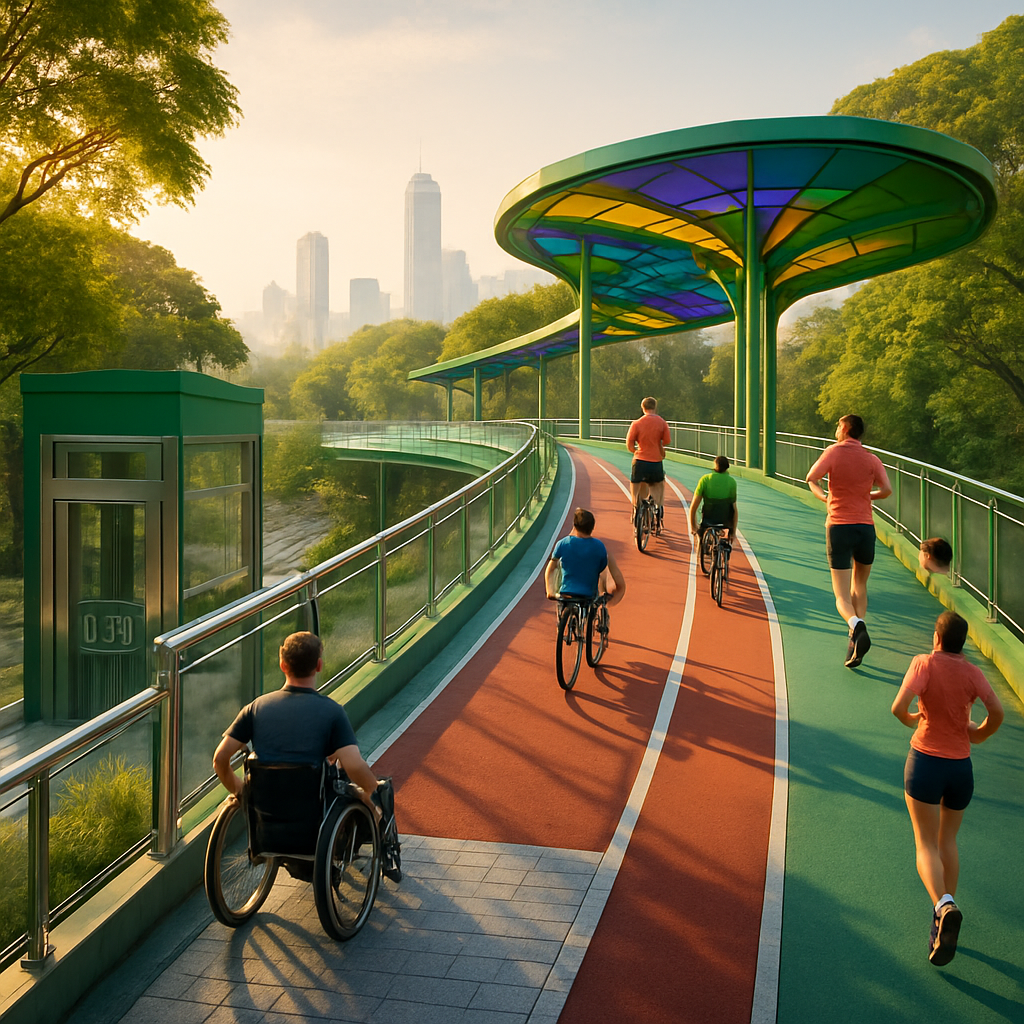
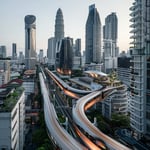
If you’ve ever dreamed of a scenic, traffic-free promenade connecting two of Bangkok’s most beloved green lungs, your wish is starting to come true. The Bangkok Metropolitan Administration (BMA) has thrown open parts of the newly renovated “Green Bridge” for public trial — a 1.6-kilometre elevated skywalk that now links Lumpini Park and Benjakitti Park with a fresh splash of accessibility, safety, and colour.
A bridge that welcomes everyone
This isn’t just a facelift. The Green Bridge has been reimagined with Universal Design at its core: the once steep staircases have been replaced by gentle, elevated ramps so wheelchair users, parents pushing prams, and cyclists can glide between parks without battling steps. It’s a simple idea, brilliantly executed — an inclusive artery through the city where everyone can move at their own pace.
Underfoot: surfaces built for safety and comfort
City officials made safety and comfort top priorities. The walking lanes are now paved with granite for a solid, pleasant stride, while cycle lanes feature a specialised “Sport Surface” engineered for high impact absorption and slip resistance. Translation: fewer scrapes, more smiles, and a smoother ride for commuters and weekend cyclists alike.
And yes, the bridge got a style update too. Vibrant strokes of purple, yellow, and blue add playful accents, but the path’s signature green still prevails — a respectful nod to the parks it joins.
What the BMA says
Aekwaranyoo Amrapal, a BMA spokesperson, summed it up succinctly: “The best gift we can give is good physical and mental health. This link makes it easier than ever for residents to integrate exercise into their daily lives.” It’s more than a quote; it’s the project’s beating heart. The Green Bridge isn’t just infrastructure — it’s public health by design.
Where the project stands — and what’s next
The renovation is currently about 45% complete. The remaining works are the trickiest parts: complex skywalk structures that span expressways and the busy Sukhumvit Soi 4, as well as upgrades to drainage and electrical systems. BMA has set sights on finishing those sections by May 2026, aiming to stitch the entire route into a continuous, seamless experience.
Good news for early adopters: at the Sarasin Road entrance to Lumpini Park, newly installed lifts for bicycles and wheelchairs are already operational. Expect more conveniences to arrive in phases — additional landscaping, upgraded under‑bridge links, and finishing touches that will make the whole route feel finished and polished.
Why this matters to Bangkok
On paper, it’s a pathway. In practice, it’s urban alchemy: converting transit space into daily opportunity. The Green Bridge reconnects neighborhoods, encourages active travel, and gives residents a pleasant reason to choose walking or cycling over short car trips. For a city that often hums with traffic and heat, a shady, accessible elevated route is a small revolution.
Think of it as an invitation: joggers testing sunrise tempos, families on evening stroller strolls, commuters beating ground-level congestion, and visitors discovering a scenic shortcut between two flagship parks. The bridge enhances mobility and ups the city’s liveability score at the same time.
Practical tips for first-timers
- Bring comfortable shoes — the granite walkways make for a great walk, not a sprint.
- Cycle politely — sport-surface lanes are designed for safety and cushion but share the route considerately.
- Use the Sarasin Road lift if you’re on wheels — those bicycle/wheelchair lifts are already working and make access a breeze.
- Enjoy the colours — the playful accents are intentional, making the skywalk feel vibrant without losing its leafy identity.
Looking ahead
By May 2026 the BMA aims to complete the remaining construction, which will close gaps and fully realise the Green Bridge’s inclusive promise. Until then, the partially opened sections offer a sneak peek — a chance to test the ramps, try the new surfaces, and enjoy a uniquely Bangkok perspective between Lumpini Park and Benjakitti Park.
Whether you’re a cyclist dodging rush-hour gridlock, a parent seeking a safe walking loop, or someone hunting a peaceful route for a morning run, this newly renovated elevated walkway is a welcome reminder that city design can be both practical and delightful. The Green Bridge is already proving itself as more than a connector of parks — it’s a connector of people.


Great to see the Green Bridge getting an inclusive redesign, but I’ll be honest — accessibility is only as good as ongoing maintenance and enforcement. The ramps and lifts are a big win, yet without regular upkeep and clear rules for cyclists versus pedestrians, chaos could follow. We’ll keep reporting as the project progresses toward the May 2026 finish.
Maintenance is the Achilles’ heel of many Thai projects; beautiful at launch then neglected within a year. Who’s on the hook for long-term care?
BMA has said they’ll manage the bridge, but community oversight and budget transparency will matter; if citizens demand updates, officials will have to respond.
The governance model should include citizen committees and measurable KPIs like uptime for lifts and surface repairs. Technical fixes are easy; institutionalizing service standards is hard but essential.
Back in my day they built it once and expected it to last forever. Now everything needs a committee.
From a public health perspective, this is a textbook intervention: removing environmental barriers increases physical activity across demographics. The evidence suggests even modest design nudges can reduce sedentary behavior citywide. I want to see monitoring studies post-opening.
Agree on the nudge theory, but urban designers often forget microclimates — shade, wind, and heat on elevated structures matter a lot in Bangkok.
Exactly — microclimate measurements, especially thermal comfort indices at dawn and dusk, should be part of any follow-up evaluation.
Thermal studies sound fancy, but for most people it comes down to whether there’s shade and water fountains.
Thermal comfort can be engineered with vegetation and perforated screens; but structural loads and maintenance budgets often limit those options.
I love the idea of colorful bridges, but who decided purple was a good color with green? Looks like someone played with a tourist brochure. Function over form, please.
Color choices can boost wayfinding and mood; purple accents don’t hurt if they help people navigate between parks.
Wayfinding is fine, but paint fades and becomes messy. I worry about aesthetics turning into scruffy patches.
Maintenance again — paint touch-ups cost money, but good quality coatings can last years if applied properly.
Finally a safe place to bike without getting yelled at by car drivers! But will cops actually ticket bad behavior on the bridge? Some bikers think rules don’t apply to them.
As a parent I’m worried about fast cyclists near kids. Clear speed limits and physical separators between lanes would help.
Physical separators are great but can narrow the path. I’d rather see polite enforcement and education campaigns.
Education alone rarely works; you need design that naturally slows riders where pedestrians cluster, like raised crossing islands.
A 1.6-kilometre elevated walkway linking major parks is an impressive piece of urban infrastructure, but it must integrate with public transport nodes to maximize utility. If it’s an isolated amenity, its social equity impact will be limited. Coordinate with BTS/MRT planners now.
Integration is key, but last-mile connectors often fall into planning gaps. Why isn’t there a formal multimodal plan published for the bridge?
There’s mention of under-bridge links, but I’m calling for explicit multimodal junctions and signage to transit hubs in the final plan.
In practice, people will still choose motorbikes if transit is slow. The city needs reliable feeder buses and secure bike parking to change habits.
This sounds like a small revolution, but sometimes these projects displace informal vendors and musicians who made the parks vibrant. Will the redesign include spaces for local culture or just sterile promenades?
Good point — the BMA mentioned landscaping and finishing touches but hasn’t detailed cultural spaces. We’ve asked for clarification on vendor policies and will publish their response.
Please follow up; I’d hate to see the bridge sterilized of local life in the name of cleanliness.
Vendors can be a nuisance but they also make areas feel alive. Balance is needed, not bans.
Sport-surface for bikes sounds good, but impact absorption often shortens lifespan under UV and heat. What specific polymer mix did they choose, and who guarantees performance? I’m skeptical without specs.
Great technical question — most public materials don’t publish specs, which makes accountability hard.
If BMA releases vendor contracts and material data sheets, engineers can monitor expected degradation and maintenance cycles.
Honest engineering oversight would prevent cheap fixes. Hope they did proper procurement.
Is it free to use? If there’s a fee or permit for cyclists, I’ll pass. Public spaces should stay free for everyone, period.
No fees have been announced; the bridge is intended as public infrastructure. If that changes, it’ll be major news and likely unpopular.
Good to know. Charging would be a slippery slope toward privatizing public walkways.
Climate resilience matters: elevated routes can be vulnerable to storms and flooding in drainage systems. Are they designing for extreme weather and futureproofing electrical systems? May 2026 is soon but climate-proofing needs time.
They mentioned drainage upgrades; I hope that includes capacity for extreme rain events, not just normal runoff. Resilience design should be non-negotiable.
Exactly — otherwise this becomes another band-aid
Why does every city now want skywalks? It feels like a way to avoid solving ground-level traffic and public transport problems.
Skywalks are part of a toolkit, not a cure-all. They can relieve pressure on sidewalks but shouldn’t replace investments in transit.
I’d prefer buses and safer sidewalks over more elevated structures anytime.
As a mom with a stroller, gentle ramps and lifts are life-changing. The old stairs made family outings hard, so this feels personal. Please keep the lifts free and operational.
Absolutely — reliability for lifts is crucial, otherwise they become symbolic rather than functional.
I’ll volunteer to report broken lifts if the city sets up an easy hotline or app.
That’s a great idea; community reporting tools can complement official maintenance schedules. We’ll ask BMA about a service request mechanism.
One more thought: measure behavioral change, not just footfall. Are people substituting short car trips with walks? That’s the true metric of success for urban health.
Collecting that data requires surveys and sensors; I hope the city budgets for proper evaluation and not just ribbon-cutting photos.
Exactly — place-based interventions deserve rigorous pre/post studies and open data for researchers.
Open data means we can finally see whether politicians’ claims match reality.
I’m all for green routes, but security at night matters. Will the bridge be well-lit and patrolled so women and elderly feel safe after dark?
Lighting is crucial. But patrols need to be consistent — not just during festivals or holidays.
LED lighting with motion sensors and CCTV visible to the public could be a deterrent, as long as privacy is respected.
I want to see sustainable landscaping rather than ornamental plants that need tons of water. Native trees, rain gardens and shade can make the route genuinely green. Otherwise it’s just painted concrete with a few pots.
Native landscaping is cheaper and supports biodiversity — why do planners ignore that?
Because short election cycles prioritize quick wins over long-term ecological planning.
We’ve asked BMA for details on planting schemes and water usage; they promised more native species but provided no specs yet.
Will this be accessible to tourists on bikes? Seems like a nice way to explore two parks without dodging taxis. Hope bike rentals get permission to advertise near the entrances.
Tourists are welcome, but locals should come first. Keep services affordable and not hyper-commercialized.
Affordable bike rentals can boost active tourism and reduce short taxi trips if managed well.
What about emergency access for ambulances or fire crews on the elevated route? Elevated structures sometimes complicate rescue operations. Someone please ask engineering and emergency services about protocols.
Emergency egress and access points must be integrated with the design; lifts should have override features for responders and clear evacuation plans.
Good — I hope those features are in the project specs and tested before the final opening.