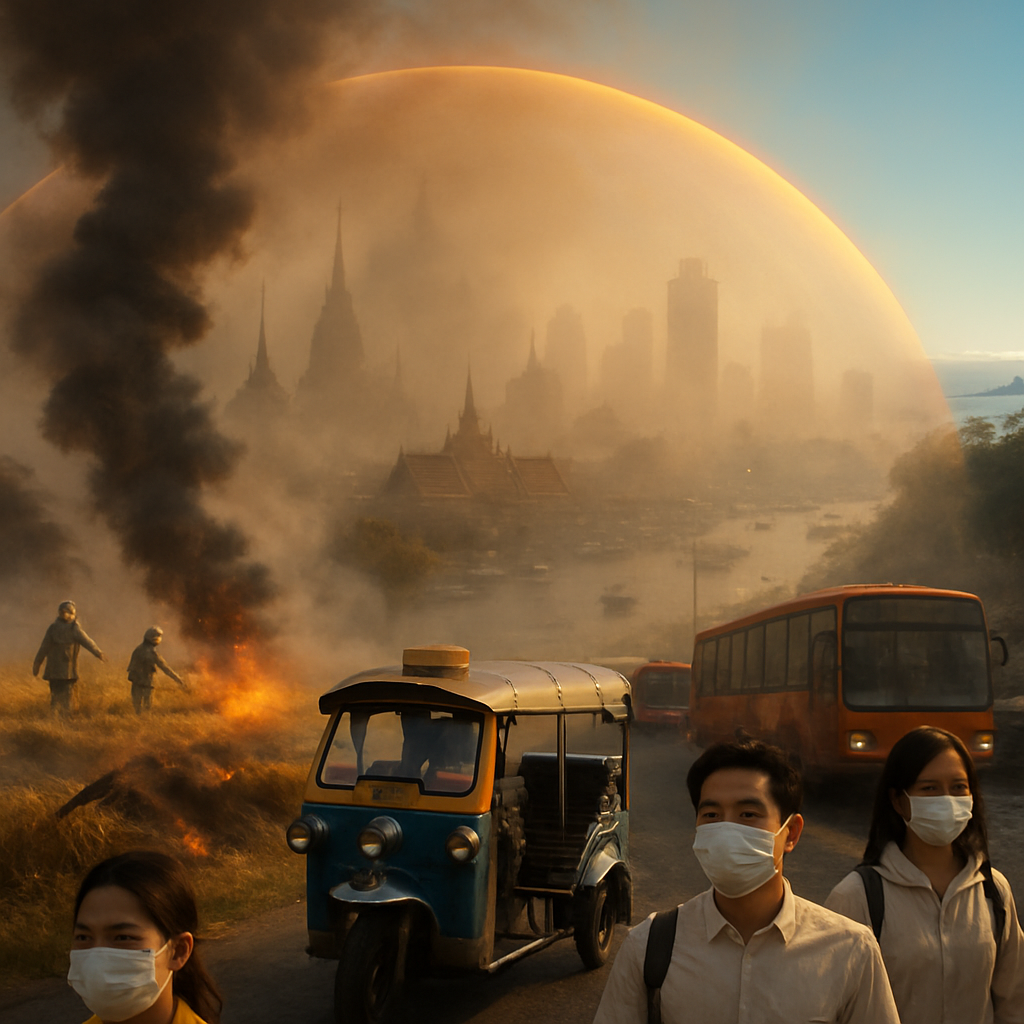
The air in Bangkok—and a staggering 47 other provinces—has turned from merely hazy to outright hazardous as ultrafine particulate matter (PM2.5) rose across the kingdom over the past 24 hours. Government guidelines peg a safe PM2.5 level at 37.5 microgrammes per cubic metre (µg/m³). As of 3pm on 30 November, the Geo-Informatics and Space Technology Development Agency (Gistda) found readings that pushed well beyond that limit, ranging from 38.3 to 60.7 µg/m³ in Bangkok and the affected provinces.
Nong Khai in the northeast wore the dubious crown yesterday with the highest recorded concentration at 60.7 µg/m³. Bangkok’s citywide average was an uncomfortable 49.1 µg/m³, with all 50 districts flagged as unsafe. Nong Khaem district topped the capital’s list at 53.4 µg/m³—proof that the smog blanket is being felt across wards, sois, and skyline alike.
Outside the capital, the worst-hit provinces read like a geography lesson in alarm: Bung Kan (northeast), Samut Sakhon, and Samut Songkhram (central plains) showed substantially higher concentrations than many other provinces. In contrast, several southern and northern provinces enjoyed relatively cleaner air, with PM2.5 between 20 and 24.9 µg/m³—comfortably below the government threshold. These include Satun, Songkhla, Phuket, Krabi, Mae Hong Son, Narathiwat, Phangnga, Chiang Mai, Nakhon Si Thammarat, Chumphon, and Phatthalung.
So what dragged Bangkok and swathes of central and northeastern Thailand into orange and red air-quality zones? Narong Ruangsri, permanent secretary of the Bangkok Metropolitan Administration (BMA), pointed to a high-pressure system advancing from China that is suppressing vertical mixing and trapping pollutants close to the surface. Seasonal factors are also in play: hotspots have multiplied across the Central Plains and parts of the northeast as harvest season wraps up and post-harvest burning increases particulate emissions.
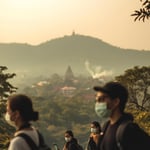
Narong urged caution: wear face masks when outdoors and, where possible, vulnerable groups should stay indoors. That practical advice—simple, sensible, and repeated by health officials during smog episodes—remains the best immediate defense for people in affected areas. Expect relief: the BMA and meteorological forecasts suggest ventilation should improve between Wednesday and Friday as the atmospheric pattern shifts and airflow returns.
For perspective, Bangkok’s current readings are notably worse than earlier in the month. On 12 November the BMA reported that the citywide average was a relatively benign 24.1 µg/m³, under the national safety threshold. At that time only a few districts—Lat Krabang (39.8 µg/m³), Bueng Kum (39.6 µg/m³), and Prawet (39.2 µg/m³)—approached the orange level. The recent spike shows how quickly air quality can swing from “manageable” to “health alert.”
Practical tips if you’re in Bangkok or any affected province:
- Wear an N95/KN95 mask outdoors—cloth masks won’t stop PM2.5.
- Keep windows and doors closed when concentrations are high; use air purifiers if available.
- Reduce strenuous outdoor exercise and avoid open-air markets near heavy traffic or burning fields.
- Check local air-quality updates from Gistda, the BMA, and official health channels—conditions can change fast.
It’s worth noting the patchwork nature of the problem. While Bangkok and several central and northeastern provinces struggle under a thickening veil of fine particles, many southern and northern provinces are breathing easier for now. That uneven pattern is a reminder that local sources—crop burning, traffic, industrial emissions—combine with regional weather to determine who gets the worst of it on any given day.
Images from past smog episodes—such as the February 15, 2024 photo via AP News/Sakchai Lalit—have become visual shorthand for the city’s recurring problem: iconic skyscrapers blurred into ghostly silhouettes and residents shielding their faces as if bracing for a storm. This season’s spike may be temporary if the predicted airflow returns, but it’s also another prompt to ask long-term questions about crop-burning practices, urban emissions controls, and how to make Thai cities more resilient to air-quality swings.
Until the skies clear, the simplest moves are the most effective: mask up, limit outdoor exposure for children, the elderly and those with respiratory conditions, and keep tuned to official updates. With forecasts pointing to easing later in the week, there’s hope the city will swap today’s smoggy panorama for clearer air—until the next weather system and agricultural season conspire to test us again.






This piece just in: PM2.5 hit dangerous levels across 47 provinces and Bangkok averaged 49.1 µg/m³ — what are people doing to stay safe?
I’ve been keeping my kids inside and running the purifier nonstop, but the electricity bill is killing us.
Thanks for sharing, Kanya — are there local shelters or community centers offering filtered air for families who can’t afford purifiers?
Some temples opened halls during the last crisis, but it’s patchy and not a long-term fix.
Community centers exist but the government should fund dedicated clean-air spaces, not rely on goodwill.
Mask on, windows shut, watch anime — simple.
Masks help but only N95/KN95 sufficiently filter PM2.5; many people still use ineffective cloth masks.
Farmers burn fields because it’s cheap and fast; we need alternatives but who will pay for them?
Subsidized machinery and biomass-to-energy programs can reduce burning, but policy design and enforcement are key.
If subsidies come, expect corruption and misuse unless there’s transparency and monitoring.
The meteorological explanation is sound: a strong high-pressure system suppresses vertical mixing, trapping emissions near the surface and elevating PM2.5 levels.
Agree, and public advisories should incorporate short-term forecasts with health-risk stratification to prioritize vulnerable groups.
Health stratification is great on paper, but do officials have the data and capacity to act at neighborhood level?
In the north we saw this pattern last year; forecasting helped but farmers still burned out of habit and cost pressure.
Habit isn’t the main issue, it’s survival. You scientists want change, show a way to keep our livelihoods.
Economic incentives can nudge behavior, but we must model the cost-benefit: who pays and who benefits in the short and long term?
This is criminal negligence by policymakers; decades of half-measures and weak enforcement got us here.
Blaming policymakers alone is lazy. Smallholder farmers are under pressure; enforcement without alternatives punishes the poor.
True, but empathy must be paired with action: fund alternatives, penalize big polluters, and educate communities.
Penalties without capacity-building will drive burning underground; economic design matters.
I just want clean air, not lectures.
The underlying issue is misaligned incentives: agriculture, industry, and urban transport externalize health costs that society pays.
Exactly — we need Pigovian taxes or tradable permits for particulates, paired with subsidies for cleaner tech.
Careful with taxes; regressive policies can hurt low-income households unless rebates or tiered schemes are used.
If you tax us, tell me how I’ll eat. I’ll burn if it’s the cheapest way to clear fields.
Redistribute the revenue to rural transition funds and you’ll align incentives and reduce poverty-driven burning.
My toddler has asthma and today was terrifying; hospitals are full and no one is talking about pediatric respiratory beds.
Do you know if local clinics are offering masks or temporary care? We can highlight gaps if you share specifics.
Local clinic gave a few masks but they were cloth. I was told to go to a hospital if he wheezes more.
Mask distribution and targeted air-clean shelters for kids and elderly should be immediate priorities for BMA and provincial health offices.
We in Chiang Mai saw haze last year but this spike in central plains seems worse for breathing in the city.
Cities trap pollution from surrounding countryside when winds change; everyone is affected, not just burners.
Urban emissions — traffic and factories — are not off the hook. People point fingers at farms but city policy must clean up transport too.
True, trucks and old buses do belch smoke; fix that fleet and you help the city as well.
When I was young the air was different; now I cough on temple grounds. Who will pay for this decline in public health?
We all pay via healthcare costs, lost labor, and lower productivity. It’s an intergenerational economic drag.
Pay the polluters, simple. Make them fix it.
Historic change needs policy, cultural shifts, and investment; it’s not just about money but priorities.
From a public-health perspective, repeated PM2.5 spikes increase chronic respiratory and cardiovascular risk across populations.
Long-term exposure models show rising morbidity; that’s a silent epidemic policymakers underestimate.
So should schools be closed on bad days? My employer refuses remote work policies, which puts kids at risk.
Temporary school closures help but disrupt families; we need clear thresholds and compensation policies for working parents.
I want to fix this too, but machinery costs and credit are barriers. NGOs talk big but rarely deliver lasting solutions.
NGOs can pilot, but government must scale — and fast. This isn’t just a farmer problem; it’s systemic.
Microfinance with training and conditional grants for no-burn methods could work if monitored.
I’ve seen cooperative models where villages pooled resources for machines. Not perfect, but promising.
Photos of blurred skyscrapers hurt tourism and business confidence; a smoggy city is bad optics and bad economics.
Short-term tourist dips are probable, but long-term reputation damage depends on policy response and visible action.
Tourism blaming is unfair — tourists don’t set farm policy. Fix emissions at source, not scapegoat visitors.
Public pressure via tourism losses can be a powerful lever if activists and media amplify the story.