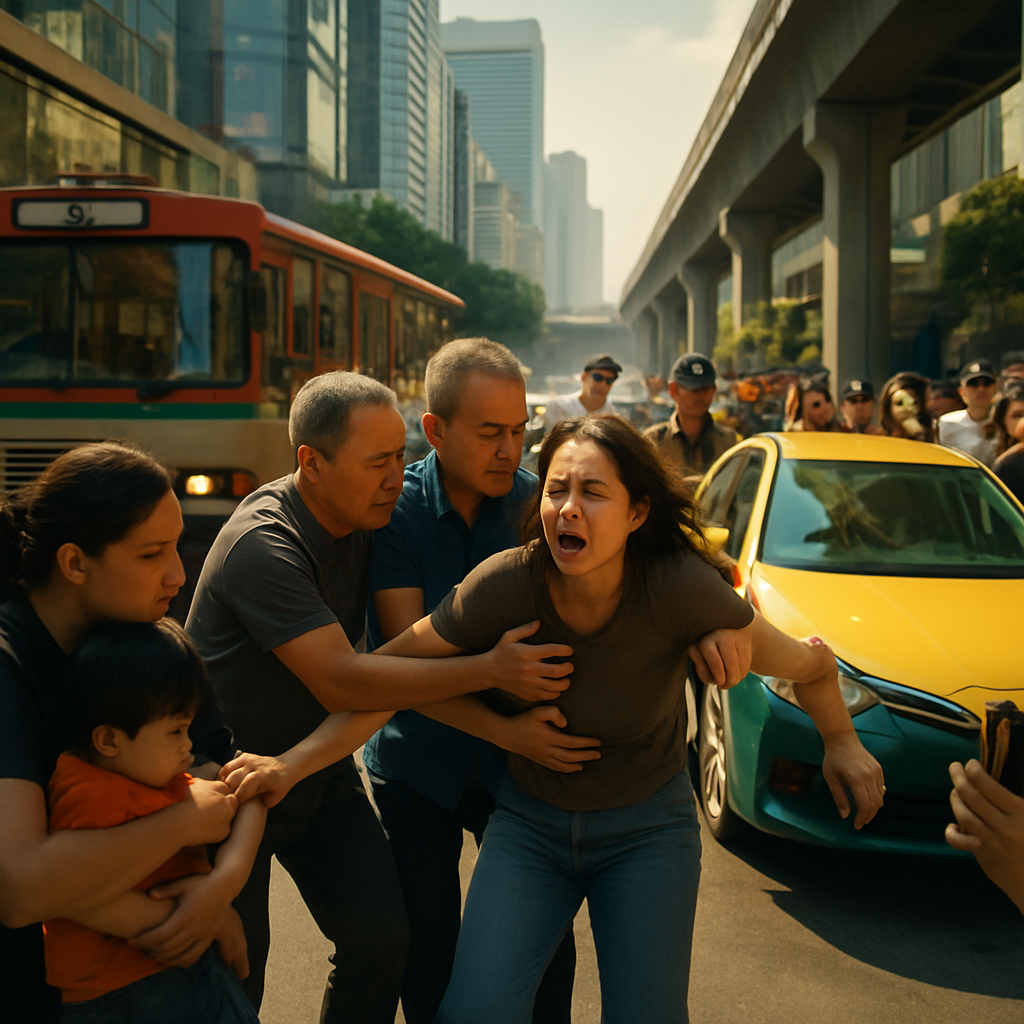
The midday hum of Sukhumvit Road — a ribbon of commerce and commuter bustle in the heart of Bangkok — was shattered when a woman armed with a knife began lunging at passersby, sending shoppers, office workers and tourists sprinting for cover. What started as a chaotic scramble quickly became a strange, harrowing tableau captured on video and shared across social media, leaving residents with the same question: how did this happen on a stretch of road that should feel safe?
Facebook user Nisarat Gam Dumnernsawat posted the footage, and the clip is as uncomfortable as it is compelling. In it, a woman repeatedly attacks a foreign man with a knife while he frantically defends himself, trying to fend off the blows and protect others nearby. At one point she appears to search the crowd for more victims, and the poster’s voice, tinged with panic, notes: “She just stabbed a child over ten years old.”
Witnesses and locals didn’t wait for police sirens. Several residents chased and cornered the woman after what witnesses described as a tense struggle. She was eventually restrained and then found trying to flee inside a taxi — a desperate exit attempt interrupted when bystanders and, later, officers surrounded the vehicle and took her into custody without further incident.
What has heightened public alarm is a chilling similarity to an earlier episode. The poster and other observers raised the possibility that this may be the same woman who, on December 13, allegedly tried to stab passengers aboard an air-conditioned bus that also ran along Sukhumvit Road. Parallel details — height, hairstyle and conspicuous behaviour — have prompted calls for a deeper look into the incidents and whether they are connected.
Local outlets, including KhaoSod, previously reported on the bus incident, in which a woman brandished a knife and threatened a bus conductor, sparking panic among passengers. The recurrence of such behaviour in the same neighborhood — allegedly by the same person — has left residents questioning whether the woman was released after prior detention or never sufficiently monitored.
“How can no one do anything about her?” the video poster demanded online. “Letting her roam freely like this is unacceptable. She is released quickly and repeats the offence. Who should we alert to ensure public safety? She dresses so normally that she seems like any other person.” The tone captures a familiar frustration: the public’s anger when individuals perceived as dangerous appear to fall through the cracks of the justice or mental-health systems.
Authorities have not yet publicly confirmed whether the two Sukhumvit incidents involve the same suspect, or whether underlying issues such as mental illness played a role. Those are critical details: they could shape charges and determine whether detention, treatment or a combination of interventions is most appropriate. For now, what’s clear is that witnesses stepped in and prevented what could have been an even worse outcome.
The clip has also prompted a wider conversation about everyday safety on Bangkok’s busy arteries. Sukhumvit Road, lined with malls, restaurants and skyscrapers, is normally a backdrop for mundane city life — not a stage for knife attacks. That contrast only magnifies the shock. Social feeds have filled with calls for stronger patrols, better surveillance, and clearer protocols for handling suspected violent individuals before they can re-offend.
There’s also a human element often lost in the headlines: people who were simply trying to go about their day and suddenly faced terror. The foreign man who defended himself and the child said to have been stabbed are reminders that such incidents ripple outward — affecting commuters, families, tourists and the sense of security that binds urban life together.
For now, police custody ends the immediate danger, but it doesn’t soothe the broader unease. Residents want accountability and assurances: thorough investigations into whether earlier complaints were adequately addressed, transparency about the suspect’s status and, importantly, action that reduces the chances of repetition.
As the city digests the video and the episode becomes another entry in the daily news feed, one detail is worth holding onto: community vigilance mattered. Strangers acted to restrain a dangerous individual and prevented further harm. That civic courage, combined with an effective police and public-health response, is what will ultimately determine whether Sukhumvit — and other crowded corridors across Bangkok — can return to its usual rhythm without the shadow of recurrence.
Officials overseeing the case should publicly clarify next steps. Was this incident linked to the December bus episode? Was the suspect previously detained or treated? Answering these questions will help restore public confidence and, crucially, protect people on the sidewalks where normal life should take place without fear.


















Unbelievable that this happened on Sukhumvit during midday; that road is always packed. If she really did the bus attack before, why was she out again so soon? Citizens stepping in is brave but also terrifying — we shouldn’t have to detain attackers ourselves.
Because the system sometimes treats repeat disturbances as minor unless someone is gravely injured, sadly. This looks like a system failure between policing and mental-health services.
Exactly my point, Larry — if police or hospitals release someone who then attacks again, there must be accountability. We need clearer follow-up procedures.
People saying ‘system failure’ ignore that hospitals also have legal limits on holding someone without charge. It’s messy, and mental-health law needs reform.
True, but laws can be changed. Public safety has to be balanced with rights, but right now the balance feels tilted toward inaction.
Also remember bystander detention can go wrong; cops should be trained to de-escalate and process suspects properly rather than letting mobs handle it.
If it’s the same woman from the bus incident, that points to repeated missed opportunities. Who’s tracking these cases? The public deserves answers.
Tracking requires data sharing between transit authorities and police, which often doesn’t happen. Privacy laws sometimes make this hard, but there are ways to coordinate.
Or we can just increase patrols on Sukhumvit and hope scares deter repeat offenders. Not the smartest solution, but visible policing calms people fast.
Patrols are a short-term fix. I want to know why someone who allegedly threatened people on a bus wasn’t monitored afterward. Transparency matters.
Video evidence is helpful, but social media mobs can misidentify people. We must be careful before assuming guilt.
Sure, but video also prevents cover-ups. If the video shows the attack, the priority is victim protection, not armchair detectives.
I’m just saying mistakes happen. False accusations ruin lives too, so both cautious verification and swift action are needed.
This raises big questions about how mental health intersects with criminal justice in Thailand. Are we criminalizing illness or failing to protect the public? Neither outcome is acceptable.
Clinical perspective: incidents like this often stem from untreated psychosis, but resources for long-term outpatient care are scarce. Involuntary treatment statutes are strict, and community follow-up is underfunded.
So what’s the fix? More hospital beds, outreach teams, or legal change to allow temporary holds when someone is clearly dangerous?
All of the above, honestly. We need crisis intervention teams, legal frameworks that protect both rights and safety, and funding for community mental-health workers.
As a psychiatrist, I worry about simplistic narratives. If she is unwell, punishment alone won’t prevent recurrence. But neither should we ignore victims. Integrated responses are necessary.
Too many people treat ‘mental illness’ as a catch-all excuse. We shouldn’t absolve violent acts without investigation.
I agree on accountability; evaluation is part of the legal process. My point is about using appropriate interventions rather than only incarceration or letting people go.
This makes me nervous to take my kids to the mall. Knife attacks are so random and scary. Authorities must do better.
Totally understandable fear. But we should avoid panic and instead push for clear updates from police and hospitals about steps being taken.
The foreign man defending himself is a reminder that tourists can be targets too. This will hit Thailand’s image as a safe travel spot. Bad for economy and morale.
Tourist fears are real, but one incident doesn’t define a country. Still, officials should address perception through transparency and visible measures.
Perception matters more than you’d think. If word spreads that Sukhumvit is unsafe, businesses will feel it immediately.
Why are people saying ‘she dressed normal’ like that’s suspicious? Normal clothes don’t equal normal minds. That comment felt biased to me.
I think the point was that dangerous people can blend in, not to shame attire. But I hear you — phrasing matters in tense moments.
If CCTV or bus records show the same person, there should be criminal proceedings. Releasing someone who re-offends is not acceptable.
Criminal proceedings depend on evidence and intent. If mental illness affects intent, courts might order treatment — which the public sees as leniency.
Bystander action saved lives, but this isn’t a legal strategy. People could have been hurt trying to restrain someone with a weapon. We should train civilians in safe intervention.
Training helps, but realistically few will sign up. Better to push authorities to have rapid response units near busy corridors.
Rapid response is ideal, but until then some basic public guidance on nonviolent intervention could reduce injuries.
Why is there so much focus on mental health? This could be pure criminality. We need to treat attacks as attacks and prosecute accordingly.
Both perspectives are needed. Clinical assessment determines criminal responsibility, but victims deserve justice and society needs safety measures.
This will ignite debates on security vs civil liberty. People want immediate confinement; civil libertarians will caution against knee-jerk policy. Neither side is entirely right.
Agreed. Policy must be nuanced: protect citizens while upholding rights, with transparent oversight so people trust the system.
Has anyone asked whether the taxi driver is being questioned? Letting someone flee in a cab suggests gaps in immediate escalation and coordination.
Good point. Drivers are conveyors of evidence too — dashcam footage, passenger statements. They could be crucial witnesses.
Exactly. Small details like that help reconstruct timelines and determine if the suspect had intent to escape or reoffend.
People are quick to shout ‘mental illness’ but slow to demand better policing and transit safety. Both need improvement, not just blame.
Yes, I’m tired of the talk and want action: more patrols, better inter-agency communication, and clear reporting lines.
This is a test of public institutions. If investigations are opaque, rumors will fill the vacuum and erode trust. Transparency is the cheapest vaccine against panic.
Transparency won’t fix resource shortages, but it’s crucial for accountability. Publish case statuses and rationale for decisions respectfully.
As the person who posted the video originally, I can say it felt chaotic and surreal. People stepped in because they feared innocent lives were at stake.
Thank you for sharing despite the danger. How are the victims doing? Any official updates?
I heard the child was taken to hospital and is stable, but police didn’t give full details yet. I’m waiting for official statements too.
Thanks for the update. Your footage is hard to watch but probably helped authorities act and the public be aware.
Humans restraining an attacker is brave, but someone could have used a firearm and escalated everything. Thailand’s gun laws matter too when people panic.
Introducing more guns is the worst idea here. De-escalation and trained response reduce violence more effectively than arming civilians.
International tourists seeing this will worry, but locals know incidents happen anywhere. We need balanced reporting that avoids sensationalism.
Balanced reporting is ideal, but outrage drives policy. If people didn’t complain loudly, nothing would change.
If they link her to the bus attack, I’d like to see past responses documented. Was she given a restraining order, psychiatric evaluation, or simply released?
Those are the right questions. Documentation of prior interventions shapes legal outcomes and future measures like mandated treatment.
Online commenters calling for ‘lock her up’ forget ethics; people can be dangerous because they’re sick. But victims also need justice. It’s complicated.
Complicated or not, public safety should be prioritized. We can’t let complexity become an excuse for inaction.
I saw CCTV of a different incident and it was unclear, so I’m cautious. However, if the person is repeatedly violent, restraining orders and supervision are necessary.
Restraints without treatment can worsen outcomes. Supervision plus medical care tends to work better in the long run.
Social media outrage can lead to rushed policy that harms vulnerable people. We need informed debate before laws change.
Meanwhile, while we debate, people remain at risk. There’s urgency too; both caution and speed should coexist.
I live nearby and now avoid that stretch during lunch hours. It’s sad when streets you trust become places of anxiety.
Community patrols or volunteer safety ambassadors could help restore calm while officials act. Small local initiatives matter.
I hope police will release a timeline soon. People deserve to know if systems failed or if there was genuine unpredictability.
Agreed. I’ll update my post if I hear more from authorities, and I’ll push for clarity about the bus case link.