A Golden Walk Over the Chao Phraya: Bangkok’s Proposed Pedestrian Bridge
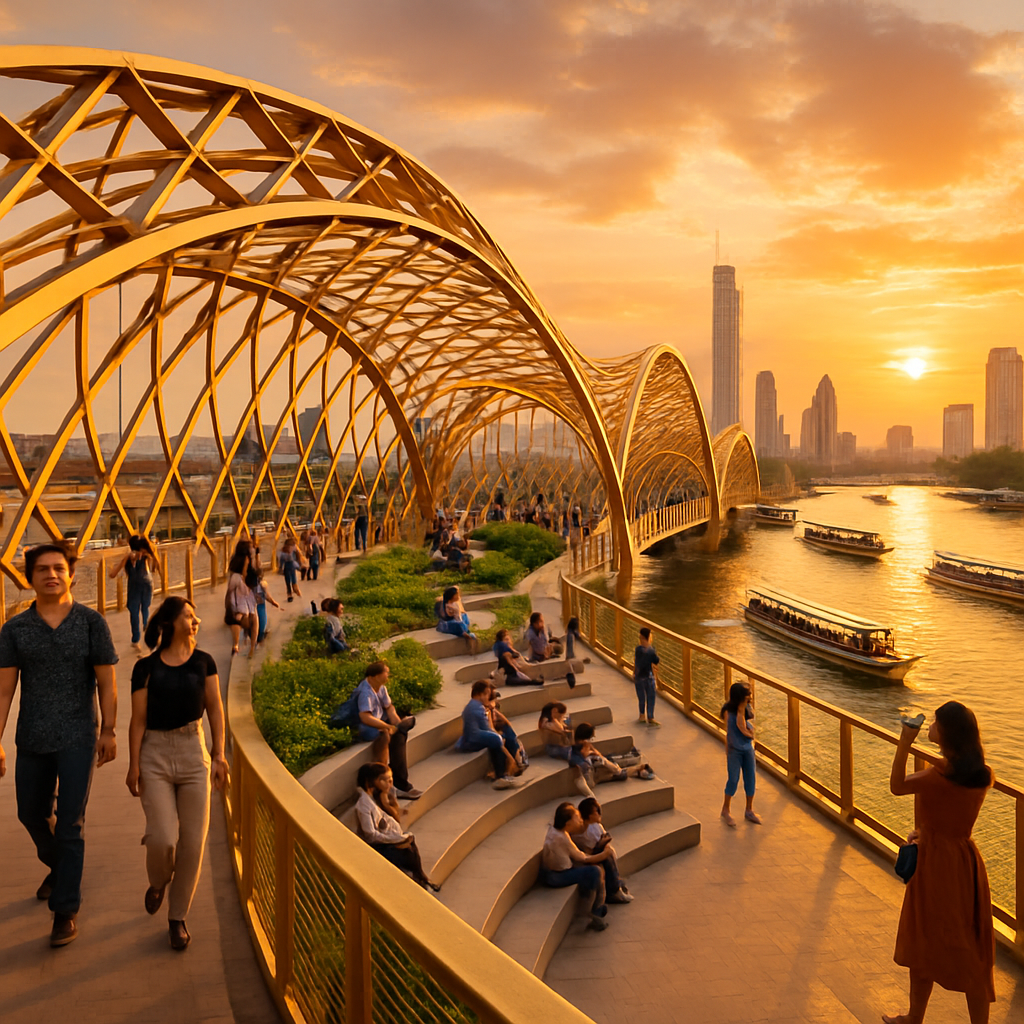
Bangkok is flirting with a new kind of skyline showpiece — a pedestrian-only bridge over the Chao Phraya River that promises to be as much a strolling promenade as a photo-ready landmark. Unveiled recently by the Bangkok Metropolitan Administration (BMA), the concept features a modern, golden lattice structure with a central garden and stepped seating where people can pause, take in the river, and snap that perfect skyline shot.
If the bridge goes ahead, it would be the first crossing on the Chao Phraya dedicated solely to foot traffic. That’s notable in a city where most river crossings prioritize vehicles and passengers hopping on and off ferries. The proposed span is planned to link Chiang Mai Road on one bank with Songwat Road near Chinatown on the other — a neat, walkable tie between two neighborhoods that have been buzzing with new life and interest from both locals and tourists.
Design with a View
The model released by the BMA shows a structure woven from golden metal in a criss-cross lattice, giving the bridge a sculptural, contemporary presence. At the heart of the design is a little urban oasis — a garden with staircases that double as benches. Picture pausing mid‑river, feet tucked into a step, sipping an iced coffee while longtail boats and tourist ferries slip by. It’s intended not just for movement, but also for lingering: rest, people-watching, and capturing sunsets over the Chao Phraya.
Why Now?
The BMA frames the proposal as an answer to a very practical issue: rising population and growing development along the riverfront have increased demand for better pedestrian connections. While riverfront areas have flourished with markets, eateries, heritage sites, and boutique hotels, the options for people on foot remain limited. Ferries fill the gap but aren’t always convenient for short trips across the river. A dedicated footbridge could knit neighborhoods more tightly together and create a fresh pedestrian route that both residents and visitors would use daily.
Not Just a Pretty Picture: Real Challenges Ahead
Design models are one thing; building over a working river is another. BMA officials are careful to emphasize that the project is still in the study phase. The stretch of the Chao Phraya in central Bangkok is dense with infrastructure and economic activity, which means land use and access are complicated. Acquiring land or altering existing spaces can be politically and financially thorny.
Another hard constraint is river traffic. The bridge must be designed so it doesn’t obstruct passenger boats, cargo vessels, or the many tourist ferries that are the river’s lifeblood. The engineering challenge will be to balance a striking visual design with adequate clearances and safe navigation channels below.
Community Voice and Tough Questions
The BMA has said a public referendum will be part of the process, giving riverfront communities — especially those on Songwat and Chiang Mai Road — a direct say. That’s important, because public reaction so far has been mixed. Many Thais online are excited: they see a new “check-in” spot that could boost tourism, create flow between neighborhoods, and generate income for local vendors.
Others are urging caution. Common concerns include the construction cost, long-term maintenance, and whether the bridge will provide real value beyond being an Instagram backdrop. Residents and commentators are asking to see detailed feasibility studies: projected costs, revenue or economic benefits, maintenance plans, and realistic timetables. The worry is that without serious planning, a striking structure could become a neglected landmark rather than a thriving public space.
What Success Would Look Like
In its ideal form, the pedestrian bridge would be more than an architectural flourish. It would enhance everyday connectivity, make it easier for locals to walk between key nodes of commerce and culture, and encourage slower, more human-scale exploration of the riverfront. For tourists, it could become a gentle new way to experience the Chao Phraya — not cramped in a ferry or rushing across a vehicle bridge, but ambling through a gardened span with panoramic views.
For that to happen, the BMA will need to balance beauty with hard-headed logistics: ensure the design doesn’t interfere with river navigation, secure funding that covers both construction and long-term upkeep, and win the trust of local communities through transparent studies and consultations.
Looking Ahead
It’s still early days. The bridge is a proposal under study rather than a committed project. But the idea has already sparked lively conversation — a sign that Bangkok’s riverfront continues to be a canvas for new ideas. Whether the golden lattice will one day arch over the Chao Phraya remains to be seen, but the very discussion is a reminder: cities are living things, and thoughtful design can turn a simple crossing into a shared experience that connects people, places, and stories.
For now, imagine stepping onto that golden weave, hearing the lapping water, and watching Bangkok’s vibrant river life glide beneath your feet. If the plan sails through studies, permits, and a public vote, that walk could become part of the city’s next chapter.
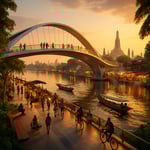
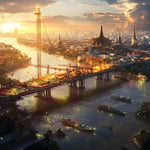







We’re excited to share the concept for a pedestrian-only bridge connecting Chiang Mai Road and Songwat Road. Public studies and a referendum will guide the next steps, and we welcome feedback from everyone along the river. The model focuses on pedestrian flow, maintenance plans, and minimizing disruption to river traffic.
As a historian, I love bold city pieces, but I worry a shiny golden lattice could overshadow the older riverside streets and heritage views. Will the BMA commit to view-shed studies so historic temples and buildings aren’t visually dominated?
The proposal is visually striking, yet the key test is economic viability: who pays for construction and long-term upkeep, and how will benefits to residents be measured? I’d like to see a cost–benefit with varied scenarios, not just optimistic tourist projections.
Beautiful renderings are one thing; real-world nav clearance and foundation works on a busy river are another. If this blocks ferries or cargo lanes even temporarily, the cost to commerce could be huge.
We hear the concerns; the study includes navigation simulations and a maintenance funding plan. Public funds will be clearly itemized and alternatives like public–private partnerships will be evaluated transparently.
Transparency is good, but PPPs often privatize revenue streams and public access. Please commit to clauses that protect open access and cap vendor commercialization so it doesn’t become a privatized promenade.
I appreciate that reply, but promises on paper mean little without enforceable preservation covenants. If views change permanently, that damage isn’t reversible.
This would be awesome for photos and walking around at sunset. Bangkok needs more pedestrian spaces like this that aren’t just traffic bridges.
Yes! Tourists will love it and local cafes will get more foot traffic, which helps small businesses. But it must be affordable to maintain or it’ll just fall apart in a decade.
Of course tourists will love it — they’ll snap and move on. The problem is when you prioritize Instagram over real transit needs. Walkability should mean useful routes, not just pretty stops.
Pretty stops can be useful too if they connect places people actually want to go, not just if they look good. Balance is key.
I live near Songwat and I’m worried about land grabs and rising rents. Will local residents be consulted and protected from displacement during and after construction?
As a stall vendor I fear more tourists means higher vendor fees and less space for locals to sell their everyday food. We need guaranteed spaces for long-term vendors, not temporary pop-ups.
Consultation is part of the referendum process and we plan to hold targeted meetings with residents and vendors. Compensation and relocation policies would comply with existing laws and include local vendor priority schemes.
Promises again — I’ve heard this before and still lost a shop. I’ll believe it when I see binding contracts and budget lines for compensation.
Exactly. We need a dedicated fund written into any plan, not a ‘we’ll figure it out later’ statement.
As an urban planner I appreciate the idea of pedestrian-first infrastructure, but design must prioritize universal access, flood resilience, and real micro-mobility connections. Without those, it risks being a costly vanity project.
Totally — who gets to use the space matters. If it’s full of private vendors and exclusive events, that defeats the public purpose. The design should maximize daily commuters, not just weekend visitors.
Maya makes a good point about flood resilience. Long-term climate adaptation costs are often left out of initial budgets and then projects become financial drains.
Exactly. That’s why lifecycle costing needs to be public from day one — construction, yearly maintenance, and climate adaptation expenses should be clear.
This is either a brilliant piece of civic design or a gilded trap for tourists and investors. My bet is on the latter until I see actual benefits for people who live here.
Too often projects like this are sold on photos and then become long-term liabilities. I want independent engineering reviews before any contracts are signed.
Independent reviews and community oversight boards, yes. Not just architects’ hype reels.
From an engineering view, the Chao Phraya is busy and has variable currents. Any low-to-mid span would require removable sections or very tall clearances, which changes the aesthetic and cost dramatically.
What worries me is heavy construction in the river affecting sediment and local fish. Has an environmental impact assessment been mentioned yet?
Good point. Sediment disturbance can damage shallow-water ecology and also shift navigation channels. EIA should be mandatory before design finalization.
I think it will be so pretty and I want to bring my grandparents to sit on the steps. Can people with wheelchairs get up to the garden too?
Accessibility is non-negotiable. Ramps, lifts, and shaded rest areas should be in the first designs, not added later.
Yes! Thank you. If my grandma can’t go, I won’t like it very much.
I want to stress that delicate heritage areas can be harmed visually and commercially by flashy new works. Who decides what ‘enhances’ the riverfront — tourists or residents?
Decisions should include heritage impact assessments and local committees. Too often tourism-led projects override local cultural priorities.
Exactly. A bridge could help if it’s designed to complement and reveal heritage, not cover or compete with it.
If we evaluate this like a transport project, we ask: what trips will it replace, reduce, or create? Without modeling pedestrian origin–destination patterns the project might serve mostly leisure trips rather than commuting needs.
Modeling is essential. A bridge that improves last-mile connections for workers would be far more defensible than a purely scenic span.
Agreed. Please commission travel demand modeling and make the data public so the referendum is informed and not emotional.
Vendors like me want more customers but not if permits cost an arm and a leg. The city must guarantee affordable vendor spaces, especially for locals who rely on daily income.
If vendors get priced out, the bridge will be just another sterile tourist trap. Keep market culture alive, not sanitized for foreigners.
Vendor affordability will be part of the consultations; we’re exploring fee caps for local vendors and priority licensing schemes to protect long-term residents.
Good to hear, but I want that in writing and not just sentiments at a meeting.
As someone who brings tour groups, this could be a unique selling point for Bangkok tourism that spreads visitors to Chinatown and the creative riverfront. Managed well, it could boost small operators.
Tour operators boosting small businesses sounds great, but who sets the rules when businesses clash with preservation or resident needs? Not all gains are local.
Rules can be set collaboratively. Excluding tourism entirely isn’t the answer; integration is.
River ecosystems are fragile. Construction could change currents, erode banks, and harm species. EIA and mitigation plans must be detailed, public, and independently verified.
Precisely. Engineering responses can mitigate but only if the EIA guides the design. Don’t let engineers retrofit ecological fixes after the fact.
And ongoing monitoring after construction is essential, not optional.
A referendum is the right call, but information given to voters must be clear and unbiased. Too often campaigns tilt public opinion with selective data.
Yes, provide independent analyses and hold public workshops with Q&A panels including engineers, historians, and local vendors.
And translate materials into community languages and street-level handouts — not just glossy PDFs online.
As a critic, I love iconic urban gestures but the BMA must avoid the trap of monuments over mobility. The bridge should prioritize flows, connections, and public value over headline aesthetics.
Amen. I’d add that lighting design, seating, and safety at night are often afterthoughts — these determine whether people use a space daily or just take selfies there.
Exactly. A beautiful bridge that’s unsafe at night is a liability, not an asset.
Will bicycles be allowed? If it’s truly pedestrian-only but bans bikes, it could hurt commuters who rely on e-bikes and pedal cycles.
Shared-use paths or separate cycle lanes should be considered. Banning bikes often excludes people who can’t afford motor transport.
Modal mix is under study. The goal is to accommodate pedestrians and light micro-mobility while ensuring safety; bike access options are being considered.
Maintenance is my biggest fear. Golden metal will need cleaning, and plants need care. Who will fund upkeep in 10, 20 years when novelty fades?
Long-term maintenance funds must be endowment-style or budgeted annually; deferred maintenance kills public projects. Ask for a 30-year cost forecast before voting.
A 30-year forecast would make me sleep better. Otherwise it’s just another future headache.
If the bridge truly improves daily commutes and supports local traders, I’m for it. If it’s just another photo op, I’ll oppose it at the referendum.
That’s a fair line. Demand measurable commitments before the vote — e.g., X percent vendor allocation to locals, Y percent maintenance fund secured.
Bangkok needs attractions, but it also needs honest planning. I’ll come either way, but I don’t want my visit to push locals out.
Tourists who care are welcome. Tourists who gentrify neighborhoods for luxury shops are not.
Agreed. Responsible tourism should be part of the plan.
Could the bridge host cultural events or markets periodically so it benefits locals year-round? Otherwise it might just be a transient attraction.
Allowed markets are only helpful if local vendors get priority and fees are low. I’d support curated events that include us.
Event programming is on the table; we’re exploring community-led activations and annual market schedules that prioritize local traders.