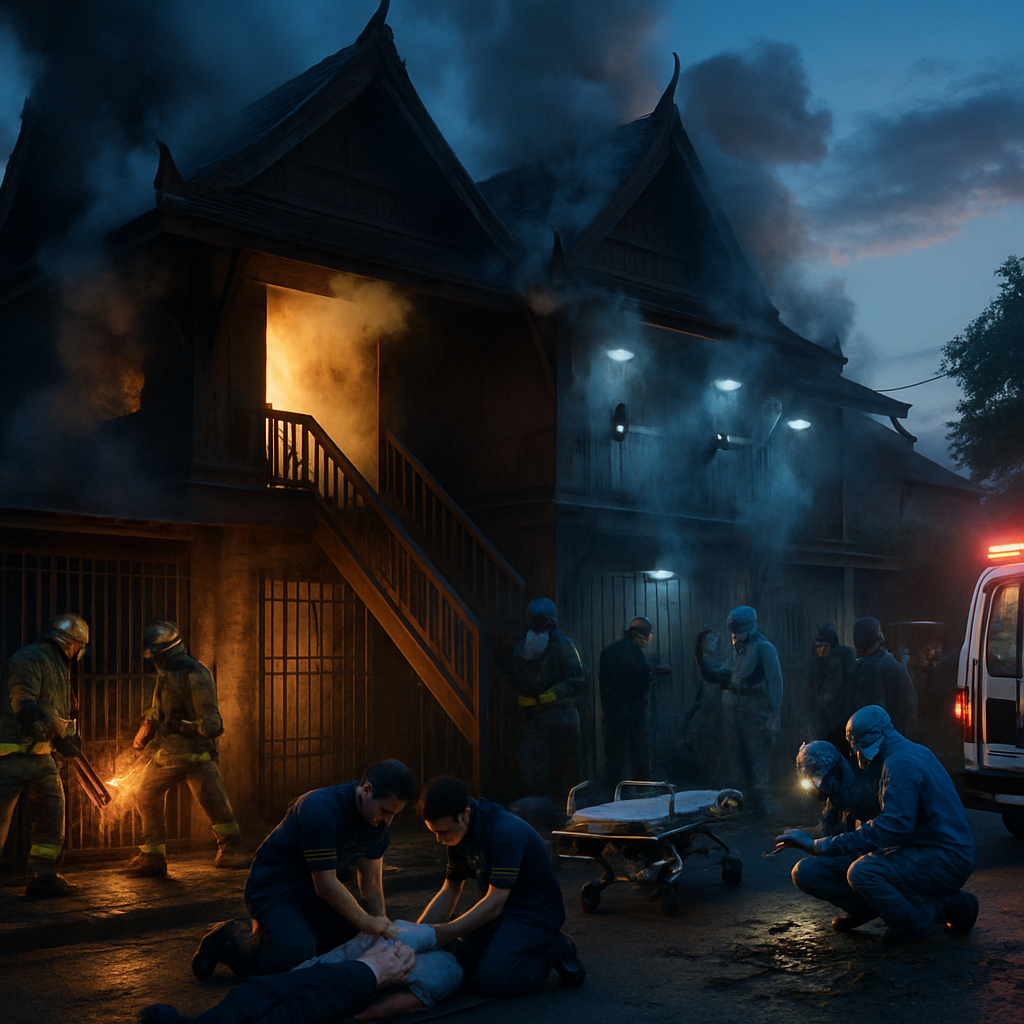
In the small hours of January 8, a quiet neighbourhood in Chiang Mai’s Pa Dad sub-district was rocked by a tragedy that has left the community searching for answers. A two-storey house went up in flames, and by the time rescuers forced their way inside, five members of the same family had died—none from burns, but from heavy smoke inhalation despite desperate attempts at resuscitation.
The victims have been named as 38-year-old businessman Kawin, his 38-year-old wife Warissara, their five-year-old twin daughters Lalisa and Lalinda, and Kawin’s 70-year-old mother, Sunee. Rescue teams performed CPR at the scene before rushing the family to hospital, but all were later pronounced dead.
The house itself belongs to Kawin’s father, former education official Somsak Taichai, who reportedly does not live on the property and visits only occasionally. Authorities say one other family member was not present at the time of the blaze; police are attempting to contact Somsak for further information.
Why investigators are uneasy
What began as an apparent late-night house fire quickly moved into the realm of mystery. At first, officers suspected a routine electrical short circuit—an unfortunately common cause of household blazes. But forensic teams and frontline rescuers flagged an unusual detail: investigators found two separate points of origin for the fire.
One area of burning was identified on the ground floor and another distinct blaze on the second floor. Even more puzzling, the staircase between floors showed no signs of fire damage, suggesting the fires did not simply spread from one level to the other. That unusual pattern has prompted concern that the incident might not have been accidental and opened the door to a deeper criminal inquiry into possible arson.
Rescue hampered by security features
Rescuers who rushed to the property said their efforts were seriously hampered by the house’s security features. All the doors and windows were fitted with wrought iron bars, meaning emergency crews had to bring metal-cutting tools to breach entry points. The five victims were discovered on the second floor in two separate rooms—Kawin and his mother in one, and Warissara with the twin girls in another—each found without a pulse.
That combination of restricted access and rapid smoke spread made life-saving measures extraordinarily difficult. Emergency personnel performed CPR at the scene, then transported the victims to nearby medical facilities where doctors were unable to revive them. Authorities stress that while the victims did not exhibit burn wounds, the amount of smoke inhaled was severe.
Forensics on the scene
Chiang Mai police and forensic teams continue to comb the property for clues. The discovery of two separate ignition points has elevated the investigation from a routine fire report to a full-scale forensic inquiry. Officials are collecting evidence to determine if a mechanical failure, deliberate ignition, or another factor caused the tragic event.
Police have been meticulous about documenting the scene. Forensic officials are expected to analyze burn patterns, look for accelerants, and review electrical wiring, appliances, and any surveillance or witness accounts that might exist. Local media outlets report that frontline responders themselves urged a careful examination, describing the two-origin pattern as “extremely rare” in their experience.
Community reaction and next steps
The loss has hit the neighbourhood hard—a family of educators and entrepreneurs taken in a single night. Kawin was known locally as a hotel operator in Chiang Mai, while his wife and mother had backgrounds in education. Neighbours and community members are awaiting the police findings, hoping for clarity and accountability.
For now, investigators are keeping details close to the vest as they seek to confirm whether the blaze was an accident or something more sinister. Police have said they will release more information when forensic tests are complete and any leads have been fully checked. In the meantime, they are in contact with family members and continuing to gather statements from neighbours and first responders.
This tragic incident is a stark reminder of how quickly everyday safety can be compromised and how difficult rescues become when homes are fitted with heavy security features that unintentionally obstruct emergency access. As Chiang Mai awaits forensic results, the priority remains uncovering the cause and giving the grieving family the answers they deserve.


















This reads like a cover-up waiting to be exposed; two separate ignition points without staircase damage is too convenient for an accident claim.
Conspiracy talk always pops up, but arson with that many victims is a high-risk move — who benefits and how would they get away with such obvious signs?
Insurance is the first thing people assume, but the father owns the house and reportedly doesn’t live there; motive isn’t obvious to me.
Exactly — motive might not be money. Personal grudges, inheritance disputes, or someone trying to scare the family are all possibilities.
From a forensic perspective, two origin points strongly suggest deliberate ignition, but investigators must rule out simultaneous electrical faults or appliances before declaring arson.
This is so sad. Why would someone hurt little kids? Houses should be safe, not traps.
As the house owner mentioned in reports, I would want full transparency; I hope police check security footage and phone records carefully.
I am shocked and grieving; investigators keep asking me questions and I have nothing to hide, I only visit sometimes.
Neighbors said we heard nothing unusual overnight and the family seemed normal, but that’s hardly proof either way.
I appreciate the support; please share any small detail with police — even something that seems trivial could matter.
Hope the police expedite the lab tests; accelerant detection and CCTV retrieval should be prioritized before evidence degrades.
If the father doesn’t live there, he’s suddenly a person of interest by virtue of ownership and access. Police will need to be thorough.
The wrought iron bars that blocked rescuers are haunting — people add security without considering life-safety trade-offs.
As a firefighter, barred windows are a nightmare; every second counts with smoke inhalation and cutting bars delays entry dangerously.
Can regulations require quick-release bars or interior emergency exits? This seems like a preventable risk with policy changes.
There are standards for egress in many places that require quick-release hardware, but local enforcement and retrofit costs often lag behind.
People want to protect against theft but forget about emergencies; it’s a tragic calculus that killed five people here.
This is classic arson staged to look accidental — two ignition points plus bars equals premeditated murder, not misfortune.
Jumping straight to accusations without evidence hurts grieving families more; let the forensics speak before we sensationalize.
I get that, but when victims are whole families and evidence seems odd, vigilance matters. Silence won’t bring answers faster.
Public speculation can contaminate witness testimony and tip off suspects. A measured approach that pressures investigators to be thorough is more productive.
Back in my day we didn’t have cameras everywhere, but the pattern of two origins would still raise eyebrows among experienced responders.
My heart breaks for the twins and the whole family; this could happen to anyone and the community will never forget.
Empathy is good, but we also need to demand accountability so lessons are learned and tragedies aren’t repeated.
You’re right — mourning and advocacy must go hand in hand. I hope reforms follow so bars and safety are reconciled.
Two separate points of ignition usually trigger a full criminal forensic protocol; labs will test for accelerants and analyze burn patterns.
How reliable are those tests? I heard contamination and false positives can mislead investigations if not handled properly.
Proper chain-of-custody and modern GC-MS techniques are reliable when done by accredited labs, but sloppy scene work can indeed compromise results.
What’s GC-MS? Is that like a really fancy microscope? I want to know how they figure out what caused the fire.
GC-MS stands for Gas Chromatography–Mass Spectrometry; it separates and identifies chemical compounds, which helps detect accelerants at low concentrations.
Good explanation — the public often underestimates how technical and slow forensic work can be, which fuels rumors in the meantime.
I responded to similar calls; smoke kills faster than flames and bars turn homes into cages during crises.
Would community education programs about safe security modifications help? People might not realize the risk until it’s too late.
Absolutely — outreach and subsidized retrofit programs for high-risk households could save lives, but funding and political will are hurdles.
I always thought those bars looked prison-like; tragic they contributed to this outcome even if unintentionally.
Why was only one family member not home? That detail keeps nagging at me — was it planned or coincidence?
Small towns have small dramas; sometimes absence is pure chance. But it does raise questions investigators should chase.
The missing relative has been contacted by police; I hope authorities will release clear facts soon to avoid harmful speculation.
I keep thinking about the twins — five years old and gone. The human cost should be at the center, not just the mystery.
Agreed, memorials and support for extended family and neighbors will be essential while the legal process unfolds.
If investigators documented the staircase as undamaged, that observation alone could shift the investigation toward multiple ignition sources.
Yes, uninterrupted stair damage would suggest vertical spread; intact stairs and dual origins is a textbook red flag for deliberate ignition.
But what if the fire was introduced from sealed chimneys or vents? We shouldn’t discount unconventional accidental causes.
Local reporters say frontline responders called the pattern ‘extremely rare’ — responders often notice subtleties that initial reports miss.
True, emergency crews can see scene quirks first-hand, but their impressions need to be corroborated with lab results and witness statements.
I’ve covered fires for years; community outrage often builds quickly when families are involved, and that pressure can speed investigations but also risk errors.
Public pressure is necessary though — otherwise such cases sometimes get buried or labeled accidents without proper checks.
Pressure is a double-edged sword; it must be informed and balanced with due process to find the truth.
There should be clear municipal guidelines about emergency egress and retrofits; grief shouldn’t be the only catalyst for policy change.
I plan to push for a local ordinance requiring quick-release mechanisms on security bars after this. People deserve both safety and security.
Please do — policy changes at the local level can make a tangible difference fast, unlike national reforms that take years.
This makes me want to learn more about fire science and safety rules so it doesn’t happen near me.
Start with basic home escape planning and understanding smoke alarms; those simple measures save lives more often than fancy defenses.
I worry that rush-to-judgment reporting will distort the facts; witnesses are unreliable and early observations can be mistaken.
Responsible reporting requires caveats and clarifications; journalists should avoid definitive language until forensic results are released.
For 40 years I’ve seen similar tragedies where security became a deathtrap; people don’t always think about the unintended effects of protective measures.
Police will likely wait for lab confirmation before charging anyone, but scene documentation and witness interviews this week are critical.
I hope investigators handle everything sensitively; this is not just evidence, it’s our family’s grief on public display.
If investigators find multiple independent heat sources, they will map timelines using burn rate models to reconstruct events and occupant incapacitation times.
The neighborhood is rattled and some families are already removing bars from windows; fear prompts swift, sometimes dangerous, reactions.
Please keep in mind that retrofit solutions exist: breakaway bars, internal releases, and community fire-escape drills can reduce these risks effectively.
How do we get those options subsidized for lower-income families? Cost seems the main barrier to safer retrofits.
Municipal grants and NGO partnerships have worked elsewhere; advocacy and budgeting at the local council level are the next steps.
I’m frustrated with the slow drip of information; transparency builds trust and right now there’s too much silence and rumor.
Journalists often have to balance the family’s privacy with the public’s need to know; it’s a tough line but we’re pushing for more verified updates.
Fair point, but regular briefings from investigators could help curb misinformation while preserving sensitive details.
Can people stop making wild theories and just mourn? This is scary and confusing for kids in the neighborhood.
You’re right, Maya; let’s protect children from speculation and focus on community healing and safety measures.
We’ll publish verified findings once labs report; for now, be cautious with sharing unverified claims to avoid harming the investigation.
This story will probably spark a tourist boycott in Chiang Mai even though it’s a private tragedy, and that economic fallout will be unfair.
Tourism reacts fast to bad headlines, but clear communication from authorities can contain misinformation and reassure visitors.
I hope so — local livelihoods can’t be collateral damage to one tragic incident.
They were lovely people; please respect prayers and memorial donations instead of turning this into a political football.