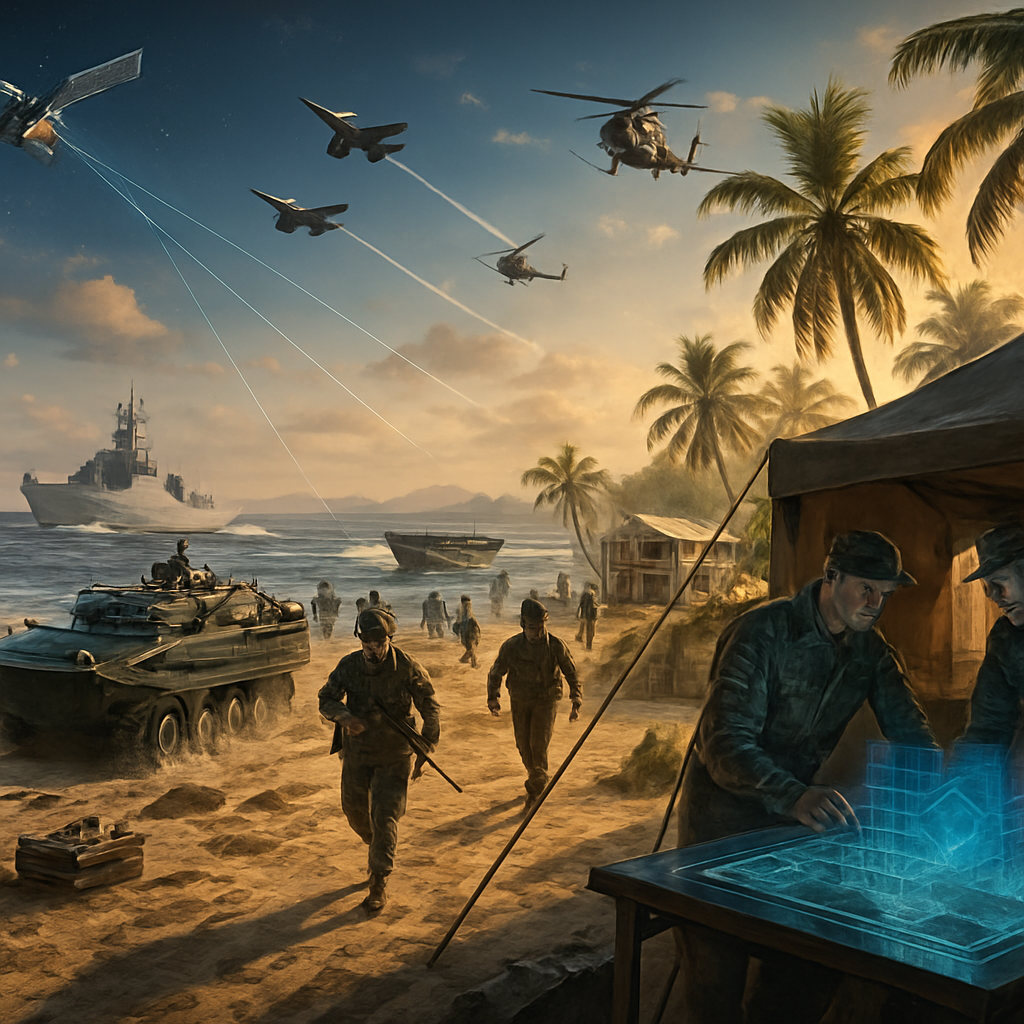
Thailand is gearing up to host the 45th annual Cobra Gold military exercise from February 24 to March 6, a large-scale multinational event that will bring together more than 8,000 personnel from 30 countries. Co-hosted by the Royal Thai Armed Forces and the United States Indo-Pacific Command (US INDOPACOM), Cobra Gold has grown into one of the region’s most important drills — part training ground, part diplomatic handshake, and part high-stakes logistical ballet.
Five domains, one big rehearsal
This year’s edition will emphasize integrated operations across five domains: land, sea, air, space, and cyber. That’s not military-speak for “we’re doing more stuff” — it’s a recognition that modern security challenges don’t respect old boundaries. Expect to see amphibious landings, maritime strike planning, air-defence drills, satellite and space coordination, and cyber-defence exercises running in parallel as units practice operating together in a complex battlespace.
Who’s playing
Seven countries are listed as core participants: Thailand, the United States, Singapore, Indonesia, Japan, South Korea, and Malaysia. New this year, China, India, and Australia will join the drills — a notable expansion that underlines the exercise’s growing diplomatic and security footprint in the Indo-Pacific. Cambodia is absent this year, though Vietnam and Laos will attend as observers.
Beyond core participants and observers, Cobra Gold also features two flexible participation streams. The Combined Observer Liaison Team (COLT) includes Brunei, Germany, Jordan, the Netherlands, Pakistan, Saudi Arabia, Sweden, and Timor-Leste alongside Vietnam and Laos. The Multinational Planning Augmentation Team (MPAT) will rotate in ten additional nations for selected activities: the United Kingdom, France, Italy, Canada, New Zealand, Bangladesh, Fiji, Mongolia, Nepal, and the Philippines.
What they’ll actually do
Training is structured around three main segments: command and control exercises (C2X), humanitarian civil assistance (HCA), and field training exercises (FTX). Each segment mixes technical skill-building with real-world scenarios meant to improve interoperability and response times.
Command and control (C2X)
C2X will simulate joint amphibious operations — think beach landings, rapid coordination between ships, aircraft and ground forces, and complex decision-making under pressure. One high-profile element is the beach landing at Rayong’s Haad Yao, where planners will rehearse synchronizing forces across space and cyber domains as effectively as they do on the sand.
Humanitarian civil assistance (HCA)
Not everything in Cobra Gold is about force projection. HCA efforts will see troops and engineers working with local communities to build multipurpose school buildings in five different areas. Teams will also conduct disaster relief simulations, from tabletop planning sessions to demonstration-based emergency response drills — practical training designed to save lives during floods, storms, or other humanitarian crises.
Field training exercises (FTX)
FTX is where the rubber meets the road: combined live-fire exercises (CALFEX), amphibious assaults (AMPHIBEX), maritime strike missions, long-range artillery drills (HIRAIN), integrated air-defence operations, drone countermeasure exercises, and civilian evacuation scenarios (NEO/RJNO). Specialized intelligence training will include signal interception (SIGINT) exercises to sharpen surveillance and communications capabilities.
Why Cobra Gold matters
Cobra Gold has long been more than a military rehearsal; it’s a platform for building trust, sharing best practices, and improving the sort of technical interoperability that matters when crises occur. Whether responding to natural disasters or coordinating combined defence operations, the exercise helps countries streamline communications, refine logistics, and strengthen diplomatic ties.
For Thailand, hosting the 45th Cobra Gold reinforces its role as a regional security hub. For many participating nations, the value lies in meeting partners face-to-face, practicing joint procedures, and building the relationships that make complex operations possible when they’re needed most.
A growing tradition
Last year’s Cobra Gold, held from February 25 to March 7, included around 3,200 US personnel and almost 30 other nations, illustrating steady participation year over year. The 45th iteration continues that trajectory — larger, more diverse, and more domain-integrated than ever.
Whether you’re tracking geopolitical shifts, interested in disaster readiness, or simply curious about how navies, air forces, and armies learn to work together, Cobra Gold 2026 promises a compelling mix of complex exercises, humanitarian projects, and high-level cooperation across the Indo-Pacific.














Hosting Cobra Gold 45 feels like Thailand walking a tightrope — welcoming China and India alongside the US changes the game. This isn’t just training anymore; it’s diplomacy in combat boots.
China’s presence smells like a PR play to me: include Beijing to neutralize criticism while still letting the US lead. I doubt it will reduce tensions; it might just legitimize competing influence.
Exactly — these drills always come with smiles and ribbon-cuttings, but who’s checking long-term strategic strings? Aid and exercises are subtle levers of power.
I hear you, but interoperability does matter for real disasters and evacuations; learning to work together can save lives even if geopolitics complicates it. We have to keep pressure for transparency while practicing the basics.
With the US co-hosting and now China participating, isn’t that a recipe for awkward standoffs? Feels like an arena where everyone postures rather than actually cooperating.
I disagree — bringing China and India into the fold could reduce fog and miscalculation. More faces at the table mean more chance to build common procedures and de-escalate incidents.
India’s entry reflects a nuanced strategic calculus: New Delhi seeks operational experience and diplomatic flexibility without becoming tethered to any single bloc. Cobra Gold offers practical interoperability while preserving India’s policy of strategic autonomy.
But won’t that autonomy be undermined if India starts aligning logistics and doctrine with US-led exercises? There’s a difference between attending and harmonizing command structures.
We shouldn’t forget the HCA projects — building schools and disaster drills are tangible benefits for locals, even if military motives are mixed.
Including space and cyber as full domains is overdue, and it changes training complexity in meaningful ways. Modern operations can’t ignore satellite links or network defense.
Cool they will practice cyber stuff, hope no hackers break things.
Tammy, good point — most cyber exercises are defensive simulations, but they also expose vulnerabilities that need real investment to fix.
Putting ‘build schools’ in the PR line is classic: humanitarian veneer for expanding influence. Who pays and who controls construction is the real question.
Often it’s a mix of funding from participant militaries and host-nation budgets; accept the aid but negotiate oversight and maintenance clauses. Local communities deserve durable benefits, not short-term photo-ops.
Sure, but local governance rarely gets the leverage to enforce those clauses against big donors.
Scholarship on military diplomacy shows a pattern: humanitarian programs improve soft power but can complicate sovereignty and local politics. The legal framework around combined exercises often lacks enforceable long-term maintenance commitments.
So it’s influence under the guise of goodwill — exactly what I suspected.
Thailand benefits economically and strategically from hosting, but each handshake with a superpower increases the chance of getting dragged into someone else’s conflict. That’s a real national security cost.
Live-fire and amphibious drills near civilian areas are a safety concern; accidents happen even with protocols. Local evacuation plans must be public and practiced.
Safety is central to planning and we coordinate with local authorities before any live events. Still, transparency about schedules and exclusion zones should be improved so residents aren’t surprised.
Protocols are fine on paper but enforcement varies; independent observers should monitor environmental and safety impacts in real time.
India’s participation signals pragmatic engagement rather than formal alliance-building. It lets New Delhi shape regional norms without signing treaties.
Does India actually have the joint command experience necessary for these integrated five-domain drills? Past exercises suggest gaps in interoperability persist.
India has modernized rapidly and has been participating in several multilateral drills; gaps remain but exercises are exactly where those get ironed out.
Will there be cool jets and boats? I like watching big explosions in movies.
I worry about normalizing the militarization of space through exercises that train for space coordination in conflict scenarios. Once practices solidify, reversing them is hard.
Space is inherently dual-use; satellite coordination is needed for disaster response, but doctrine often blurs into offensive signaling. International law hasn’t caught up, so confidence-building measures are crucial.
So we need transparency and legally binding norms before these habits harden.
China joining could be a genuine confidence-building move that defangs regional rivalries; engagement beats isolation. If Beijing participates meaningfully, that’s a net positive.
Or it’s a way for China to co-opt regional security mechanisms while still pursuing coercive policies elsewhere. Participation doesn’t equal goodwill.
Fair — it’s a nuanced outcome, and we should judge by concrete actions rather than attendance alone.
Observing nations like Vietnam and Laos taking part shows ASEAN’s soft cohesion; even observation is diplomacy. It keeps lines of communication open.