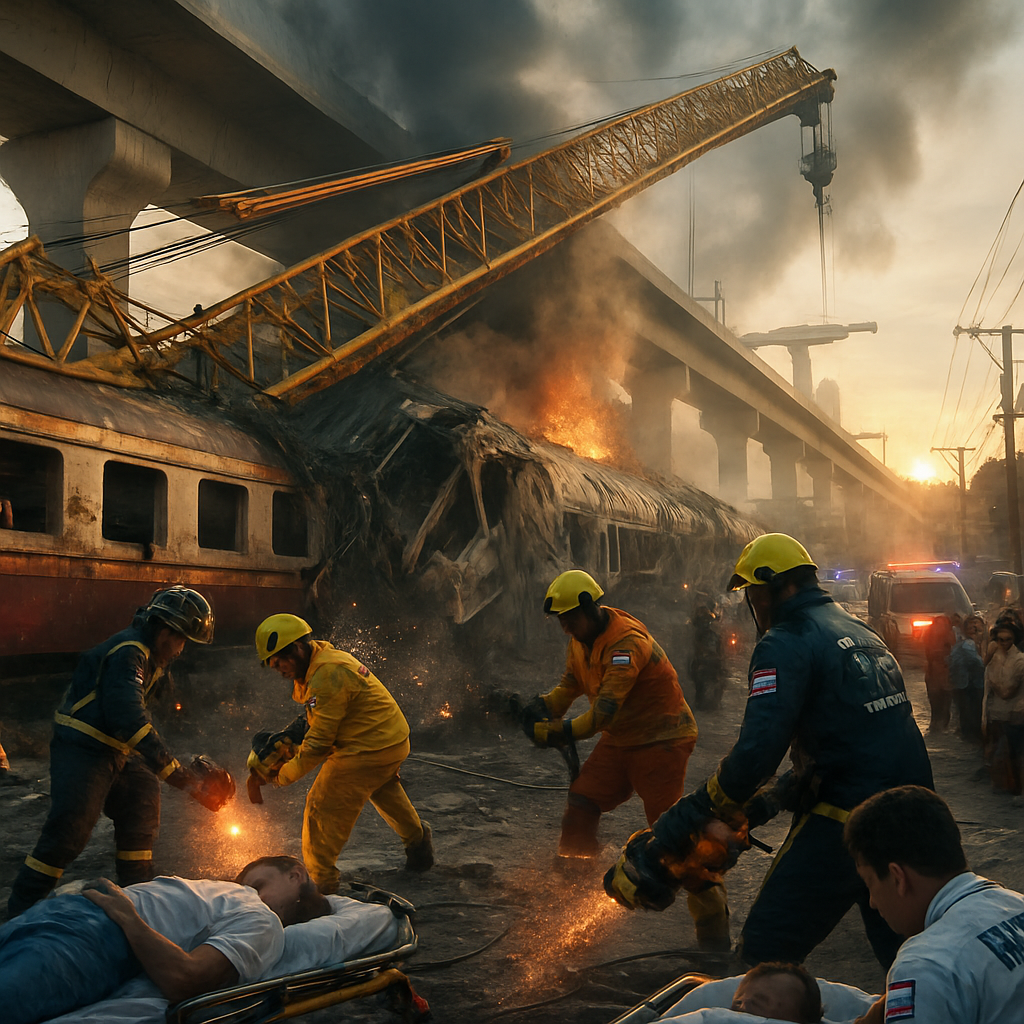
On the morning of January 14, a routine commute turned tragic in Nakhon Ratchasima when an elevated-construction crane collapsed onto Train No. 21, leaving at least four people dead and more than 20 injured — some reports suggest the wounded could top 30. The collapse happened at about 9:00 a.m. near the Baan Thanon Kot community in Sikhiu district, directly beneath works for the Bangkok–Nong Khai High-Speed Railway. What should have been a typical weekday journey became a chaotic rescue scene and a stark reminder of the risks that shadow large infrastructure projects.
Train No. 21, operating the Bangkok–Ubon Ratchathani route, had just departed Nong Nam Khun station when the construction crane gave way and plunged onto carriages below. Witnesses described a loud crash followed almost immediately by a blaze. Firefighters and volunteer rescue teams were on the scene within minutes — foundations and groups including Hook 31, Phromtham Sikhiu, Sawangwicha Pak Chong, and Sung Noen coordinated with local fire crews to bring the flames under control and extract people trapped in the wreckage.
Rescuers used metal-cutting equipment to pry open crushed sections of the coaches and free passengers who had been pinned inside. Images shared by Fire & Rescue Thailand circulated widely online, showing scorched carriages and the desperate, tireless efforts of first responders. Most of the passengers were students and local workers travelling from Pak Chong district to their jobs elsewhere — ordinary people whose morning routines were suddenly upended by a catastrophic failure at a building site overhead.
Authorities confirmed that four passengers were pronounced dead at the scene, while more than 20 suffered injuries of varying severity. Official counts were still being verified at the time of reporting, and several media outlets cautioned that the number of injured could ultimately be higher than initial tallies. Families of passengers, local leaders and commuters watched anxiously as medical teams treated the wounded and investigators began piecing together how a towering crane came down onto an active passenger service.
Beyond the immediate human toll, the incident has cast a shadow over Thailand’s high-speed rail ambitions. The Bangkok–Nong Khai High-Speed Railway is a flagship infrastructure project intended to strengthen transport and economic links between Thailand and China via Laos, and to plug into the larger Kunming–Singapore rail corridor. The line will deploy CRRC CR300AF (Fuxing) trains — technology capable of 300 km/h — though operational speeds within Thailand are expected to cap around 250 km/h for safety and local conditions.
The current construction phase — the first of two — spans roughly 250 to 253 kilometres and will feature six major stations: Krung Thep Aphiwat Central Terminal, Don Mueang, Ayutthaya, Saraburi, Pak Chong and Nakhon Ratchasima. That first phase is scheduled to begin operations in 2028, with phase two extending the line from Nakhon Ratchasima through Khon Kaen, Udon Thani and Nong Khai before continuing into Laos, projected to open by 2030. For communities along the route, this connectivity promises economic development, faster travel and new opportunities — but the Nakhon Ratchasima accident underscores the safety trade-offs and logistical challenges of building at scale.
Investigations into the collapse are ongoing, and early questions center on construction safety protocols, crane maintenance and whether proper exclusion zones were in place beneath heavy lifting operations. With passengers traveling directly under an elevated worksite, many are asking whether adequate measures were taken to protect trains and commuters. Authorities will need to examine not only technical failures but also project management decisions that allowed equipment to operate above an active rail corridor.
For affected families and the community of Sikhiu, the immediate priority is recovery: accounting for all passengers, providing medical care to the injured, and supporting those who lost loved ones. For project leaders and government officials, the incident should prompt a hard look at construction oversight, safety culture and the balance between speed of delivery and the human cost of mistakes. Ambitious infrastructure can transform a region — but only if safety is built in, not bolted on as an afterthought.
As rescue teams cleared the scene and investigators began documenting the wreckage, the story in Nakhon Ratchasima became a sober chapter in Thailand’s broader modernization drive. The high-speed railway still carries the promise of faster, greener travel and stronger regional ties; yet this morning’s tragedy serves as a painful reminder that progress must go hand-in-hand with rigorous safety standards and transparent accountability.
Officials have pledged full inquiries and updates as more information emerges. In the meantime, the community, first responders and thousands of commuters will be left grappling with the consequences of a single collapse that changed many lives in an instant.














This is horrible — people commuting to work shouldn’t be under falling cranes. The project managers and contractors need to explain how a crane could collapse above an active train line. I want swift resignations and real safety audits, not just promises.
Resignations are symbolic but not enough, Somchai; the investigation must include independent engineers and the construction firm’s safety logs. There are patterns in fast-track projects where speed is prioritized over checks.
Agreed, independent oversight is key and families deserve transparent findings and compensation.
Independent reports are often delayed or buried, been watching this for years on road projects around here. The poor get the worst of it.
From an engineering standpoint, crane collapse over active corridors suggests critical failure in either rigging, foundation, or wind assessments. We must see load charts, maintenance logs, and the certified capacity of the crane used. If exclusion zones were absent, that’s a procedural failure at multiple levels.
This incident raises systemic questions about how mega-projects are governed, especially when multinational partnerships and political timelines push for speed. Engineering capacity is important, but institutional checks and community voices must be part of the process.
Community voices are often sidelined, true. People living near projects rarely get a say until disasters happen.
My heart goes out to the victims and their families, but I’m worried this will be politicized to block progress. We need safer construction, yes, but also completion of infrastructure for economic benefits.
Progress shouldn’t be an excuse for cutting corners, Ravi. You can’t measure development in lives lost.
I didn’t mean that at all — I just worry reactions will halt funding and delay benefits to regions who need them. But accountability must be strict and transparent.
My nephew was on that train and I’m terrified; why were trains allowed to run under active lifting? Someone must have approved that. I demand answers and immediate relief for families.
I’m sorry, Somsri, that is awful news and such approvals often come from project managers under pressure. In many places there are permits for ‘rolling’ work, but they must enforce exclusion during lifts.
Thank you, Chai, but a permit doesn’t help my family now. I want prosecutions if negligence is proven.
First responders did hero work, but the focus must shift to long-term care for the injured and compensation schemes. The state and contractors owe the victims ongoing support, not just one-time payments.
As someone who works in safety oversight, I can say claims for compensation are complex but necessary; the line between criminal negligence and accident will be scrutinized. We’ll push for victim assistance funds immediately.
Please make sure families know where to apply and get legal help, Inspector.
Why is there always a crane near a public transport route? This could have been avoided with simple scheduling and blocking of trains during risky lifts.
Simple in theory, Larry, but contractors often schedule work at peak times to meet targets and save money. The invisible savings cost lives.
We should also examine the supply chain: were parts or operators sourced from firms with poor safety records? Cross-border procurement can complicate accountability. A forensic engineering team is essential to avoid politicized narratives.
Forensic teams must be genuinely independent and publish their data; secrecy breeds conspiracy theories and erodes trust in institutions.
I take trains every day; this shakes my confidence in public transport safety. How will commuters be protected going forward? Transparency will be key.
Commuter protections usually arrive as new rules, but enforcement is the weak link. People get outraged, rules get stricter on paper, and then nothing changes on the ground.
That’s exactly my fear — I want to see inspectors on-site and public updates, not just closed-door investigations.
I read reports saying most passengers were students and workers; it’s devastating because these are not VIPs, just ordinary lives. Compensation and long-term trauma support should be a priority.
Preliminary scene work suggests an equipment failure, but we must avoid speculation until lab tests are done. The forensic team is collecting samples as we speak.
That’s good to hear, but please ensure custody chains for evidence are airtight — any contamination could derail accountability. Families deserve an impartial technical record.
I trust the police but past investigations have been slow and opaque; make the timeline public, otherwise trust will erode.
We cannot let mega-project nationalism silence concerns; converging interests can create incentives to hide problems. Independent audits and civil society oversight are non-negotiable.
Civil society groups need resources to monitor projects, not just moral appeals. Empower local watchdogs with funding and legal access.
Suspicion of corruption will rise now, and rightly so; whenever huge budgets are involved, corner-cutting follows. I want to see contract clauses that guarantee safety audits before any work over active lines.
Contracts can include those clauses, but enforcement and penalties must bite. If penalties are toothless, the same cycle repeats.
So many people praised the idea of high-speed rail, but did anyone think about how it would be built safely? Ambition without capacity is dangerous.
Ambition gets headlines, but day-to-day safety needs boots on the ground and worker training. Skip that and disasters happen.
As a teacher, we worry for students who commute by train; schools need clear communication and support plans for affected pupils. Trauma counseling should be immediately available on campus.
I feel scared to take the train now and I don’t know who to talk to at school. Please tell us what’s happening, adults.
The report will hinge on whether the crane had been certified for the lift conditions and whether the ground bearing was adequate. Often the surface looks solid but there are hidden subsurface issues for large cranes.
Exactly — soil bearing, unexpected load transfers, or improper outriggers deployment can cause toppling. Photographs of the foundation and crane setup will be informative.
I’ll be watching for photos and technical sheets; it’s a small victory if the forensic report is public and technical so we can learn.
This will become a legal minefield. Are contractors insured enough? Who signs off on the safety of the work zone?