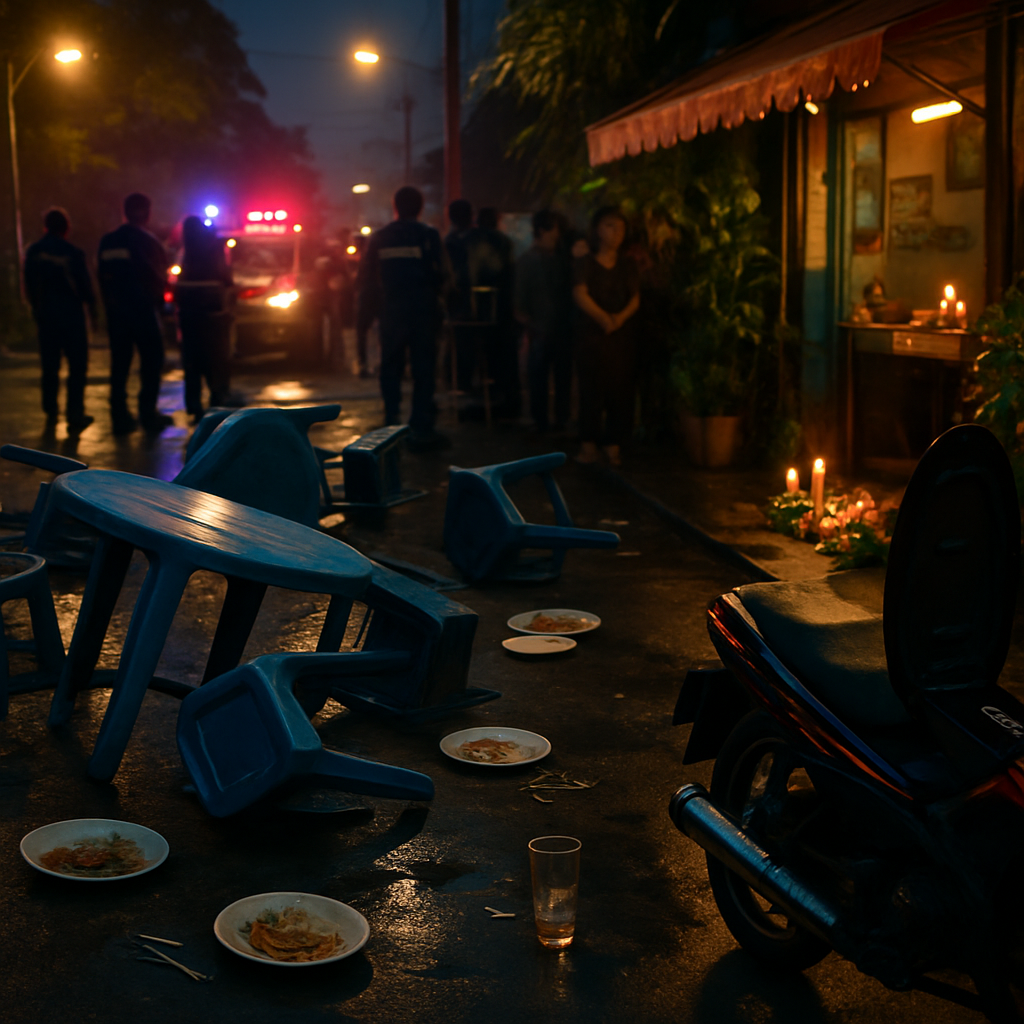
What began as a petty quarrel over a missing scoop of ice ended in a tragedy that no one at the little roadside restaurant in Thailand will soon forget. In the pre-dawn hours of January 4, a drunken customer’s fury boiled over into violence: a waiter was fatally stabbed and a young woman who tried to intervene was left fighting for her life.
Police and rescuers from the Ruam Katanyu Foundation were called to the scene at about 4:30 a.m., finding chaos in the aftermath. Tables had been overturned outside the shop, cutlery and chairs scattered, and three people critically injured — two men and a woman. One man, the waiter identified only as Don, had suffered deep stab wounds to his chest and abdomen. He was rushed to hospital but later succumbed to his injuries.
The woman, a 29-year-old known by the nickname Nong Nam, was stabbed once in the abdomen as she attempted to pull the attacker away. She remains in critical condition in hospital. A third man, believed by witnesses to be the assailant, was found with facial swelling and bruises after restaurant staff and bystanders restrained him.
How a missing cube of ice sparked a deadly fight
According to witness accounts passed to local news outlet KhaoSod, the suspect had been drinking at the restaurant until around midnight. When staff began closing for the night, they stayed inside to watch a football match while clearing tables. At some point the man noticed ice was missing from his drink and became incensed.
Witnesses say he tried to help himself to ice from his girlfriend’s table before leaving the premises in a huff. But the story did not end there: the man returned, still angry, and confronted Don about the missing ice. The argument escalated quickly. The suspect reportedly went to his motorcycle, retrieved a pocket knife stashed under the seat, and returned to stab the waiter. Don collapsed at the scene.
The woman, Nong Nam, rushed in to stop the attack and was struck down as well. Bystanders and staff subdued the attacker, leaving him bruised and bloodied. Police later recovered four knives from the suspect, including what they believe was the fatal weapon — a short pocket knife about 15 centimetres long.
Police response and next steps
Pol Lt Col Thalingkiat Maneeinth, deputy superintendent of crime prevention and suppression, confirmed that the restaurant was closing at the time and was operating within permitted hours. He said the suspect had left the premises before returning to commit the attack. The man remains under police guard at hospital and will be formally questioned once medical staff deem him fit to speak.
Investigators are piecing together statements from staff and patrons, cataloguing physical evidence — the overturned furniture and the knives — and working to determine whether alcohol, a heated argument, or other factors most directly contributed to the fatal outcome.
Community shock and a wider caution
News of the stabbing has rippled through the local community and across national news feeds. It is a grim reminder of how quickly ordinary nights can turn violent and of the unpredictable consequences of alcohol-fueled confrontations. Friends and colleagues of the victims are left grieving, while restaurant staff and diners who witnessed the scene will carry the event with them for a long time.
Local crime-prevention officials stress the importance of de-escalation and staff safety training in hospitality environments where late hours and alcohol are common. Simple policies — such as limiting drink service as closing time approaches, ensuring trained staff are on hand to defuse disputes, and securing sharp objects — can make a difference. Of course, those measures cannot undo what happened to Don and Nong Nam, but they may help prevent similar tragedies.
Authorities say the investigation is ongoing. The suspect will face questioning once medically cleared, and prosecutors will determine charges based on the evidence and witness statements. For now, a community mourns a life lost over something as small and ordinary as missing ice, and raises uncomfortable questions about how small sparks of anger can ignite into catastrophic violence.
Further updates are expected as police complete their inquiries and hospital staff report on the condition of the injured woman. Local and national outlets, including KhaoSod, continue to follow the story.


















This is devastating — a life taken over a scoop of ice is almost incomprehensible. It shows how alcohol and pride can turn tiny provocations into deadly outcomes. The community needs to demand better safety at late-night eateries.
I agree it’s senseless, but people keep making bad choices when drunk and we keep forgiving them. Where is personal responsibility in all this? The attacker should face the full force of the law.
Sounds like another example of public disorder being swept under the rug until bodies pile up. If permits and late hours are allowed without real supervision this will repeat. Restaurants need rules and better enforcement.
This is tragic, but calling for harsher law enforcement alone won’t fix the drinking culture. Prevention and education matter too, not just punishment.
Thanks for replying, Joe — I meant both enforcement and prevention. Staff training, visible security at night, and community awareness could lower risks without turning every incident into a political crusade.
Alcohol-fueled violence is a predictable public health issue and should be treated like one by policymakers. Limitations on service close to closing time, plus mandatory de-escalation training, are evidence-based measures. We should push for measured interventions rather than moralizing from the sidelines.
No, enough with soft measures — someone who kills in a bar deserves maximum punishment. Soft interventions are just excuses for leniency that encourage repeat offenders.
As a criminologist I agree with Aisha that multi-layered approaches work best: environmental design, staff training, and targeted enforcement. Harsher sentences alone have mixed deterrent effects and can strain justice systems without preventing the next impulsive act.
The casualness here is disgusting, people die over an ice cube. I support the toughest legal response possible to deter others. Sometimes severe punishment is the only language that stops violence.
I get wanting justice, but revenge rhetoric risks escalating tensions. We need transparent trials and consistent sentences, not angry calls for spectacle justice.
Maybe if waiters and staff stood up for themselves more, these things wouldn’t happen. There’s a responsibility on workers too, not just customers.
Restaurants must make staff safety a priority, especially during late hours with alcohol involved. Simple steps like training, securing knives, and staff rotations can reduce confrontations. Employers should invest rather than blame fate.
But who pays for that training in tiny roadside shops? Most of these places barely break even and will just cut corners until tragedy forces change.
This feels like a systemic failure: failing public safety, weak enforcement, and cultural tolerance for drunken aggression. You can’t just tell people to be nicer when booze is involved. Change has to come from policy and community norms.
As a local, I can tell you community pressure does work sometimes; when neighbors organize, owners listen. But it’s slow and reactive after someone dies, which is the tragedy.
Blaming culture is slippery. People everywhere get drunk and fight; this isn’t unique to one place. We need universal solutions that work across contexts.
Two points from research: first, alcohol increases impulsive aggression through disinhibition, and second, environmental cues at venues (lighting, layout, staff behavior) modulate escalation. Policy interventions combining environmental, service, and legal measures show the most promise. Knee-jerk punitive reactions often ignore the complexity of prevention.
Your theory is fine for journals, but when someone is dead people want justice now. Prevention is nice for the future, but what about accountability today?
Both are necessary — hold the attacker to account while also implementing prevention. It’s not an either/or situation, and pretending it is helps no one.
Sometimes I wonder if modern society coddles poor impulse control. Back in the day agressive behavior had immediate social costs. Now people get hospital visits and apologetic articles.
That’s a cold take when a person died. Don wasn’t ‘coddled’ and he was just doing his job. We should center the victim, not nostalgia for harsh social orders.
My heart goes out to the victims and their families. This is just heartbreaking and feels so avoidable.
Police will investigate and then often it fizzles into bureaucratic limbo unless there’s public pressure. Corruption or indifference can let poor prosecutions slide. Keep the cameras and people watching.
Police can be slow but in many local cases public attention speeds things up. If the community demands transparency we might see better follow-through.
Conspiracies aside, sometimes hospitals and police are overwhelmed and it’s not malice, just resource limits. That doesn’t excuse poor outcomes but explains delays.
We have to avoid demonizing entire groups or places because of one tragedy. This is a horrible incident, yes, but it shouldn’t become a platform for xenophobia or sensationalism.
I never suggested demonizing people, just that violent acts need firm consequences. Protecting society isn’t xenophobia.
Imagine arguing over ice and ending a life; it feels surreal and grotesque. How do we make humans less trigger-happy in public spaces? That’s the big question.
I knew Don — he was quiet, hardworking, and always smiled. It’s unbearable that such a small thing led to this. Please don’t reduce his life to a headline about ‘ice’.
Thank you for saying that, Kanya. Naming him and remembering the person matters more than outrage headlines; we should honor his memory by pushing for real protections.
There should be mandatory cut-off times for alcohol and trained security around closing time, especially where football matches keep patrons riled up. It’s a predictable risk and must be managed.
That kind of targeted regulation — limiting last-call service and ensuring trained staff during events — aligns with evidence from urban safety studies. It’s pragmatic and politically feasible.
Why did the attacker even have four knives? That suggests premeditation or at least recklessness beyond a simple drunk mistake. He should be charged accordingly.
I’m skeptical of quick judgments — witnesses can be unreliable in chaotic scenes. Let investigations do their work before we call for extreme measures.
This is an argument for making small businesses safer with affordable training subsidies. If governments provided grants for safety workshops, places like this could implement protocols without breaking the bank.
Victim-blaming comments are gross. This is on the attacker, full stop. Dialogue about prevention is fine, but let’s not shift sympathy away from the family who lost someone.
Cultural change takes generations, but legal frameworks can accelerate it. Tough, consistent consequences for violent acts paired with visible prevention measures send a clear message.
I worry about the injured woman too; she intervened to help and was gravely hurt. Where is the support for bystanders who step in to stop violence? They need protection and care.
If the attacker was basing rage on ‘missing ice’ that sounds like an excuse masking deeper issues like jealousy, substance abuse, or control problems. We need to address underlying social harms, not just the surface claim.
The mention of a football match is telling — sports can heighten emotions and act as a trigger when alcohol is present. Venue managers should anticipate that and plan accordingly.
Every time I read something like this I think of knife control and whether easy access to blades makes these tragedies more likely. It’s a hard balance with daily utility items, but something to consider.
Community memorials and public conversations can channel grief into action. Hold vigils, demand safety audits, and press prosecutors — that combination honors victims and helps prevent repeats.
Sad and enraging in equal measure. People keep saying ‘small spark’ but the spark met a dry forest of social acceptance for drunken aggression. We must change both the spark and the forest.