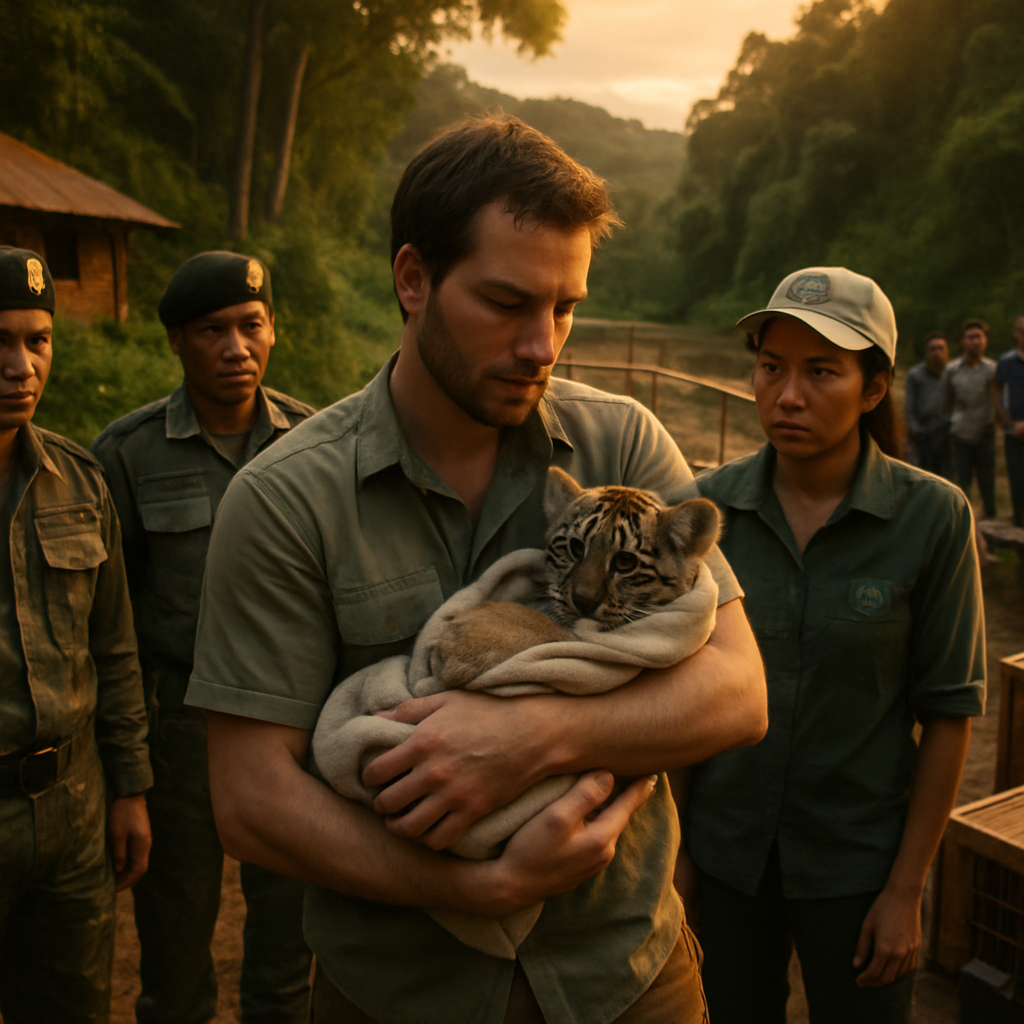
In a story that reads like a cross-border thriller — complete with a rescued tiger, a murky handover at the frontier, and a social-media exposé from a retired park official — the founder of Wildlife Friends Foundation Thailand (WFFT) has pushed back strongly against allegations of animal trafficking. The drama unfolded after the Karen National Liberation Army (KNU) handed a tiger to WFFT personnel in Sangkhla Buri district, Kanchanaburi, on Wednesday, December 17.
Retired national park official Chaiwat Limlikit-aksorn set the scene on his Facebook page on December 18, alleging that Thai officials and a foreign-led animal rescue centre were involved in an illegal transfer of the tiger from Myanmar into Thailand. Chaiwat specifically identified a foreigner who, he said, was standing with Department of National Parks, Wildlife and Plant Conservation (DNP) officers at the handover. That foreigner has now been confirmed: Edwin Wiek, the Dutch founder of WFFT based in Phetchaburi.
Wiek does not dispute being present — but he emphatically denies any wrongdoing. According to his account, he and his WFFT team were contacted by KNU personnel on December 16, who said they had found a tiger cub that urgently needed help. The next morning, KNU brought the animal to a point very near the Thai-Myanmar border and asked WFFT to examine it.
“We were told the cub could not be cared for by those who seized it, and they asked for our assistance,” Wiek said in his clarification. He explained that, because the original handover site was dangerously close to the border and complicated by legal questions about cross-border movement of wildlife, he requested the animal be moved to nearby army premises for safety and proper handling. At that location, WFFT staff examined the tiger and reported it to be in good health.
The backstory reported by the KNU adds further colour: the armed group claims the tiger had been seized during a raid on a call-centre scam base in Myanmar. Disturbingly, the KNU also alleges there had been a second tiger at the site that scam gang members consumed before the raid. Unable to care for the surviving animal, the KNU says they reached out to WFFT for professional help.
Wiek has been careful to underline his awareness of Thai law. He says he instructed his team not to cross the border — no official permission to bring wildlife into Thailand was granted — and that when KNU personnel could not provide legal documentation for the tiger, WFFT contacted DNP officers so the matter could be handled through official channels.
Despite Wiek’s version of events and his insistence that neither he nor his organisation violated Thai law, media reports say the DNP filed a formal complaint with Sangkhla Buri Police Station. Channel 7 reported details including the tiger’s profile: a female around four years old, approximately 29 kilograms. The animal has since been transferred to the Wildlife Forensic Science Centre, where DNA testing will determine species and origin — an important step in sorting fact from rumour.
The incident highlights how messy and legally fraught wildlife rescues can be when they brush up against conflict zones and cross-border operations. A rescue that begins with good intentions — to save a distressed animal — can quickly become entangled in questions of jurisdiction, documentation, and national law. That’s especially true in border regions where multiple actors operate: local officials, armed groups, non-governmental organisations, and law enforcement.
For Wiek and WFFT, the stakes are both reputational and legal. Charities and rescue organisations rely on public trust to operate effectively, and allegations of trafficking can be devastating even if later disproven. For the authorities, the priority is enforcing wildlife protection laws and ensuring any transboundary movement of protected species follows strict procedures to prevent illegal trade.
As the investigation progresses — with DNA tests and official inquiries underway — key questions remain: Was the tiger smuggled across the border, or was it handed over on Thai soil? Did WFFT follow appropriate protocols once the animal was in their care? And crucially, what is the provenance of the tiger: wild-caught, captive-bred, or trafficked? The answers will determine whether this episode is a rescue gone awry or evidence of criminal activity.
For now, Wiek stands by his account: the WFFT inspected the animal at a secure location, sought formal involvement from the DNP, and did not engage in any illegal transfer. The DNP’s complaint and the pending DNA results will be pivotal in clarifying the full story. Either way, the incident has thrust the complexities of wildlife rescue and cross-border enforcement into the spotlight — and reminded everyone that when big cats and human controversies meet at the frontier, the claws of public scrutiny are sharp.


















This smells like trafficking to me — foreign NGO shows up at a border and suddenly a tiger appears. You don’t just casually accept endangered animals without full paperwork. Wiek should be investigated until there’s absolute clarity.
Jumping to ‘trafficking’ ignores the mess on the ground: conflict zone, armed group handing over the cub, and a charity trying to save an animal. Law matters, but so does urgent animal welfare when a cub is in danger.
I get the welfare angle, Larry, but charities have been used as covers before. If WFFT broke protocols it sets a bad precedent, even if intentions were good.
Also how did the cub even end up at a call-centre? The whole story has weird layers — smuggling, scams, and now a rescue. Not convinced by the clean narrative yet.
I work with rescues and I believe WFFT probably acted correctly trying to get the cub to safety. In conflict zones you sometimes have to prioritise life over paperwork, then sort documentation later. Demonizing people who rescue animals usually makes things worse.
Exactly. If they stayed put and the cub died, the headline would be ‘NGO lets tiger die’. They called authorities and handed it over to DNP — that looks responsible to me.
Respectfully, emergency rescue does not negate legal obligations. There must be transparent records of chain-of-custody and immediate reporting to proper agencies, especially with cross-border issues.
Fair point. I hope WFFT publishes all their logs and communications with KNU and DNP so this is clear.
Border handovers are never clean. Armed groups, local politics, and bad documentation create loopholes exploited by traffickers. DNA testing is the only sane next step here.
But DNA only tells species and maybe origin, it won’t prove whether WFFT broke the law at the handover. You still need verified timestamps and witness statements.
True, Nok. That’s why transparent paperwork and police reports are essential. If those are absent, suspicion is legitimate.
Honestly, I distrust both NGOs and corrupt officials. This reads like everyone covering their own backside while the animal becomes a political pawn.
From an international law perspective, the key legal question is where the transfer occurred and whether Thai jurisdiction was invoked appropriately. Cross-border wildlife movement requires permits and inter-state communication, not informal handovers. The DNP complaint is a typical procedural response pending forensic results.
That’s dry but accurate. Still, we must balance statutory requirements with the ethical imperative to save a suffering animal in a conflict zone. Laws are not designed for every messy reality.
Ethics and law intersect, but ignoring legal process can enable criminal networks. Better to document emergency exceptions formally and quickly.
My heart hurts for the tiger — whoever saved her deserves credit if they genuinely helped. But if they broke the law, animals and conservation lose credibility. This is why transparency matters.
Simple: post the photos, timestamps, and the contact details of the soldiers and KNU who handed it over. If WFFT shares everything, the public can judge.
Yes — full transparency would calm many. I hope WFFT and the DNP release a full timeline soon.
The call-centre angle creeps me out. If criminals were eating tigers, that’s horror-level cruelty, and it points to deeper trafficking and organized crime. We should investigate the criminal ring thoroughly.
Most likely sensationalised by social media to get clicks. Don’t forget how often wild stories balloon online before facts come out.
Maybe, but even if part is exaggerated, the presence of a tiger at a scam den is too odd to ignore. I want full vet and police reports.
Anyone suggesting the KNU would simply hand an animal to foreigners without diplomatic steps is naive. These regions have their own rules; outsiders must be careful.
WFFT has rescued many animals transparently — let’s not crucify them on suspicion alone. The DNP complaint might just be protocol, not proof of wrongdoing.
Protocol or not, public trust in rescue NGOs is fragile. Even a procedural misstep damages reputation and fundraising, so they should cooperate fully with investigators.
Agreed. They should proactively release their logs and communications with the KNU and DNP to avoid speculation.
We need scientific safeguards: immediate quarantine, disease screening, and proper chain-of-custody for DNA samples. Conservation depends on both biology and bureaucracy working together.
Quarantine protocols are crucial, especially with cross-border pathogens. I hope the centre handling the tiger follows strict biosafety measures.
Right — pathogens don’t respect borders. Public health must be part of the investigation too.
I called it earlier here — too many coincidences. The DNP filing a complaint suggests officials are not buying the simple rescue story. Something smells off.
Or the DNP is just covering procedural bases because a retired official made the allegation public. Reactionary filings aren’t rare when reputations are at stake.
True, but I still want to see the timestamps and the soldiers’ statements. Without them it’s just he-said-she-said.
I’m more worried about the geopolitical angle — KNU handing over to an NGO could be politically motivated. Maybe they wanted international attention or leverage, not just animal welfare.
Exactly. Armed groups sometimes use symbolic gestures to curry favour or create narratives. The context matters as much as the act itself.
If so, this whole incident could be a staged PR moment that backfires and implicates NGOs unfairly.
Media will milk this for drama either way. People should withhold judgment until the DNA and official statements are out. Remember, accusations can ruin careers even if later disproven.
That’s naive. The public already made up their minds days ago. The real question is whether the institutions will act transparently to restore trust.
Transparency is the only remedy at this point. Quick, clear disclosure of facts will limit damage.
As someone who grew up near borders, I can tell you paperwork is often a luxury there. Saving a life sometimes means bending rules a bit, but that should never become habit or cover for crime.
That’s a wise balance. Compassion without accountability leads to trouble, but rigid bureaucracy can be lethal in emergencies.
Exactly. I hope this becomes a learning moment: better emergency protocols at borders, not witch hunts.