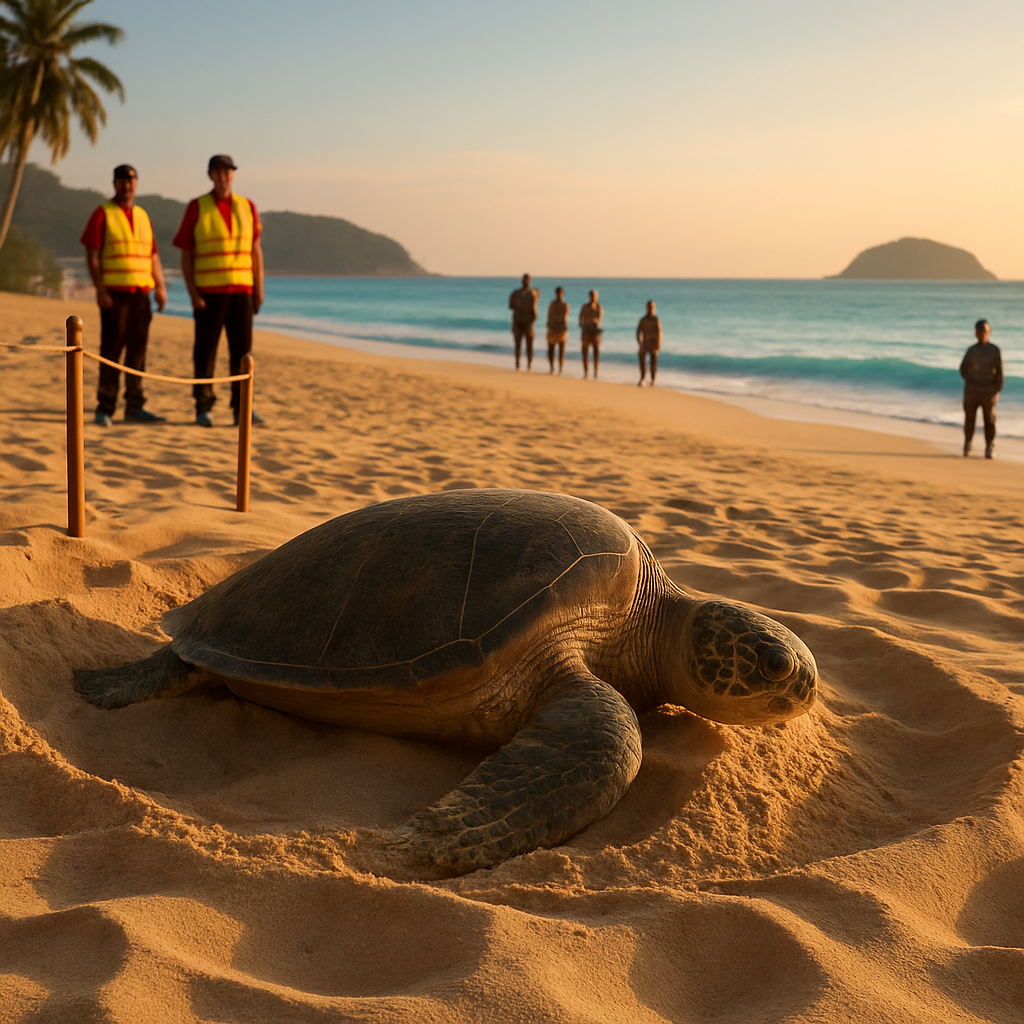
On the sleepy morning of January 3, 2026, Karon Beach in Phuket played host to a small miracle. At about 11:00 a.m., an adult female green sea turtle hauled herself up from the Andaman Sea, found a soft, quiet patch of sand, and began the ancient business of making new life. The scene—part natural drama, part seaside sermon—drew Thai and foreign holidaymakers who had come to celebrate the New Year and paused, respectfully, to watch one of the ocean’s most patient survivors go about her work.
There was no trumpet fanfare, just the hush of waves and the soft shuffling of flippers. Witnesses said the turtle lingered onshore for an extended period, carefully digging her nest, laying a large clutch of eggs, and then using her rear flippers like a pair of careful gardeners to sweep and compact sand over the nest. Once satisfied, she turned and made the slow, earnest pilgrimage back to the water, leaving behind a buried promise of dozens of tiny lives that may one day sprint toward the sea.
Quick action from lifeguards and local authorities
As soon as the turtle returned to the ocean, lifeguards stationed along Karon Beach moved into protective mode. Wooden stakes and rope were set up to cordon off the nest from curious passersby, beach chairs, and vehicles. Warning signs were readied to explain the cautionary perimeter—this is not just a patch of sand, it’s an incubator.
The lifeguard team then notified Karon Municipality, which coordinated with the Rare and Endangered Marine Animals Group at the Upper Andaman Marine and Coastal Resources Research Centre in Wichit, Muang district. Marine biologists are expected to assess the clutch, estimate egg numbers, and put a monitoring plan in place to maximize hatching success. Their toolkit will include regular nest checks, predator control measures, and community outreach to keep human disturbance to an absolute minimum.
Why this nesting matters
Green sea turtles are a protected species in Thailand, and a nesting event on a popular tourist beach like Karon is more than a curiosity—it’s an encouraging barometer of environmental health. For a female turtle to choose this stretch of sand suggests cleaner beaches, less coastal disturbance, and an ecosystem recovering pieces of its former balance. In short: the beach is once again a safe enough nursery for the species to invest its future here.
Officials note the incubation period for green sea turtles is usually around 50 to 60 days. That means, if everything goes well, Phuket could welcome a wave of hatchlings hurrying to the Andaman Sea late in the season—dozens of tiny flippers stamping a hopeful rhythm toward survival.
How locals and tourists can help
Conservationists are asking the public for patience and restraint. Simple actions make a huge difference: do not touch the nest, avoid using flashlights or bright lights near the area at night, keep pets away, and heed any temporary foot-traffic restrictions. Increased noise or foot traffic can disorient turtles and jeopardize hatchlings when they emerge. The lifeguards and municipal team will post clear instructions and enforce protective measures as the incubation window closes.
Beyond the immediate nest, experts say long-term support matters: backing local conservation programs, reducing single-use plastics, respecting nesting zones, and supporting sustainable coastal development all contribute to giving sea turtles a fighting chance.
A brighter trend for Phuket’s turtles
Phuket has seen a gradual uptick in sea turtle nesting in recent years, a trend credited to tighter coastal controls, stronger conservation programs, and growing public awareness. Each successful nest adds another ripple to that positive momentum. If the Karon clutch is protected and the hatchlings reach the sea, this event won’t just be a momentary headline—it will be another small win in a long, patient campaign to restore marine life along Thailand’s shores.
For those who watched the turtle on that January morning, the memory is likely to linger: the methodical digging, the soft pat of flippers, the slow retreat to the water. It’s a reminder that even in a busy tourist hub, nature keeps making space for its oldest rituals. With a little care from locals and visitors alike, the next chapter of that ritual—a run of tiny, shimmering hatchlings racing for the Andaman—might be written on the same sand this year.
Local authorities and marine experts will continue monitoring the site. In the meantime, anyone heading to Karon Beach is asked to respect the protected area and enjoy the chance to witness a rare and hopeful story of conservation unfold by the sea.


















What a beautiful moment — seeing a turtle nest on a busy tourist beach gives me real hope, but I worry people won’t follow the rules.
As a marine biologist, I can confirm that these incidents are indeed encouraging, but protection must be science-led: minimal interference, light management, and predator control are key.
Science-led sounds expensive. Maybe we should let market forces decide: charge tourists for photo ops and fund conservation with that cash.
Monetizing could help, but it also invites crowds and disrespect; conservation funded by tourism often backfires when profit trumps protection.
Eco-fees can work if tightly regulated and transparently applied to conservation, with strict visitor caps and education built in.
As a Phuket local I saw people quietly watch and then step away when ropes were placed. Respect from tourists is real sometimes.
Glad to hear locals are on board — local enforcement and pride make the biggest difference.
Why don’t they just move the eggs to a protected hatchery? Sounds safer than leaving them on a busy beach.
Relocation can harm eggs if not done properly. Native incubation conditions matter and moving should be a last resort.
I get that, but with dogs and beach parties, a controlled hatchery seems like a practical option to ensure more hatchlings survive.
Correct — hatcheries can be useful when nests are doomed in situ, but they change temperature-dependent sex ratios and may reduce natural selection pressures.
Also, hatcheries can strip local communities of a connection to the animals; letting nature take its course when possible helps maintain ecosystems.
Turtles are so cute! I hope baby turtles don’t get lost because of lights.
You’re right — bright lights confuse hatchlings and lead them away from the sea, so they need darkness to find the ocean.
I told my family to turn off flashlights if we go to the beach. They listened!
I’m proud but conflicted: tourism pays our bills, yet we must restrict parts of the beach. Authorities need clear plans so locals aren’t hit financially.
As a tourist, I support closures for wildlife, but it would be fair if authorities offered alternatives for vendors and small businesses.
Exactly — short-term compensation or shifting vendor spots helps compliance and keeps community support for conservation.
Microgrants or temporary vendor permits funded by eco-entrance fees could be a solution, aligning economic and environmental goals.
Small correction: relocating adults to new beaches doesn’t help; long-term protection of nesting habitat is the priority alongside community engagement.
Hmm, seems like a lot of talk and complicated measures. Can’t we just put up bigger fences and call it a day?
Fences help with human foot traffic but not with light pollution, predators, or beach erosion — a suite of measures is required.
Fine, but who’s going to pay for that? Governments are always broke.
Governments can reallocate small tourism taxes toward conservation; it’s a political choice, not an impossible expense.
This is getting theatrical. How do we know the turtle wasn’t just after tourists’ leftover snacks? I’m skeptical of the narrative.
That’s a weird take. Turtles lay eggs instinctively — it’s not a staged PR stunt for tourists.
Maybe not staged, but media loves a good feel-good story. Keeps people distracted from bigger environmental failures.
You can be critical and still celebrate a species slowly coming back. Both are valid.
Skepticism is healthy, but let’s not weaponize it to erase positive conservation wins that actually help species recover.
This nesting is proof that policy changes work. But we must push for durable laws protecting nesting beaches year-round, not just reactive measures.
True, but enforcement is the crux. Fines are meaningless if they’re never applied or are too low to deter violations.
Agreed. Enforcement must be visible and paired with public education so rules feel legitimate, not arbitrary.
Laws sound nice, but who decides what counts as ‘durable’? Sometimes locals get sidelined by conservation elites.
Watching that turtle would have been life-changing. We need more guided, respectful experiences rather than crowds with phones.
As a guide I can say structured night walks with strict rules are a great way to educate tourists without harming the turtles.
Yes — education plus strict limits. That would turn tourist curiosity into conservation allies.
Guided tours can also become commodified and mass-market. Keep it small, or it loses value fast.
I smell PR — this kind of story boosts Phuket’s image and stimulates bookings. Be wary of the narrative.
Even if PR benefits follow, the conservation outcome matters more. If more hatchlings survive, that’s real progress.
Sure, but track the funding and results. Anecdotes shouldn’t replace data-driven policies.
We publish monitoring results annually; transparency is essential. Media stories can raise awareness but must be paired with data.
We must control dogs and crabs near nests. Predators take a huge toll; humane control measures are needed immediately.
Humane predator control, like deterrents and fences, can reduce losses without killing local wildlife, which is important ethically.
Yes, lethal measures are last resort. Community volunteers have had success with night patrols here before.
I was there on holiday — the lifeguards did a great job. But tourists kept trying to get closer for pictures, and that infuriated me.
We need more visible signage and volunteers politely moving people away; shaming rarely helps and can escalate.
Agree, gentle guidance works. I intervened once and it stopped someone from crossing the rope.
Maybe ticketed viewing windows with fixed spots could minimize disturbance while allowing education and controlled observation.
Ticketing would be fine if it’s affordable and funds local conservation efforts directly.
This should be an opportunity to fund long-term monitoring: monthly data from locals, app-based reporting, and community stewardship.
Community science works well when data is validated and participants are trained. It also creates ownership over outcomes.
Exactly. Training workshops and small stipends for citizen scientists can sustain long-term engagement.
I want to help count baby turtles! Do kids get to join?
As someone from Phuket, I feel proud but nervous: media attention brings more people to the exact spot we need quiet for the nest.
Maybe temporary media blackouts or controlled press access would reduce the surge of visitors after such stories.
Maybe. But it’s hard to ask journalists not to cover a beautiful conservation win; we need instant, practical crowd control.