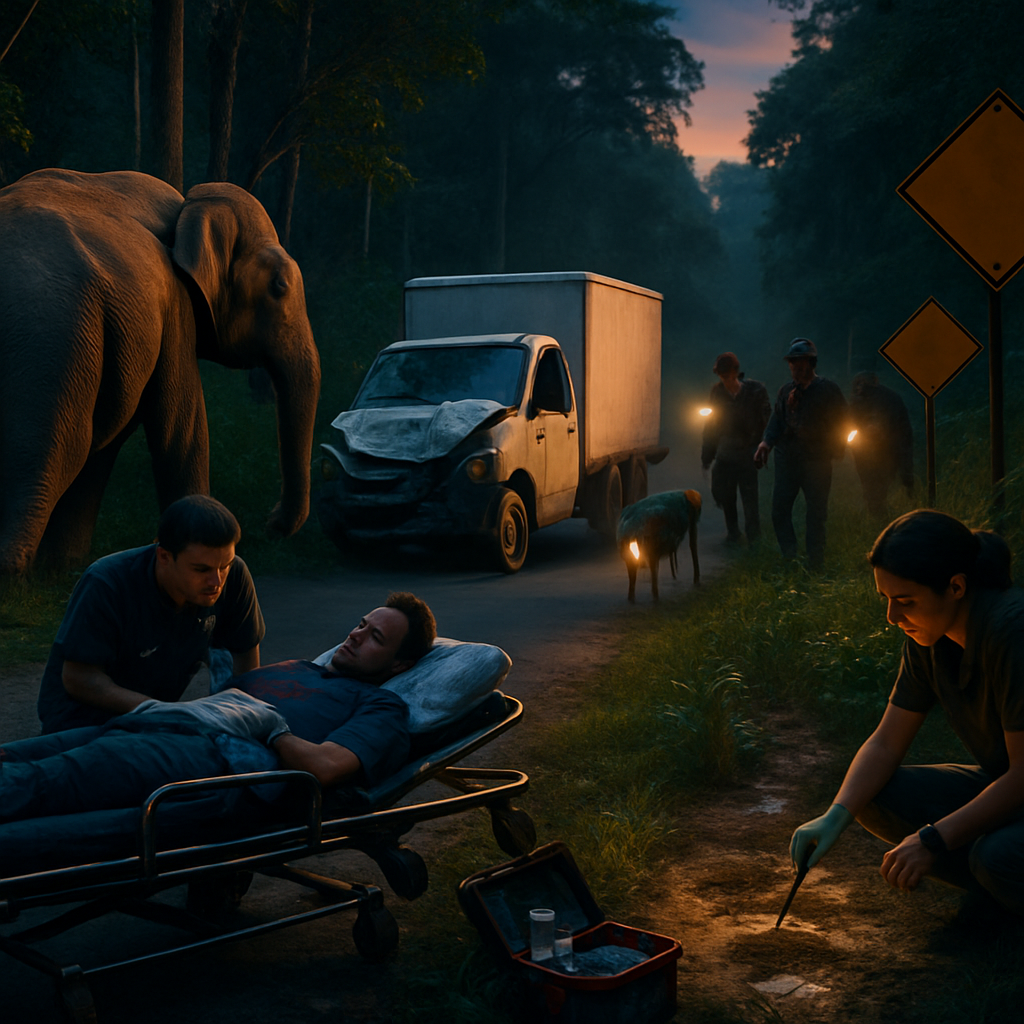
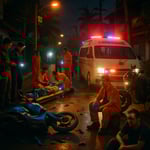
On the evening of January 4, Khao Yai’s quiet wildlife corridor was rocked by a rare and alarming collision: a closed-box van struck a wild elephant known locally as Phlai Chom View — also called Phlai Biang Yai Moosi — while the animal was crossing the road near the Mun River Headwater Research Station in Pak Chong district. The van driver sustained serious head injuries and was rushed to Bangkok Hospital Pak Chong. The vehicle itself was heavily damaged. Phlai Chom View, shaken and probably hurt, fled back into the forest, leaving a worried team of officials and volunteers to begin a high-stakes search under fading light.
By the morning of January 5, Marine Officer Nithat Plodsomboon had posted an update on Facebook: Khao Yai’s rapid response team, working closely with local Moosi volunteers, had been tracking the elephant since dawn. Despite careful efforts, the animal had not been located by midday, and the search team took a brief break before resuming in the afternoon. A wildlife veterinarian known as Doctor Boy is scheduled to join the operation to evaluate and, if necessary, treat the elephant. Authorities stressed the urgency: locating Phlai Chom View quickly could prevent complications and increase the chances of a successful intervention.
The collision occurred in a stretch of road that serves as a known wildlife corridor — one of those vital green highways that connect forest patches and allow elephants to move between feeding and breeding areas. Such corridors are lifelines for large mammals, but they also create dangerous crossings where wildlife and vehicles meet. While this incident produced dramatic damage to a vehicle and serious injuries to a human driver, the real headline is the unknown condition of the elephant that disappeared into the forest with suspected injuries.
Officials from the Department of National Parks have used the incident to re-emphasize a message that shouldn’t need repeating: when you drive through conservation zones, be vigilant. Elephants and other wildlife are most active in low-light hours — dusk, dawn, and nighttime — and a moment’s inattention can end in tragedy for both people and animals. In response to the crash, authorities have increased signage and launched public awareness measures in high-risk areas in a bid to prevent future collisions.
There’s an emotional thread to this story that goes beyond the practicalities of response teams and road signs. Locals know Phlai Chom View by name — Phlai Biang Yai Moosi is not just a label but a personality in the landscape. When an individual animal with a familiar name disappears after an accident, communities feel it. Volunteers and wildlife staff have been working together, combing tracks, checking for blood, and following leads in the brush, all while the clock ticks. The hope is that the elephant will be found, assessed by Doctor Boy, and either treated on-site or gently guided to a location where further care is possible.
How common are incidents like this? Unfortunately, collisions between vehicles and large mammals are a recurring problem in many conservation areas worldwide. Roads that cut through habitat create unavoidable conflict zones. Even at moderate speeds, a collision with an elephant can devastate a vehicle and cause severe injury to people and animals alike. That’s why reinforced signage, speed reductions, wildlife crossings, and driver education are essential tools for reducing risk.
While the Khao Yai search continues, authorities have pledged to keep the public informed. CH7 HD and local outlets are reporting updates as they come in, and social channels are amplifying official requests: if you were driving in the Pak Chong area on January 4 and noticed anything — skid marks, disturbances at the roadside, or signs of an injured animal — please report it to local park authorities to help the search.
In a separate, but equally sobering incident, a young wild elephant was electrocuted while foraging on farmland near Kaeng Krachan National Park in Phetchaburi. The animal was in Pa Deng subdistrict of Kaeng Krachan district when it made contact with illegal electric fencing that a farmer had installed to protect his crops. That event underlines another peril facing elephants at the fringes of protected areas: when human-wildlife boundaries blur, animals can encounter hazardous deterrents that cause fatal injuries. Authorities continue to crack down on illegal measures like electric fences and are urging farmers to seek legal, safe methods for protecting property.
For now, the twin incidents — the hit-and-run involving Phlai Chom View in Khao Yai and the electrocution near Kaeng Krachan — serve as a wake-up call. Conservation areas are not places to speed through on autopilot. They are living landscapes where animals with long memories and long legs move at all hours. If you travel through or near parks: slow down, watch for wildlife signs, and respect the warnings posted along the road.
Officials, veterinarians, and volunteers remain on alert, and updates will be posted as the situation develops. In the meantime, communities around Khao Yai and Kaeng Krachan are holding their breath for good news: the safe recovery of Phlai Chom View and stronger protections to keep wild elephants and people out of harm’s way.












This is heartbreaking — hit-and-run with an elephant in a known corridor shows utter negligence. Drivers need to slow down and respect wildlife zones, it’s not optional. Authorities should enforce lower speed limits with cameras, not just signs.
Enforcement costs money and people complain about cameras, but the insurance bills from smashed vans will pay for it eventually. We can have both compassion and common sense.
Exactly, prevention saves lives and money.
As a vet who has treated collision trauma in wildlife, I can say delays kill. If Phlai Chom View has internal injuries they may not show immediately, so the search must be fast and equipped.
I feel bad for the driver but why are elephants roaming roads? Humans built roads through their homes. This is a policy failure.
Roads are inevitable but we can design them smarter, with underpasses, overpasses, and timed speed limits during dusk and dawn. Education campaigns are nice, but engineering works best.
Engineering is expensive though and governments dodge the bill until something dramatic happens.
We patrol these corridors and can attest that most collisions happen in low light; we’ve pushed for wildlife crossings but development wins votes.
Naming an elephant like Phlai Chom View shows how deeply people connect to wildlife, and that emotional loss fuels activism. This should push authorities to act quicker on fencing rules and road design. Volunteers deserve credit for risking time and safety for the search.
We combed tracks before dawn; if anyone saw blood or skid marks the park wants the info now. Small tips can change the outcome for the animal.
I was driving near Pak Chong that night and slowed at a herd but didn’t see this elephant; wish I had more to report, just sending moral support.
Thanks to volunteers like you, the community keeps hope alive.
People keep saying ‘respect wildlife zones’ but tourists speed to catch selfies and ruin it for locals. There should be heavier fines for reckless driving in parks. You can’t have both uncontrolled tourism and safe animals.
Fines help but need visible enforcement; also tour operators must be licensed and trained to avoid putting vehicles and animals at risk. Blaming tourists alone is scapegoating local negligence.
I agree that operators should be regulated more strictly.
Tourism brings money but also responsibility; perhaps concession contracts should require wildlife safety training.
This article highlights systemic issues: roads fragment habitat and create conflict. We need corridors that are truly safe, not just signs that say ‘watch out.’
Doctor Boy is great but one vet can’t cover everything; invest in mobile response units with immobilization gear and quick transport plans.
Agreed, building local rapid-response capacity should be a priority.
As someone who lives near Khao Yai I see elephants every few nights, and sometimes they come close to houses. I worry more about retaliatory harm when accidents happen. Farmers are scared.
Scared farmers sometimes react badly, but illegal electric fences that kill elephants are inexcusable. There must be compensation and safe deterrents offered to farmers.
Compensation and safe options would reduce illegal fences, yes.
This is a conservation crisis wrapped in human tragedy. An injured elephant may develop infections, and social disruption in its herd can have long-term impacts. We must treat wildlife welfare as serious medical emergencies.
Long-term monitoring after collisions is rare but necessary; trauma affects reproduction and stress hormones that cascade through populations. Funding is the bottleneck, not the desire to act.
Then let’s push donors and governments to fund longitudinal studies tied to mitigation actions.
Back in my day we lost more forest, but people now care more, which is hopeful even if progress is slow.
The twin incidents illustrate two different conflict mechanisms: vehicle collisions and illegal fencing. Policy must be multi-pronged — land-use planning, transport design, farmer incentives, and strict enforcement of illegal barriers. Piecemeal responses will not suffice.
Sounds idealistic; policy makers are reactive and the politics of rural livelihoods often override conservation science. How do you make it stick?
Make it stick by combining community benefits with strict penalties. We need local buy-in and tangible alternatives to dangerous practices.
Incentives plus enforcement, yes — and transparent metrics to show improvements over time.
Honestly, I want to see harsher punishment for people who install illegal fences. That electrocution was preventable and cruel. It’s about accountability.
Punishment is necessary but also education; many farmers fear losing livelihoods and feel cornered into desperate measures. Offer alternatives first.
Alternatives should come with fast support, not wait years for rollout.
Calling for more signs is weak. We need engineered wildlife crossings, speed bumps, and real deterrents for illegal fencing. Tech (thermal cameras) could help at night. Stop pretending a sign fixes a design problem.
Engineering is best, but who pays? Big developers and tourist revenue should fund mitigation as part of permits. Private-public partnerships could work.
Don’t trust developers to self-regulate; binding legal requirements and community oversight are essential.
I agree with legal backing; voluntary measures are often ignored.
I’m torn: I love elephants but sometimes they destroy crops and people suffer. The solution must balance animal safety and human livelihoods. Otherwise resentment grows and protection fails.
Balancing is code for compromising animal lives. People chose to build near habitats; the priority should be wildlife safety and removing lethal deterrents.
But telling a farmer to do nothing when their family depends on a harvest is unrealistic.
Exactly, we need crop insurance and community-driven barriers that are safe for animals and protect fields.
Local media are trying to keep attention on Phlai Chom View, but public interest wanes fast. Sustained coverage is needed to pressure authorities into action. If readers have tips, share them with park HQ.
Thanks for reporting. Please follow up on what happened to the driver too, and be transparent about the response timeline.
Will do — we’ll update as vets and teams report outcomes.
Journalists should also probe whether previous warnings were ignored; accountability matters.