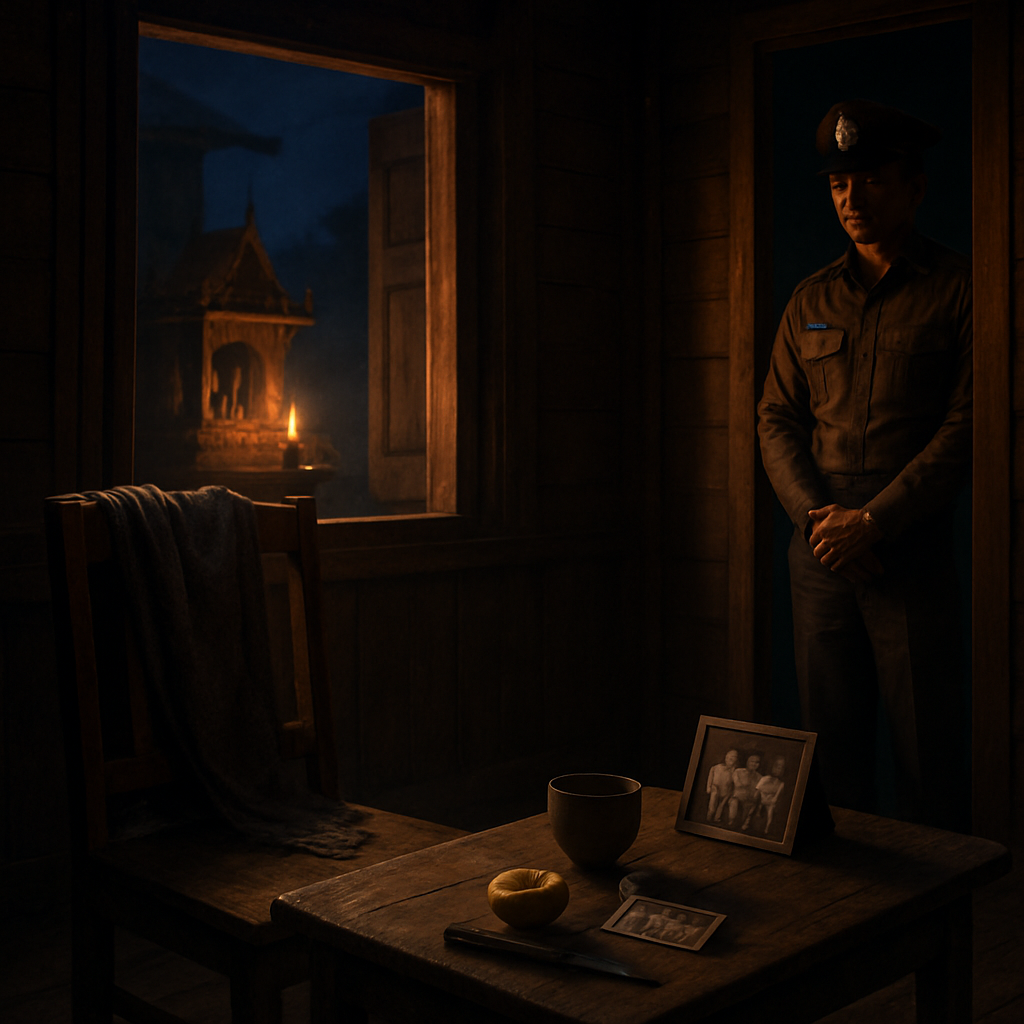
Grandson Arrested After Fatal Stabbing of 89-Year-Old Grandmother in Udon Thani
Police in Udon Thani province have detained a 44-year-old man after an apparently brutal and bewildering attack that left his 89-year-old grandmother dead at their family home in Nong Hai subdistrict, Mueang district. The grim discovery was made when officers from Huai Luang Police Station responded to a report of a fatal assault and found the elderly woman, identified as Mrs. Tan, inside the residence with multiple stab wounds.
The suspect, named by police as Mr. Kiattisak—also known locally as “Ham Noi”—lives at the same address and was taken into custody shortly after the incident. A fruit-peeling knife was recovered at the scene and is now evidence in the investigation.
What the Suspect Told Investigators
Initially silent during questioning, Mr. Kiattisak later made a startling confession. According to police statements released on 24 January 2026, he told investigators that he believed he was possessed by two spirits at the time of the attack. He reportedly said these entities caused him to lose control and that, before striking, he bowed to his grandmother while she was speaking to him.
Pol Lt Col Manit Kaewcharoen, deputy superintendent of Huai Luang Police Station, confirmed that Mr. Kiattisak has been formally charged with intentional homicide. A preliminary drug test returned negative, and authorities say they are examining whether the suspect has a history of mental illness or had stopped taking any prescribed medication prior to the incident. Further medical and psychological assessments are expected to be requested as part of the legal process.
Possession Claims and the Legal Road Ahead
Claims of spirit possession are not unheard of in Thailand, where spiritual beliefs and traditional practices coexist alongside modern medicine and law enforcement. That cultural backdrop adds a complex layer to this case: investigators must now weigh the suspect’s statements about possession against forensic evidence, witness accounts and medical assessments.
Police have said they will explore whether there is a documented history of mental illness and whether any prescribed treatment had been interrupted. Such findings could influence the legal course—while a confession may seem straightforward, courts also consider a suspect’s mental state when determining criminal responsibility. For now, prosecutors are preparing the case file and the suspect remains in custody pending further proceedings.
What Is Known — and What Remains Unclear
Certain facts are clear: the elderly victim, Mrs. Tan, suffered multiple stab wounds; the weapon was a fruit-peeling knife; the suspect lived at the home and was detained soon after the attack. Beyond that, many details remain under investigation. Authorities have not released a timeline of the attack, nor have they confirmed whether any other people were present in the home when the stabbing occurred.
Local media reports, including those from Khaosod, have relayed the official police statements and updates as the inquiry progresses. Because the case involves an elderly victim and a family member as the suspect, community reaction in Nong Hai and broader Mueang district is likely to be one of shock and sorrow.
Community and Cultural Context
In small-town Thailand, family homes are often multigenerational, and neighbors tend to be close-knit—so crimes of this nature can have a ripple effect. The invocation of spirits in a confession will draw attention not only from investigators but also from local leaders and those who study the intersections of mental health and cultural belief systems.
Officials have pledged a thorough investigation, including medical and psychological assessments, to ensure the legal process accounts for all relevant factors. As Pol Lt Col Manit Kaewcharoen noted, the case file is being prepared for prosecutors while the suspect remains in police custody.
Next Steps
Investigators will continue to gather evidence, complete medical and psychological evaluations, and interview witnesses. The public will likely see additional updates as prosecutors review the case and decide on charges and potential court proceedings. For now, the community waits for clarity on a violent act that has left an 89-year-old grandmother dead and a family shattered.
If you or someone you know is affected by this crime, local support agencies and community leaders in Udon Thani may be able to provide assistance and guidance as the investigation progresses. The authorities ask anyone with information about the incident to come forward to help piece together the full story of what happened that day.


















This is heartbreaking and confusing, I keep thinking about how family could end up like this. Possession claims smell like cultural cover for severe untreated mental illness to me. The police should fast-track psychiatric evaluations and share findings with the public.
You can’t just dismiss spiritual beliefs — in rural areas people genuinely believe in spirits and that affects behavior. But belief alone doesn’t excuse murder, so the court will be the battleground between culture and law.
I get the cultural part, Siti, but if someone is a danger they need treatment, not rituals. Public safety should come first and we need to learn whether meds or lack of care played a role.
As a psychiatrist who has worked in Southeast Asia, I agree this is complex; clinicians must distinguish culturally sanctioned experiences from psychosis. Forensic assessment will consider malingering, delusions, and prior treatment history before any insanity defense is credible.
If he stopped medication and then stabbed his grandmother, that’s on the family for not supervising him. It’s reckless to live in a multigenerational home with someone unstable. There should be stricter controls for caretaking of vulnerable relatives.
Stricter controls? You think rural Thailand has mental health infrastructure for that? This is an unrealistic demand and ignores systemic underfunding.
I’m not saying overnight fixes, but families should take responsibility and neighbors should keep an eye if someone has a history. Prevention matters.
Negative drug test doesn’t prove much, since many substances don’t show up on quick tests and timing matters. Police often release preliminary drug info that later changes with full toxicology. Forensics will be key.
This story reads like a horror film: bowing before stabbing? Whether spiritual or psychiatric, it’s chilling that someone would kill their own grandmother. Victims like Mrs. Tan deserve public sympathy and answers.
The bowing could be a ritual act or part of a psychotic ritual. Anthropologists have documented similar behaviors during trance states, but a court will focus on intent and capacity.
I hope investigators talk to neighbors and check medical records to piece together motive and history. Silence from officials breeds rumor and more suffering for the family.
Why would someone do that to their grandma? It’s scary and sad. My teacher says sometimes sick brains do weird things but that still seems wrong.
In our village people talk about spirits all the time, but violence is rare. I worry this will make people afraid to admit mental health problems. Shame and stigma could get worse now.
Exactly, Somsak — fear of being labeled ‘crazy’ means families hide problems until tragedy. Community education is needed, not just police action.
I agree, Mai. If we had a clinic nearby I would have told the family to seek help earlier, but rural access is limited and transport is expensive.
I knew Mrs. Tan, she was kind and helped everyone. It’s unbearable to think of her ending this way in her own home. The family will need support, and the suspect needs proper evaluation, not just prison talk.
Legally, claims of possession will not substitute for mens rea unless a court accepts a mental defect defense. The prosecution will parse every action: bowing, silence, weapon selection, and prior conduct. This case could set a local precedent on how courts handle culturally framed defenses.
Courts are supposed to be neutral, but judges are human and cultural context seeps in, especially in small districts. I’m worried the defense won’t get a rigorous psychiatric exam.
Anna, prosecutors in Thailand often request comprehensive psychiatric evaluations, and judges can order independent assessments. The key will be documentation from clinicians and witnesses.
People here will either blame spirits or the devil, but few will talk about social failure of elder care. We let our grandparents live alone too much and hope for the best.
That’s a blunt but fair point, P’Tak. Societies that rely on informal care need stronger safety nets or tragedies like this will recur.
This story reveals the collision of cosmology and modern law. Academically, cases like this illuminate how legal systems negotiate between emic beliefs and etic psychiatric models, which has implications for human rights and treatment access.
That sounds academic but important. Translating scholarly insight into practice for local police and health workers is the challenge.
True, Maggie. Training first responders in cultural competence and mental health triage could reduce misclassification and improve outcomes.
I don’t buy the spirit excuse; it’s a convenient story to avoid accountability. Murder is murder and the law should treat it as such, regardless of superstition.
Simple punitive thinking ignores rehab and prevention, ConcernedNeighbor. Locking someone up without addressing mental illness can lead to repeated tragedies.
Sam, rehabilitation is fine when applicable, but an 89-year-old was killed. The priority has to be justice for the victim and safety for the community.
Young people need better education about mental health and empathy. If schools taught basic recognition of crisis signs, neighbors and relatives might intervene earlier.
Education helps but resources are also necessary. You can’t treat someone in crisis with just knowledge; you need services.
Absolutely, Kanya — education and infrastructure must go hand in hand, and this case is a tragic argument for both.
As someone from the countryside, I feel embarrassed when outsiders assume we ignore mental health. Many families try, but there’s no hospital nearby and stigma is real. Punishment without context won’t heal the community.
This will be a fascinating test of criminal responsibility law. The defense might pursue an insanity plea or diminished capacity, but documentation will be decisive. I hope they publish court records for study.
Law students should also consider evidentiary standards and cultural testimony; expert witnesses will be crucial and cross-cultural translation of symptoms is notoriously fraught.
Quick update thought: if medical reviewers find a history of psychosis, the prosecutor could pursue treatment-in-lieu-of-full incarceration, but public outrage may push for harsher charges. Balancing public sentiment and scientific assessment is delicate.
The media’s framing matters; sensationalizing ‘spirit possession’ risks stigmatizing culture and mental illness simultaneously. Responsible reporting should emphasize facts and available services.
We need to hold people accountable but also ask why families hide problems. Did he ever get help? Were warning signs ignored? Those uncomfortable questions must be asked.
What worries me is copycat effects or moral panic. Cases tied to ‘possession’ might spur witch-hunts or unnecessary rituals that harm more people. Authorities should be careful in public messaging.
Good point, Evan. Safety and accuracy in messaging can prevent vigilantism and keep focus on evidence-based responses.
I feel for both the victim’s family and the suspect’s relatives; there’s grief all around. The community must support mourning while the justice process runs its course.
From a legal anthropology perspective, this case will be cited in debates about plural legal orders: state law versus community cosmologies. Expect lively scholarly commentary if records are open.
People will say the spirits did it, some will say mental illness, others will blame family — none of that brings Mrs. Tan back. We need action: support for elders and better mental health care now.
Nok, yes — concrete steps like mobile clinics and helplines could change outcomes in villages like ours if implemented.
Thanks, P’Tak — local leaders should pressure provincial health to fund such programs, and communities can start small with volunteer watch systems.
I suspect the confession may be complicated by interrogation conditions; we don’t know if he fully understood his rights or had legal representation during questioning. Those procedural details matter a lot.
Punish or treat — that’s the false binary. Proper courts combine forensic psychiatry, rehabilitation, and accountability. I hope prosecutors and judges take that route here.
Public safety is essential, but rehabilitation reduces future risk. The best outcome would protect the community and address the suspect’s needs if illness played a role.
I can’t imagine bowing then stabbing; maybe he wanted a ritual to ‘cleanse’ or was told to do it by someone else. There are too many unanswered questions about motive and influence.
Investigators will need to interview neighbors and religious figures who might have interacted with him; patterns often emerge from small details.
I hope they do that quickly before rumors distort memory. Witness accounts can change fast under pressure.