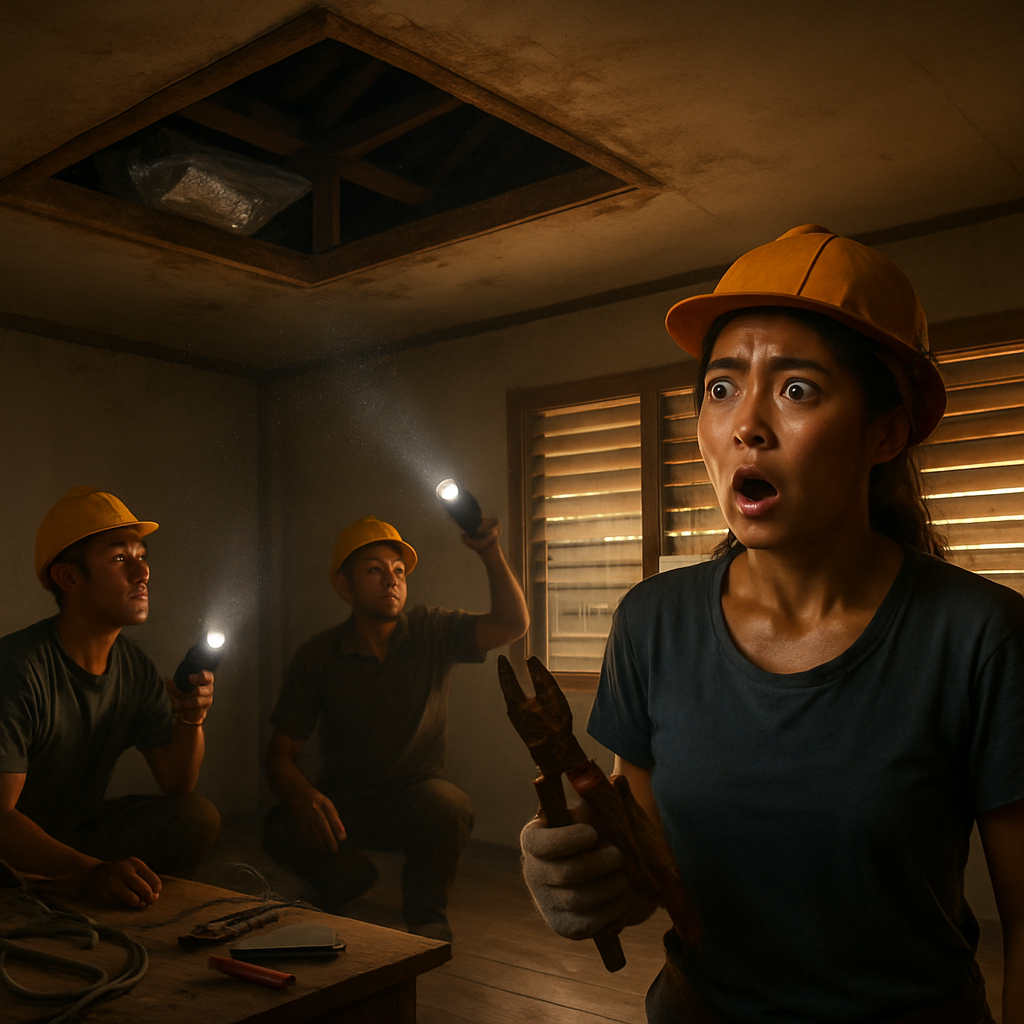
What began as an ordinary ceiling repair in a two-storey house in Lam Luk Ka district turned into a grim and puzzling discovery on January 6, when construction workers opened up a corner of the ceiling and a human skull dropped into their hands. The remains were later identified as 29-year-old Cambodian national Maikheu “Kheu” Chhean, whose disappearance had been reported by his family months earlier.
Officers from Lam Luk Ka Police Station, a forensic team from HRH Princess Maha Chakri Sirindhorn Medical Centre, and rescuers from the Romsai Lam Luk Ka Foundation responded to the scene after the workers called the authorities. The skeleton was found tucked into the ceiling void of a second-floor room, where officers also noticed discoloration on nearby walls — a sign, investigators say, that the body had been in place for an extended period.
The worker who discovered the skull, 59-year-old Kanchana, described being in shock. It was her first day back on the job after the New Year holiday; she was assigned to repair a hole in the ceiling when the skull unexpectedly fell out. She and her colleagues had been put off by a strong, unpleasant odor while renovating the property and initially assumed an animal—perhaps a monitor lizard—had died in the cavity. No one expected to find human remains.
Police report that the body appeared to have been resting among the roof structures and electrical wiring above the ceiling. Near the remains, investigators found a pair of pliers and a bag containing personal documents, which allowed them to identify the deceased as Maikheu Chhean. Known to friends and family as Kheu, he had lived and worked in Thailand alongside other family members, according to those who knew him.
A neighbour, 46-year-old Aed Thongpaen, told officers she remembered hearing about a Cambodian man who had gone missing after renting a house in the same village and living there with his family. Kheu’s wife and children reportedly searched the area and reviewed CCTV footage but were unable to locate him; ultimately, the family returned to Cambodia without having found any clues.
Another construction worker on the scene, 38-year-old Noi, who is also Cambodian, reviewed the documents and confirmed she knew Kheu and his family. She emphasized that there had been no indication of family strife, describing a household that had appeared ordinary and peaceful before his disappearance.
At this stage, police are leaning toward an accidental explanation: they suspect Kheu may have climbed into the ceiling void to cut an electrical wire and was fatally electrocuted. The presence of tools nearby supports that theory, though investigators are keeping an open mind. Kheu’s remains were sent to the Central Institute of Forensic Science Thailand for a full examination to confirm cause and time of death, and the probe remains active.
The discovery has reverberated through the local community and online. Photos and accounts shared on a local Facebook page documenting the find prompted an outpouring of sympathy and questions about how a person’s disappearance could go untraced for so long inside a small village. Neighbours, workers, and relatives alike expressed sadness and a desire for clear answers.
Beyond the immediate tragedy lies a set of broader, uncomfortable questions. How did a missing person end up concealed in a domestic ceiling where neighbors and family members later lived and worked? What checks were made when the family reported him missing, and could more have been done to locate him sooner? Authorities will need to answer these as forensics and witness interviews continue.
For now, the community that first mistook the smell in the house for a dead animal must come to terms with the human story behind that odor: a young man away from home, a family who searched in vain, and a quiet room that held the secret until a pair of pliers and a curious repair revealed it. As investigators await forensic results, Maikheu Chhean’s family and friends will be looking for closure and clear explanations from Thai authorities.
Anyone with information about Kheu’s movements before he disappeared is asked to contact Lam Luk Ka Police Station. The case underscores the importance of meticulous missing-persons inquiries and the role of community vigilance when someone vanishes without a trace.


















If the police missed a body inside a ceiling for months that’s gross incompetence or a cover-up. Neighbors smelled it but nobody looked up? That doesn’t add up and needs a full independent inquiry.
As a former investigator I can tell you cases like this are messy — missing-person reports vary in detail and follow-up resources are limited. It may be bureaucratic failure rather than malice, but either way procedures should be reviewed.
Forensic timelines can clarify whether the person died at the property or was placed there later, and whether decomposition odors would have been apparent to others at different times. Jumping to conspiracy without science risks distracting from actionable oversight recommendations.
Fine, get the forensics, but the family deserved better follow-up when they reported him missing. A transparent review and public release of findings would help rebuild trust.
Agreed — transparency is key. If procedural lapses occurred, publishing corrections and implementing training is the right response rather than silence.
This hits close to home; many Cambodian migrants live quietly and don’t want trouble. It breaks my heart that a family searched and still couldn’t find him.
I was the worker who found the skull and I am still shocked every day. We really thought it was a dead lizard at first and we never expected a person to be up there.
I knew the family and they seemed normal, nothing violent at home that I saw. People working on roofs sometimes do risky things, but it still feels like something important was missed earlier.
Thank you both for being honest; your voices matter and could help investigators understand the timeline. Families deserve clarity, not silence.
I live nearby and I remember talk of a missing Cambodian man, but as neighbors we rarely go inside each other’s houses. Still, it makes you wonder what checks were made when they reported him missing.
There’s no way this was just an accident. Tools and wiring nearby? Smells covered up? Sounds like someone tried to hide it. I’m not buying the ‘electrocution’ explanation without more proof.
Electrocution can leave a body in a ceiling if someone was working on wiring; however, forensic tests can detect burn marks on bone or tissue residues and electrical arcs. The presence of tools is circumstantial evidence but worth investigating thoroughly.
We should avoid sensationalism; while suspicious, it’s plausible he climbed up to fix wiring. Still, the bigger issue is why missing-person protocols failed and why no one found the body sooner.
Plausible maybe, but also conveniently neat. I just want a full audit and independent review so we don’t get a hush job.
That’s terrifying. How do you live above someone for months without noticing?
My teacher says smells can be ignored if people think it’s animals. Adults often assume weird smells are just normal and don’t investigate.
Good point — complacency is a problem. Still, basic checks after a missing-person report should be standard.
This case highlights systemic vulnerabilities faced by migrant workers: precarious housing, limited access to services, and social invisibility. Policy changes around migrant welfare and community outreach could prevent similar tragedies.
As a local I can say many migrants keep to themselves and landlords rarely do thorough checks. There’s a stigma too; people avoid poking into their neighbors’ lives.
We searched everywhere and watched CCTV for weeks before going home. It feels like the system let our son down and we need answers from the police.
I’m so sorry for your loss. Authorities should offer family liaisons and support while investigations proceed, and the community should push for more proactive welfare checks.
You’d think modern CCTV would have captured something useful, but footage can be incomplete. Still, it seems odd that multiple people lived there and no one noticed anything odd for months.
CCTV often overlooks ceilings and attics; cameras focus on doors and streets. Also, footage is only useful if police act on it quickly.
Exactly — and when police resources are stretched the family ends up waiting and guessing. That delay is painful and avoidable.
This story made me think about rural oversight; small villages often lack routine checks. Sad and strange.
I hope the forensic results come back quickly so the family can have closure. The community deserves to know what happened.
Could animals dragging a human body up there be a thing? Sounds wild but some stories get stranger. I want to hear the official cause before judging.
Animals wouldn’t generally place a human body into a ceiling cavity neatly among wiring; that’s highly unlikely. Forensics will be able to rule that out quickly.
Thanks — didn’t think of that. I’ll wait for the autopsy results then.
I’m bothered by how families often feel ignored during investigations, especially migrant families. If language barriers or paperwork caused delays, departments should address that immediately.
Agreed — and if language was an issue the police should coordinate translators. Missing-persons cases are time-sensitive and the family should never be sidelined.
That’s a concrete recommendation: mandatory translation services and a missing-persons checklist could reduce oversights in similar communities.