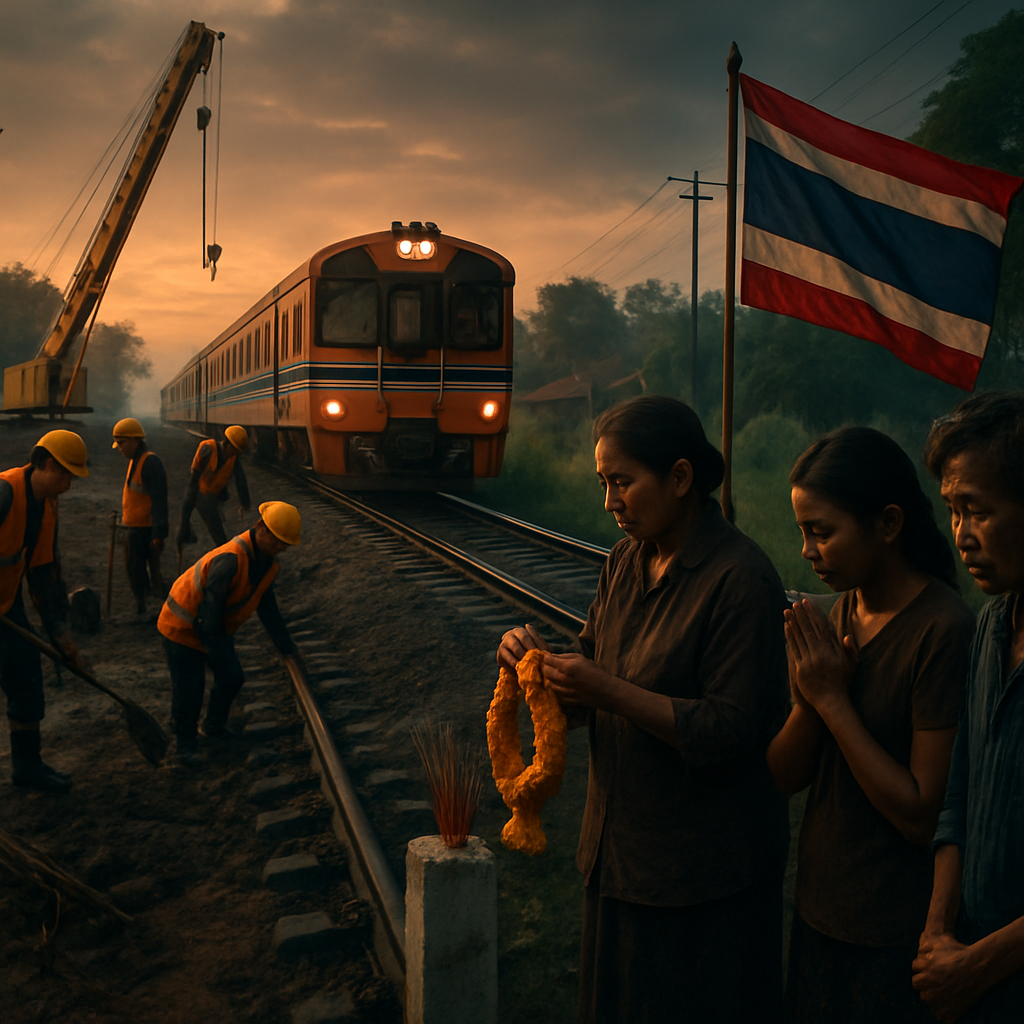
The northeastern rail line through Nakhon Ratchasima’s Sikhiu district is chugging again — but the aftershocks of the deadly crane collapse on 14 January are far from over. Following thorough safety inspections and formal sign-off from the State Railway of Thailand (SRT), services on the route between Kaeng Khoi, Pak Chong and Nakhon Ratchasima reopened at 5am on Saturday. For many passengers it was a relief to see trains rolling past the site once more; for others, the sight stirred fresh pain and unanswered questions.
Acting SRT governor Anan Phonimdaeng said crews finished repairs on Friday, including replacing about 20 metres of rail damaged in the incident. The timetable returned to life with the first northbound service from Kaeng Khoi to Khon Kaen passing the scene at 7am. A Surin–Bangkok service followed at 9:10am and Special Train No. 21 rolled through at 9:40am. Officials have tightened nationwide safety rules for construction near railway corridors to try to prevent a repeat.
But reopening tracks and restoring timetables can’t stitch up grief. The crane collapse killed 30 people, left 69 injured and sent a community into mourning and disbelief. Thirteen of the injured still remain in hospital. All the deceased have reportedly been returned to their families for funeral rites, yet the sense of loss — emotional and economic — remains acute.
Initial compensation payments of 1.77 million baht per deceased victim have been distributed, but many families say that number doesn’t come close to filling the gap left when a primary breadwinner is gone. “The money may be paid once, but the impact lasts forever,” said Kitti Pinprachak, an 80‑year‑old Ban Thanon Kot resident who lost a family member. His words capture what many survivors feel: a one‑off payout cannot replace ongoing income, daily care, or the emotional support that’s now missing.
Legal experts note that families aren’t limited to the initial payout. Kroekrit Chotthaphiphat, vice‑president of the Volunteer Lawyers Unit of the Nakhon Ratchasima Lawyers Council, confirmed that civil claims are still possible — family members can pursue additional damages for medical costs, loss of future income and other long‑term hardships.
Investigations into the cause and responsibility for the collapse are continuing. Pol Maj Gen Narongsak Phromtha of Nakhon Ratchasima Provincial Police said investigators have interviewed more than 130 witnesses, ranging from injured passengers to technical specialists. Forensic officers and outside experts are still combing through what went wrong, aiming to trace the accident’s origin and identify any parties responsible.
The contractor on the project, Italian‑Thai Development Plc (ITD), has been under public scrutiny. The company responded to concerns and denied reports of legal action against the state, while promising cooperation with authorities. Sumet Surabotsophon, senior executive vice‑president of ITD, told media the firm is committed to improving operations and placing safety first, as reported by the Bangkok Post.
On the ground near the crash site, scenes are still a mix of cleanup and contemplation. Contractors continue removing debris and repairing the area around Ban Thanon Kot, Sikhio district. Locals are split: some welcome the return of trains as vital lifelines for commerce and travel, others worry that reopening so soon risks downplaying the tragedy and its causes.
The wider picture is one of tension between urgency and caution. Restoring rail services is essential for northern and northeastern commuters and for national connectivity, yet residents and bereaved families stress that speed cannot trump accountability or long‑term remedies. The government and relevant agencies face the twin tasks of ensuring safe, reliable rail service and providing meaningful, sustained support and justice to those affected.
As trains navigate the repaired stretch, the investigation continues and the debate over compensation and responsibility will likely move into civil courts if families press claims. For now, the resumed services are a step toward normalcy — but the hollow left by the disaster will linger unless authorities, contractors and the legal system deliver answers and fair redress.
In moments like these, routines resume but memories don’t. The rails are open, timetables restored, and inspectors have tightened rules — yet the community that watched a crane collapse onto its railway remains on a slow road to healing, seeking more than a one‑time payment: recognition, accountability and measures that will ensure no other family endures the same sudden, devastating loss.
















The rail line has reopened but reopening shouldn’t be mistaken for resolution. Investigations and civil claims are likely to shape what happens next. I’ll keep covering developments and any court actions that follow.
They gave us money and then act like everything is fine. My family lost a lifetime of support and a one-time payment can’t fix that.
I get the anger, but money alone won’t bring people back. Still, compensation should be fair and linked to long-term needs.
From an engineering standpoint, the sequence of failures matters: was it rigging, load miscalculation, or ground instability? Independent forensic findings will be crucial and the SRT should publish the full technical report. Transparency will help rebuild public trust.
Families have options beyond the initial payout; civil suits for loss of future income, pain and suffering and medical costs are viable. But pursuing litigation requires good counsel and evidence, which can be costly for grieving families. Pro bono groups should step in.
ITD always dodges blame until someone forces them in court. Big contractors have been allowed to cut corners for years and nothing changes unless there’s real liability.
It’s scary trains ran where people died. Why did they open it so quick?
Officials say inspections were thorough, but several community leaders told me they felt rushed. I’ll follow up on which independent experts were allowed to examine the scene.
This is exactly what happens when big firms get lax oversight; those one-off payments are PR moves, not justice. The same contractor has a long track record of close calls and we need stricter penalties, not press statements.
You can’t tar everyone with past projects; companies can improve and cooperate. ITD says they will enhance safety and they might actually make changes this time.
Enhance safety until the next disaster. The pattern is always the same: patch, reopen, forget. Unless officials face real consequences, the incentives remain perverse.
Exactly — penalties need to be severe, and responsible managers must be held personally accountable, not just pay fines and move on.
Public pressure will influence criminal and civil investigations, but legal standards require demonstrable negligence or breach of contract. Families should document every loss now and seek counsel immediately to preserve claims.
My neighbor’s son was on that train and now the family is lost. Reopening tracks doesn’t heal the mothers and fathers who must bury loved ones.
Rail services are vital for people, but I worry about the message sent when trains resume quickly. It feels like business over people sometimes.
It is business over people; they want schedules back and forget those who can’t work or cook now that someone is gone.
Local vendors rely on passing passengers. We also lost customers and income; compensation should account for community-wide economic harm, not just individuals.
If the collapse involved inadequate shoring or dynamic load misestimation, that points to procedural failures rather than unforeseeable events. Independent structural analysis should be published with raw data. Only with that can we prevent recurrence.
I’ve seen similar collapses where ground settlement and poor crane placement were ignored. A peer review of the methodology and load calculations would help, and the SRT should commission external specialists.
Agree — and publish sensor logs, crane maintenance records and the lift plan. Without those documents it’s speculation.
External reviews are fine but only if the reviewers aren’t handpicked by the contractor. We need genuinely independent panels.
As an engineering student this scares me. We need better training and real consequences for cutting corners.
Courts will consider proximate cause and foreseeability when awarding damages, and family reliance on deceased income will be central. The Volunteer Lawyers Unit is already advising affected families. Expect multiple civil suits and perhaps criminal indictments depending on findings.
Legal remedies exist but are slow; the community deserves immediate support beyond litigation. Temporary income support and counseling should be prioritized while cases proceed.
This is also a matter of procedural justice — were safety rules enforced equally for all contractors? Marginalized workers often bear the brunt.
Exactly, and evidence of systemic regulatory failure could widen claims to the state and regulators, not only the contractor.
They keep saying rules were tightened, but who checks the inspectors? Kids and old people died and that’s not okay. Tell the truth and make sure it never happens again.
I remember when rail safety mattered more than speed. Communities used to be consulted about big projects; now decisions are made behind closed doors.
Consultation is symbolic unless it changes incentives. Regulators need teeth and whistleblowers need protection.
Yes. Protect people who speak up.
As someone who works on the tracks, I worry about the new ‘tightened rules’ being just paperwork. Real safety comes from honest, slow checks and frontline workers being heard.
From the inside, deadlines and budgets pressure decisions. I’ve seen shortcuts rationalized as ‘temporary’ and then become permanent because of schedule pressures. Fixing culture is harder than changing rules.
Thanks for saying that. Workers need safe channels to report without fear of losing jobs.
I asked the contractor about whistleblower protections; they claim a hotline exists but couldn’t show uptake figures. I’ll request more documentation on protections and any recent complaints.
Reopening restores connectivity which has measurable economic value, but externalities from safety lapses impose long-term costs. Policy should balance short-term mobility with investment in robust preventive measures. Cost-benefit analyses must include lives and livelihoods, not only ticket revenues.
Trains bring customers back, but we lost setup and inventory people who ran stalls. Compensation should help businesses re-establish or we lose more than passengers.
Agreed — compensation frameworks must consider multiplier effects in local economies. Otherwise short-term relief won’t prevent slow decay of affected towns.