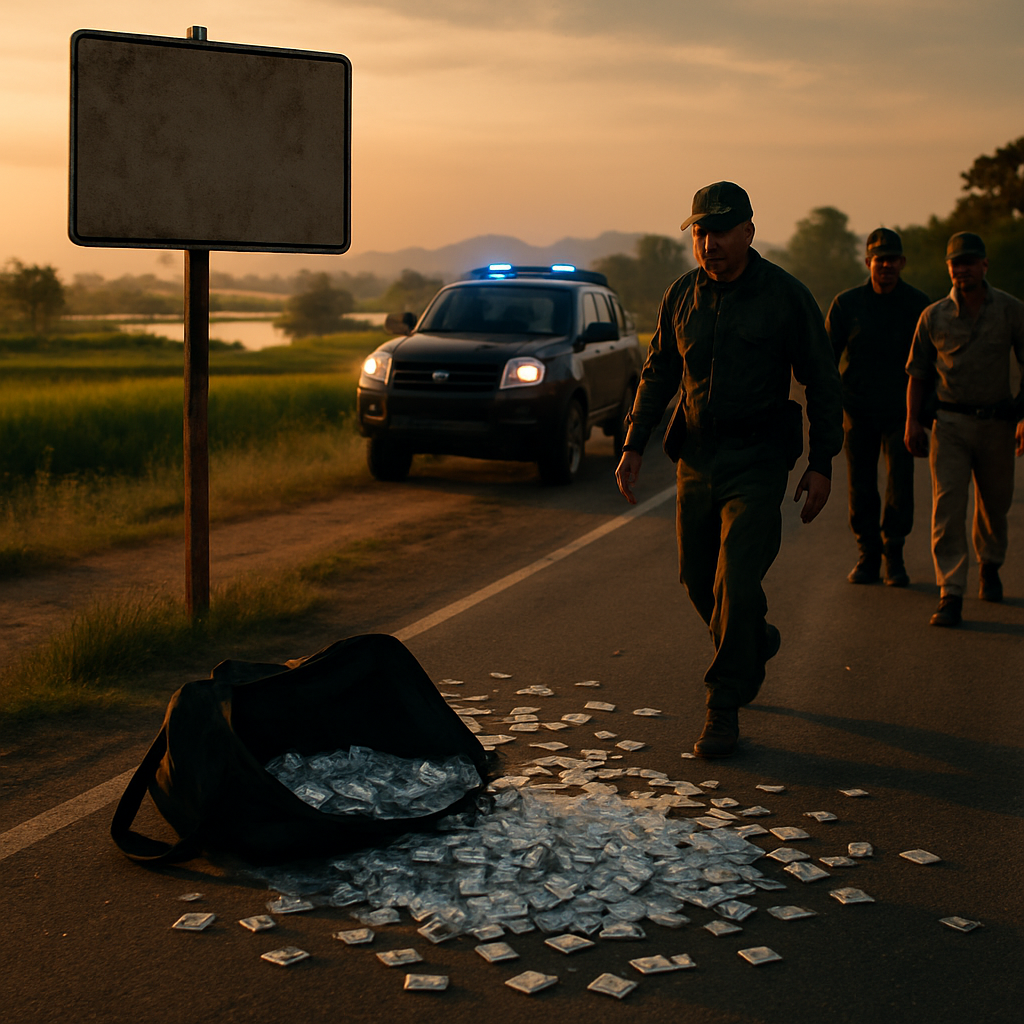
Bag by the Road, Bust in the Northeast: How a Tourist Sign Helped Stop 208,000 Meth Pills
What looked like an abandoned travel bag at a roadside tourist sign on Highway 2376 turned out to be a very bad day for one alleged drug courier — and a rare stroke of luck for Thai law enforcement. On November 29, a tip-off set off a chain reaction: the Narcotics Suppression Bureau (NSB) Unit 24, the 2nd Army Region, and the Surasak Montri Task Force coordinated with the Sakon Nakhon River Peacekeeping Unit to investigate a black bag suspected of holding narcotics. The result? A suspect arrested and 208,000 methamphetamine pills seized.
The location was unglamorous: a tourist sign between Na Yung district in Udon Thani province and Sangkhom district in Nong Khai province. But the setting mattered. Highway 2376 sits along a corridor often used to move contraband from the northeastern border areas toward Thailand’s interior. The bag’s conspicuous placement — abandoned in plain sight at a tourist marker — raised suspicions and prompted the peacekeeping unit to call in a special task force.
Ranger Company 2110 and Surveillance Unit 11 were dispatched to monitor the spot. Officers kept watch and observed a man approach the sign, apparently to retrieve the bag. That’s when they moved in, conducting a search that revealed the startling haul: 208,000 methamphetamine pills. The suspect was arrested on the scene and, during initial questioning, admitted he intended to transport the drugs to inner regions of the country. The seized pills have since been handed over to the Sakon Nakhon River Peacekeeping Unit for inventory and further investigation, reported Khao Sod.
Teamwork on the Border
This interception highlights the layered response Thai authorities are developing along the northeastern border. The operation brought together military units, the NSB, local peacekeeping, and specialized ranger and surveillance teams — a coordinated approach designed to catch traffickers who exploit remote stretches of highway and tourist stops to conceal large shipments.
Tip-offs and community vigilance played an outsized role in this bust. An anonymous report about a suspicious black bag led investigators directly to the scene. It’s a reminder that policing drug trafficking in border regions often depends on local eyes and quick coordination between units spread across provinces like Udon Thani, Nong Khai, and Sakon Nakhon.
Not an Isolated Incident: The Chiang Mai Connection
If that roadside find felt cinematic, another recent operation read like a full-blown action sequence. In northern Thailand, Chiang Mai police seized more than 3.7 million methamphetamine pills and 100 kilograms of crystal meth hidden in a truck loaded with cabbage — yes, cabbage. The discovery followed an hours-long chase that hinged on technology: an AI-powered licence plate recognition system flagged a suspicious Isuzu pickup traveling between Chiang Mai and Lamphun.
The driver tried to evade a checkpoint, speeding through several districts before officers disabled the vehicle by shooting out its tyres and apprehending 24-year-old Anusorn “Sanook” Masuk. Authorities say the system’s AI alert prompted surveillance; combined with the tactical stop, it led to one of the largest single hauls in recent memory. Like the roadside bag case, this operation is being expanded as investigators pursue broader legal action, according to Khao Sod.
Patterns, Prevention, and What Comes Next
Both incidents underline several trends: first, traffickers are creative about concealment — from black bags left at tourist signs to drug shipments hidden amid produce. Second, multi-agency cooperation and technology are increasingly central to interdiction efforts. From river peacekeeping units to AI licence plate recognition, Thai law enforcement is pairing boots-on-the-ground tactics with digital tools that can flag suspicious movements across provinces.
For communities along transit routes, these busts are a mixed blessing: relief that large shipments have been interdicted, but also a reminder of how persistent and adaptable the illicit drug trade remains. For investigators, each arrest opens new lines of inquiry — buyers, sellers, transport networks, and cross-border connections that must be unraveled.
The suspects in both cases now face inventory, interrogation, and ongoing investigations that could ripple into larger trafficking networks. While authorities tally pills and book suspects, the human cost of meth distribution — addiction, community damage, and violence — is what keeps these operations urgent.
Why It Matters
Seizing 208,000 pills from a roadside bag and uncovering millions more in a cabbage truck are headline-grabbing feats, but they represent more than dramatic police work. They underscore how vigilance, intelligence-sharing, and technology together can disrupt trafficking routes. They also offer a quiet message to couriers: sometimes the most obvious hiding spots are the riskiest.
As investigators continue to follow the threads from these arrests, the hope is that each seizure weakens the supply lines feeding methamphetamine into Thailand’s cities and rural communities. For now, a tourist sign and a cabbage truck have become unlikely landmarks in the ongoing campaign against narcotics trafficking — and two successful examples of how multiple agencies can turn a tip-off into a major bust.
Reported developments in these cases were covered by Khao Sod.
















A tourist sign and a suitcase full of pills — feels like a movie, but this is real and scary. How many more ‘obvious’ drops are out there because traffickers think no one is looking? Local vigilance did the heavy lifting, but should we be worried about civilians becoming informants in dangerous ways?
People reporting suspicious bags is brave, but it can be risky; anonymous tips help, yet this could put witnesses in harm’s way. There needs to be protection for those who call it in.
Totally agree, Anita — anonymous tips are great but we need safe channels and maybe small rewards or witness protection even for low-level informants. Otherwise fear or retaliation will silence the community.
As someone who drives those highways daily, I say the cops got lucky. But why are so many pills moving through rural roads? Someone high up is running a huge operation, not just lone couriers.
Rural transit routes are classic because of lower surveillance, yet this bust shows multi-agency tactics can work. The scientific question is how to model trafficking flows to pre-empt drops, not just react.
AI plate recognition and militarized checkpoints sound efficient, but where do we draw the line on privacy and civil liberties? Surveillance expansion always creeps beyond its initial purpose.
If AI stops millions of pills, I don’t mind a little plate scanning. Public safety beats privacy every time for me, especially when addiction and violence are at stake.
Alex, I get the instinct, but history shows temporary measures become permanent. We need strict oversight and sunset clauses for tech surveillance, otherwise it’s a slippery slope.
We need transparency on data retention and who accesses the AI logs. Otherwise marginalized groups could suffer disproportionate enforcement.
That AI license plate system in Chiang Mai is impressive. Tech plus boots is the combo that seems to finally catch big shipments.
Tech helps, but algorithms have biases and false positives; perfecting models and auditing them is necessary before scaling them nationwide.
Fair point, techsavvy — but when you can disable a vehicle and catch 3.7 million pills, the benefits look huge to cops and communities hit by meth.
This happened right near my town. Tourists stop at that sign daily — now I worry what else is left there. It’s unsettling to have crime so visible.
Maybe authorities should put up warning signs or cameras at tourist markers. If traffickers use these spots, locals deserve more protection and info.
Pat, cameras might help but could also just shift the problem. Better to have patrols and community hotlines with guaranteed anonymity.
As someone in a ranger unit, I can say patrols are effective but understaffed. Tips like this tip-off are gold; they let us focus scarce resources in the right place.
The interesting pattern here is convergence: human tips, local units, military and AI all contributed. Studying that interplay could inform optimized interdiction strategies.
Can researchers access operation data though? Without collaboration between police and academia we can’t refine predictive models ethically.
Phuong, it requires data-sharing agreements with privacy safeguards. If done right, models could highlight likely drop zones without exposing individuals.
This is proof the supply chain is massive; 208k pills from one bag is a lot. Interdicting couriers helps but I want to see arrests up the chain, not just the mule.
Exactly — the low-level couriers are replaceable. Focusing only on them is like cutting flowers off a rooted weed. Need to follow the money.
Larry, yes follow the logistics: origins, storage, buyers. Without that the plant keeps growing and new kids become couriers.
Why do we hear about huge seizures but still see crystal meth in small towns? Arrests don’t seem to reduce availability much. Is enforcement the wrong emphasis?
Enforcement alone is necessary but insufficient. Combine with demand reduction: rehab, jobs, education. Otherwise supply just adapts.
Agree on rehab and prevention, but those programs need funding and political will. Headlines help momentarily, but policy continuity matters more.
I learned about drug trafficking in geography class and this article made it real. It’s scary adult stuff, but I think schools should teach more about risks and help for addicts.
Cabbage truck and tourist sign — the creativity of traffickers is both clever and depressing. It shows they adapt quickly to enforcement tactics.
Also we should ask why certain ports of entry or border areas remain porous; corruption, resources, and terrain all play roles.
The arrest was quick because patrols were in the right place at the right time, and the tip-off mattered. But we need more training on safely handling large seizures.
Big busts are great for headlines, but they also create backlash when innocent travelers are profiled. Local checkpoints must be careful to avoid harassment.
I support enforcement but we need accountability — body cams, clear procedures, and community oversight so power isn’t abused.
AI plate recognition did heavy lifting in the Chiang Mai case, but continuous auditing is needed to prevent drift and false flags. Tech isn’t magic; it’s a tool that must be managed.
Also, open-source benchmarks for licence-plate AI could improve transparency and trust between police and the public.
As a small business owner near the highway I fear increased checkpoints will scare customers away. There are trade-offs between safety and economy that officials ignore sometimes.
I want to praise the officers for catching this, but I’m also skeptical: how many drugs slip through because of corruption? We need independent audits.
From an analytical standpoint, these cases could feed a regional interdiction model. Combine route data, commodity covers, and time-of-day patterns to predict high-risk flows.
Quick wins are important, but we must ensure detainees’ rights are protected and that investigations don’t rely on coerced confessions. Oversight is crucial.
My husband drives produce trucks and this scares me; honest drivers get stopped and lose time. Authorities should screen smarter to avoid penalizing small drivers.
We should measure public-health impact of seizures — do they reduce overdose or addiction rates? If not, interdiction alone isn’t solving the problem.
Community watch programs are powerful, but they must be organized by local leaders with police liaison to avoid vigilantism. The tip in this case sounds like proper coordination.
Coordination between units made this bust possible; joint task forces with clear command structures prevent confusion during operations. Replicate that model elsewhere.
I wonder about the markets consuming these pills. Arrests at border points won’t stop users who are driven by poverty or despair. Address root causes.
Any idea what penalties the arrested guy faces? Public needs to see justice and also rehabilitation options for addicts tied to these networks.
As a visitor I worry this will change the vibe of tourist spots. But I’d rather feel safe than think a suitcase might blow up into violence nearby.
Local schools could be hubs for prevention outreach, teaching kids about addiction and how to report suspicious activity safely. Prevention must start early.
Seizures are tactical wins; strategically we need international cooperation to cut supply at origin points and financial interdiction to freeze networks.
This smells like a coordinated syndicate operation, not amateur smugglers. I hope investigators follow the money trail and expose the larger ring.