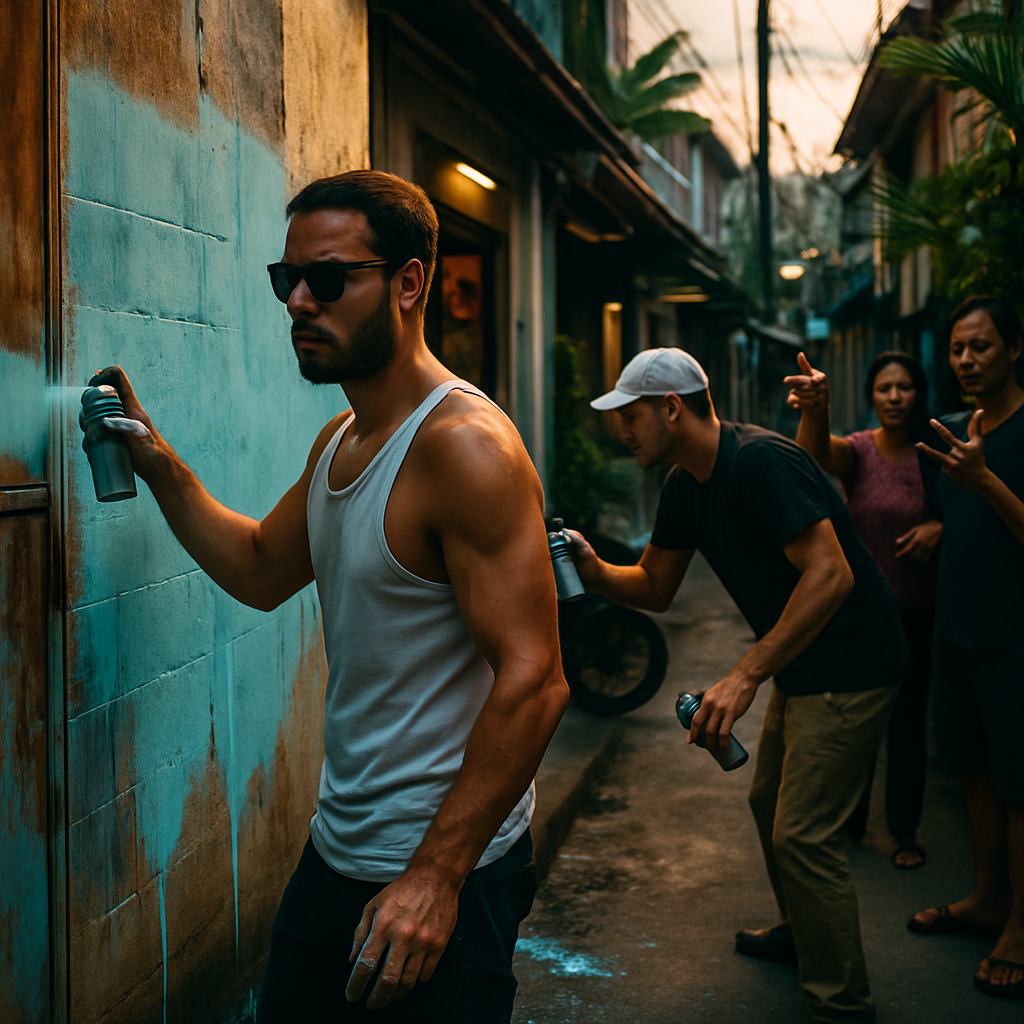
When a Phuket local posted grainy photos of two foreign men spray-painting walls around Kata, the island’s online neighbourhood quickly ignited. The post — shared on December 15 by Facebook user Yotwadee Panthong in a group for Phuket residents — showed two men caught mid-spray, cans in hand and paint on fingers, leaving fresh streaks of pastel blue across walls and a rusty door. The caption didn’t mince words: “Can anyone take action against these foreigners? They have gone too far, spray-painting everywhere. Shops in Kata should not sell spray colour so easily. Is this graffiti, art, or just rubbish? Who allowed this to happen, and is it even legal?”
The pictures are telling. One man, in a white tank top, black trousers and sunglasses, posed in front of a newly painted swathe of light-blue paint. The other, wearing a black T-shirt, beige trousers and a white cap, was photographed spraying a metal door that looked like it belonged to an abandoned building. The images were shared with the kind of quick, concerned commentary that feeds local feeds: anger, curiosity and a thirst for action.
Responses rolled in fast. Some locals offered a dose of perspective: abandoned buildings and derelict doors are magnets for graffiti, they pointed out. “If there’s already spray paint everywhere, visitors might assume it’s okay,” one commenter wrote, highlighting how visual cues shape behaviour. Others, however, raised a sharper note — that of unequal law enforcement. A frequent complaint in the thread: Thai graffiti is likely to trigger a rapid police response, while foreign spray-painters seem to slip under the radar.
One user claimed they’d seen traffic signs in Phuket sprayed with Russian words and suggested that police would act swiftly if those words were in Thai. Whether that impression is accurate or not, the perception matters: residents want fairness and clear rules. So far, though, authorities have been silent. Yotwadee didn’t specify the exact location of the incident, and local police have not released an official statement or confirmed an investigation.
It’s not the first time foreigners and paint have made headlines in Thailand. In October, two foreign teenagers were filmed spraying the wall of a roadside accommodation in Phuket. And in September, a suspect was arrested in Bangkok after damaging a mural by a Spanish artist in Soi Charoen Krung 30 — a mural that formed part of a cultural campaign run with the Embassy of Spain. That case drew a lot of attention and official involvement, because the artwork was part of a formal public project.
So what’s the line between vandalism and art? The internet loves that question. For some, any unauthorised mark on private property is vandalism plain and simple. For others, guerrilla street art can add colour and character to neglected spaces. Local sentiment often depends on who’s doing the painting, what’s being painted, and whether permission was sought. In this Phuket thread, the tone leaned toward frustration — not about creative expression per se, but about respect for property, local norms and the rule of law.
There’s also a practical side: abandoned properties are eyesores and can attract irresponsible behaviour. If spray-painting becomes a free-for-all, landlords and residents are left to pick up the tab or watch their neighbourhood’s appearance degrade. Local businesses in tourist districts like Kata understandably bristle at the idea that anyone can walk in, buy a can of spray paint and make a mess.
For visitors, this is a useful reminder: local rules and cultural expectations matter. What looks like a blank canvas to a traveller might be someone else’s damaged door or a business owner’s headache. Even when a wall already bears layers of tags, the right move is to ask permission, check local ordinances, or express creativity in places expressly designated for street art.
For residents and officials, the debate exposes a demand for clarity. If the law is applied unevenly, it erodes trust. Clear signage, consistent enforcement, and designated public-art projects could help channel creative energy into places where it’s wanted, and reduce tension where it’s not. When municipal campaigns collaborate with embassies or artists, as in the Bangkok mural case, there’s a model for how public art can be celebrated rather than erased.
Yotwadee’s post may not have solved anything overnight, but it did what neighbourhood posts do best: start a conversation. Whether you see those two men as vandals, accidental rule-breakers, or misguided artists, the real takeaway is simple — Phuket, like any community, needs clear rules, even-handed enforcement and mutual respect between locals and visitors. Until those pieces fall into place, every can of spray paint will remain a small flashpoint on an island that depends on both its residents and its guests to keep the place looking good.
For now, the police have the ball. The public waits to see whether this latest episode will lead to charges, a warning, or no action at all. And the local Facebook group keeps doing what it does best: watching, commenting and shaping the conversation about what the island should look like — one wall at a time.

















I posted the photos because I was worried—these men were literally spraying doors in Kata. If someone can help identify them or tell me how to file a complaint, please advise.
If they’re foreigners, this will blow up on Facebook fast and then fizzle with no police action. Someone should at least report it to the tambon office so there is a record.
Reporting is important, but we need to be careful not to jump to xenophobia; photos don’t show intent or permission. Still, property owners deserve protection.
As an urban planner I see this as symptom of neglect: abandoned buildings invite tagging and then escalate. A coordinated cleanup and legal murals program would reduce incidents like this.
Thank you, Laura — that idea has come up in the group before, but budgets and local politics block a lot of projects. Still, it’s worth pushing the municipality.
Lock the cans at the 7-Eleven, problem solved. Tourists shouldn’t get special rules to trash our island.
As a shop owner in Kata I worry about clients seeing our street messy; spray paint on private doors affects business. Police need to at least issue warnings to show it’s taken seriously.
This isn’t just about paint — it’s about respect. Visitors must learn local norms or face consequences.
Respect goes both ways; sometimes locals treat tourists poorly first and then complain.
I lived in Phuket for two years and saw uneven enforcement; Thai-language graffiti often gets cleaned faster. If foreigners get away with it, the message is clear: double standards exist.
Exactly, Larry. Perception of bias fuels anger and doesn’t help social cohesion.
Graffiti can be art, but context matters; a commissioned mural is different from defacing someone’s property. I think ambassadors and local councils should sponsor legal walls for visitors and locals alike.
Funding is the hurdle though; embassies help sometimes, but local governments rarely prioritize it. Private sponsorship might work better.
Private sponsorship could work, but it risks favouring commercial messages over genuine art. There needs to be community oversight.
Why are people so quick to blame ‘foreigners’? The paint could be from expats who live here legally or from gap-year kids. Don’t automatically assume criminal intent.
Intent matters, but the act is still illegal on private property without permission. We shouldn’t normalize walking up and painting someone else’s door.
This is naive. We see patterns: groups of tourists painting at night, then locals paying for repairs. It’s not harmless.
I’m just saying don’t scapegoat based on nationality; focus on individual responsibility instead.
From a legal perspective, the crucial elements are ownership and permission; the police must establish whether the properties were abandoned and who holds title. Public policy should clarify enforcement thresholds to avoid selective action.
Agreed, but in practice documentation of ownership is messy and slow which leads to inaction. That legal limbo is where problems thrive.
If the municipality registers abandoned properties and posts clear signage, it would help both enforcement and artists seeking legal spots.
I still think shops selling spray paint near tourist spots are irresponsible. They make it too easy for mischief.
Shops sell paint to locals too; banning sales would hurt local craftsmen and builders. Education and signage are better.
Education didn’t stop them tonight though, did it?
Perception of unequal law enforcement is toxic for trust. If police respond faster to Thai tags than foreign ones, that will inflame tensions with locals and tourists alike.
Sometimes police prioritize high-profile cases; a mural tied to an embassy got attention, but random tagging doesn’t. It’s about optics.
Optics reflect policy though, and policy should be consistent whether the perpetrator is Thai or foreign.
I visited Kata last year and loved the street art there, but it was all commissioned. Random tags would spoil the vibe. Tourists need to be better informed.
Brochures and signs aren’t enough; people scroll Instagram and think ‘blank wall = fame.’ Social media fuels this problem.
Police silence is frustrating; even a statement explaining the steps would calm people. Right now it’s just speculation and anger in the comments.
I’m not the official mouthpiece, but I can say police receive many non-urgent reports and must prioritize. We should file formal complaints to get cases logged.
Thanks for replying, Inspector — could the community create a template complaint to make reporting easier for residents?
This whole debate smacks of ‘not in my backyard’ syndrome; some people love street art and others hate it. The real issue is who decides what is acceptable.
Communities can decide through participatory budgeting and public meetings; top-down bans rarely work. Give citizens a voice and money to implement mural projects.
I worry about safety too — graffiti and abandoned buildings signal neglect and can attract crime. Fix the infrastructure and the tagging will drop.
Exactly, urban decay and tourism pressure are linked; investment must go beyond beach cleaning to property maintenance.
Why not create rotating legal zones where visitors can paint for a day with supervision? It could be a tourist activity with permits and fees.
That would be fun and controlled, plus fees could fund community cleanups. Win-win if properly managed.
I fear this will just be another moral panic that ends with a viral post and no change. People forget in a week and the next spray job happens.
You’re right to worry about momentum, but our group often keeps follow-up pressure; if enough residents file complaints, authorities may act differently.
As a traveller, I think visitors should be fined and deported for damaging property; it’s simple deterrence. Let the owners decide penalties.
Deportation for graffiti is extreme and could cause diplomatic issues; fines and restitution are more practical and legal.
Maybe, but consequences must be meaningful or people won’t respect them.
Kids do silly things and don’t think about the cost. Maybe schools should teach about local laws and respecting places you visit.
We already teach civic responsibility, but tourists skip that. Travel agencies could include short cultural briefings before arrival.
I will take this back to my precinct to see if signage or rapid-response protocols can be improved. Community reports with photos and times help investigations.
Thanks for engaging here, Inspector. Transparency will go a long way to rebuild trust.
Appreciate the effort, but will the police actually publish outcomes? We need follow-through, not just talk.
Social media fuels instant outrage but rarely craftsmanship; maybe we should tag the art-friendly businesses to create official canvases. It’s easier to build than to ban.
Partnering with cafes and guesthouses for rotating murals is a brilliant grassroots approach and keeps control local.
Tourism dollars don’t excuse disrespect. If visitors can’t follow simple rules, they shouldn’t be welcomed back. Protecting local aesthetics matters.
That’s harsh and could hurt the economy; better to educate and integrate visitors into community projects than ban them outright.
I support clear signs on vacant properties that say ‘No painting; penalties apply’ in Thai, English and Russian if needed. Clarity reduces excuses.
Multilingual signs are smart; they reduce language-based inequities and make enforcement straightforward.
Instagram culture makes blank walls targets, not just locals. Influencers should be responsible and local authorities could ask platforms to discourage illegal content.
Platform responsibility is tricky legally, but local campaigns that reward lawful creative content could shift incentives away from illegal tagging.
If the municipality created an easy permit system for temporary art, people would choose that over clandestine tagging. Bureaucracy scares artists away now.
Simplified permits with a small fee and quick approval would let businesses collaborate with artists and avoid surprises.
Let’s not pretend this is just about art; it’s also power and privilege. When foreigners feel entitled to do whatever, locals pay the price.
That’s a strong claim but not unfounded; enforcement patterns can send messages about who belongs and whose property matters.
We will monitor the area and reach out to property owners for statements. If evidence shows deliberate vandalism, charges will follow standard procedures.
Thank you for the follow-up, Inspector. Even a short update to the Facebook group would reassure residents that the case is being tracked.
Most people here are tired of viral outrage with zero resolution; I hope this time it leads to a real policy change. Small incidents accumulate and shape the town’s image.
As someone who paints, I wish artists would seek permission; guerrilla art can be meaningful but it should be contextual and not damage livelihoods. Let’s create spaces that welcome artistic experiments.