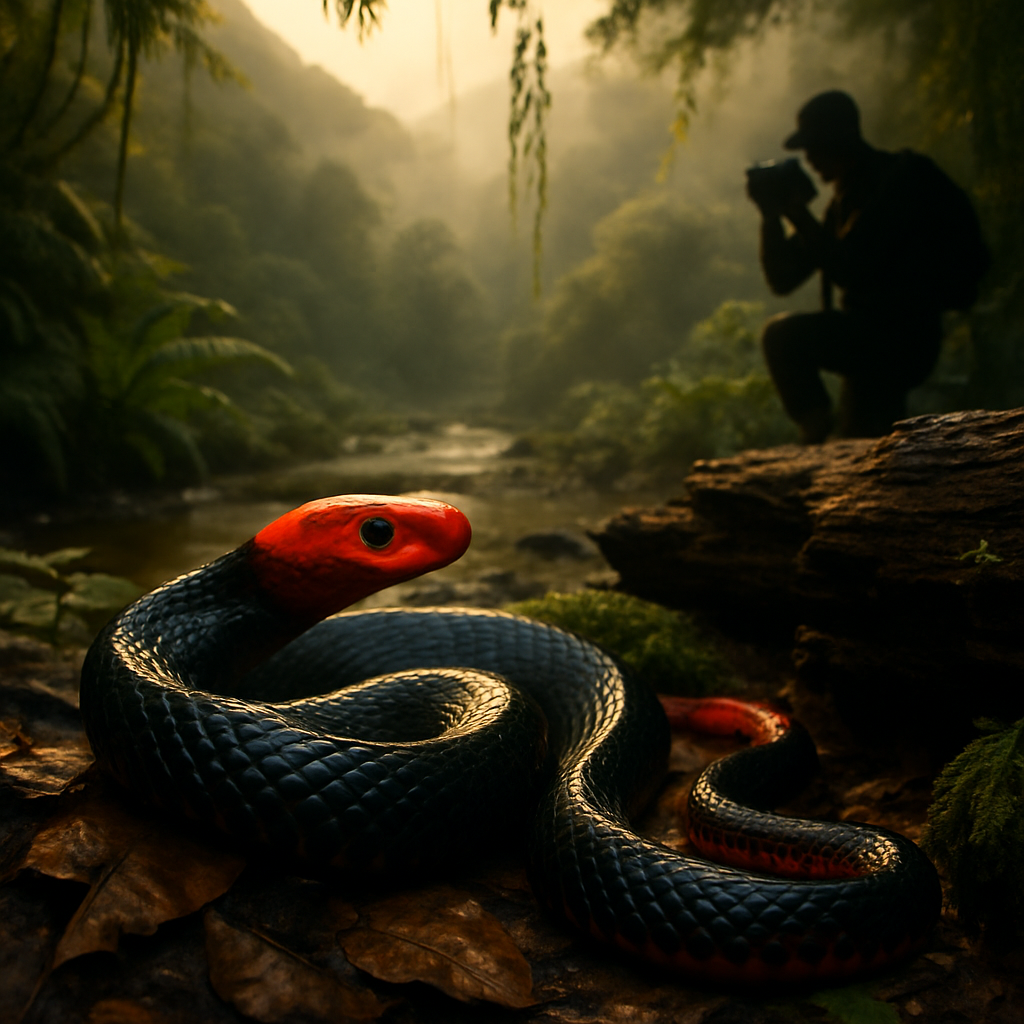
A Flash of Red: Rare Red-Headed Krait Spotted in Kaeng Krachan
On January 13, a routine patrol in Thailand’s sprawling Kaeng Krachan National Park turned into a quiet wildlife headline when park ranger Busakorn Kantook photographed one of nature’s most striking — and most dangerous — reptiles. Perched on Phanoen Thung Mountain, the snake was unmistakable: a glossy black body capped with a vivid red head and tail. Park chief Mongkhon Chaipakdee confirmed the find and said the species is a red-headed krait, a rare member of the krait family known for its potent neurotoxic venom and eerie, warning-color pattern.
What Makes the Red-Headed Krait So Unforgettable?
It’s hard to forget a snake that looks like it’s wearing a tiny warning sign. The red-headed krait’s combination of jet-black scales with bright red at both ends gives it a theatrical look. Add a slightly raised, triangular back and you’ve got a reptile that’s both beautiful and intimidating. These kraits are nocturnal hunters, preferring to hide under leaf litter, in rotting logs, or near water during the day, emerging at night to hunt small animals. Despite their dramatic appearance, sightings are uncommon — which only heightens the fascination when one turns up on a mountain patrol.
Danger and Caution: Why This Sighting Matters
Mongkhon Chaipakdee reminded the public that the red-headed krait’s venom is neurotoxic and can be life-threatening. A bite requires immediate hospital treatment; there may be no species-specific antivenom available in some cases, so rapid medical attention can be critical. The red coloration acts as a natural warning to would-be predators and curious humans alike: admire from a distance, and don’t try to handle it.
Ecologically speaking, these kraits play a meaningful role in their rainforest homes by helping control small animal populations. Despite their value to the ecosystem, they’re among the rarer kraits in Southeast Asia, so each confirmed sighting is noteworthy to herpetologists and conservationists.
Where You’re Most Likely to See One
Although this sighting occurred in Kaeng Krachan, red-headed kraits are typically associated with tropical rainforests across Southeast Asia and appear most often in southern Thailand. Sightings in Thailand have been recorded in provinces such as Phetchaburi, Phang Nga, Surat Thani, Nakhon Si Thammarat, and Yala. Even so, encounters remain uncommon — a reminder that these snakes are elusive residents of dense, humid forest habitats.
Not the Only Serpent Story: A Giant King Cobra Causes a Stir in Trang
If the krait’s appearance felt cinematic, a separate reptilian drama unfolded in Trang province that had locals buzzing. A giant king cobra, estimated at about 3.4 metres long and believed to be male, slithered into a home in search of prey. The cobra attacked another sizeable cobra on site, then displayed aggressive behavior as residents tried to keep their distance. Snake-catchers were called in and managed to secure the 3.4m reptile after roughly five minutes of tense work.
Local reactions mixed alarm with a bit of playful superstition: some residents noted the house number and other details as potential lucky numbers for the lottery — a very human response to an otherwise frightening event.
Two Snakes, Two Messages
Taken together, the red-headed krait photo in Kaeng Krachan and the king cobra incident in Trang remind us of two important things about living alongside wild snakes in Thailand: first, these animals are an integral part of healthy ecosystems; second, they deserve respect and caution. Whether you’re hiking in a national park or living in a village near forest edges, simple precautions can reduce the chance of an unwelcome encounter.
- Be vigilant at night — many venomous species are nocturnal.
- Avoid handling or approaching any snake, no matter how small or harmless it looks.
- If bitten, seek immediate medical attention — fast response saves lives.
- Report unusual snake sightings to local wildlife authorities or park rangers so experts can monitor rare species safely.
Conservation and Curiosity
Rangers like Busakorn Kantook and officials such as Mongkhon Chaipakdee play a vital role in both protecting Thailand’s wild places and documenting their inhabitants. Photographs, careful reports, and responsible public communication help scientists track distribution, behavior, and rarity — and they help the public learn how to coexist safely with some of the country’s most fascinating creatures.
So next time you spot a flash of red in the undergrowth or hear an odd rustle after dark, remember: Thailand’s forests are full of surprises. Admire them, respect them, and leave the close encounters to the experts.


















That photo is beautiful but terrifying; nature really knows how to dress for danger. I understand the need for conservation, but if that krait bites someone hiking at night there could be real tragedy. Rangers should post clearer warnings on trails and maybe close high-risk areas after dark.
Clear signage is useful, but closing large swaths of parkland at night would hurt research and local livelihoods. Better: targeted education campaigns and more trained rangers on night patrols.
Education campaigns sound nice, but who funds them? Governments cut budgets all the time. If you’re in the park at night you should accept some risk.
Funding is exactly the issue. Parks should get a small portion of tourism fees for safety and education, not just infrastructure. People assume nature is ‘free’ until someone gets hurt.
Why are we protecting a snake that can kill people? Seems backward to me.
Because ecosystems rely on predators to keep prey populations in check; removing them creates more problems long-term, like rodent outbreaks or loss of biodiversity.
As a herpetologist, rare sightings like this are invaluable for mapping species distributions and understanding behavior. The red-headed krait is understudied, and photographic records from rangers supplement scientific surveys. We need protocols to collect data safely so the animals and people stay protected.
I appreciate the science, but many villagers are terrified and want snakes gone. Education often clashes with fear. How do we change minds on the ground?
Community workshops led by trusted locals and rangers work best, blending traditional knowledge with safety tips. Demonstrations on how to avoid encounters and what to do if bitten can reduce fear.
Could schools include short lessons about local wildlife? Kids could teach their parents and that might shift attitudes over time.
Schools teaching kids about snakes is fine, but I still think people should be allowed to remove dangerous animals from near homes. No one wants a venomous snake next to their kid’s bedroom.
Removing animals from homes is okay when done by trained catchers who relocate rather than kill. Untrained removal attempts are often what lead to bites and unnecessary deaths of both people and snakes.
As the ranger who took the photo, I can say the snake was calm and we left it alone after documenting it. We patrol often but sightings like this still surprise us, and we try to share them to raise awareness.
Thank you for documenting it instead of killing it. Too often people try to be heroes with wildlife and it ends badly.
It’s a fine line. We are trained to handle encounters safely and to record sightings so experts can study rare species without provoking them.
Your work is heroic, Busakorn. Any tips for hikers who see something similar at night?
I get that snakes are important, but would I be safe walking a trail after dark? Sounds risky. Maybe parks should offer guided night hikes with experts.
Guided night hikes are a great compromise; they let people experience wildlife while minimizing danger and teaching respect for animals.
Yeah, plus guides can point out how to spot animals and keep the group calm if something appears.
I still can’t shake the feeling that flashy colors on snakes mean ‘danger first, beauty second.’ Why should my taxes help save something that might kill my neighbor?
Because losing predators can cascade into crop loss, disease, and worse economic outcomes for communities. Conservation often saves money long-term.
Maybe, but I want immediate safety measures, like rapid-response teams for villages.
Wow that snake looks like a fancy toy but it’s real. I wouldn’t go near it and I think rangers did the right thing.
Kids should see this as a lesson: beautiful animals can be dangerous and deserve respect. Simple rules like staying on trails and wearing boots help a lot.
I will tell my class about boots and not touching snakes. Sounds like good advice.
People will keep turning snake encounters into lottery tips and superstitions as the article said. It’s human nature to find luck in chaos. Still, I’m not convinced photos help much.
Photos raise awareness and provide data for scientists. Superstitions are separate; cultures will always have folklore, but documentation serves conservation.
Fair, but sometimes I think media sensationalizes every wildlife sighting to get clicks.
Sensationalism happens, but community outreach and responsible reporting by parks can counter that by focusing on safety and facts.
From an animal-welfare standpoint, I hope relocation is done humanely and that the animals aren’t harmed for human convenience. People often underestimate the trauma of capture.
Absolutely. Ethical relocation protocols minimize stress; sometimes the best action is to leave the animal alone when it’s not posing an immediate threat.
Reading this made me appreciate rangers more. They balance public safety, science, and conservation under tough conditions. Kudos to them.
Agreed, but rangers need better pay and equipment. Handing them a camera and a flashlight isn’t enough when venomous snakes are involved.
Totally. Public donations or visitor fees earmarked for ranger support could help.
Visitor fees often go into general funds and vanish. Transparency in how funds are used is crucial before people will support increases.
Point taken; accountability would make me more willing to pay to support parks and rangers.
I find the evolutionary aspect fascinating: aposematic colors like red and black warn predators, yet humans react with fear. Shouldn’t that visual language make us more careful rather than kill?
Evolutionary explanations are neat, but they don’t comfort someone in a rural home worried about kids. Theory and lived experience often clash.
If antivenom shortages are an issue, maybe international collaborations could help supply multi-species antivenoms to rural hospitals. This is a solvable medical logistics problem.
Agreed, but manufacturing antivenom is complex and expensive. Better surveillance of venomous species distributions would help target production and stockpiling.
I worry about tourists who want ‘the perfect wildlife selfie.’ People trying to handle snakes for likes is what leads to tragedy and kills for ‘memorable’ photos.
Social media fuels bad behavior. Parks should enforce strict rules and fines for approaching wildlife for photos.
Enforcement plus education would probably cut down risky behavior; peer pressure on social platforms could be leveraged too.
When I was young we killed snakes near homes and nobody cared. Now people say protect them. Times change and sometimes for the better, sometimes not.
Change brings benefits like more balanced ecosystems, but it also means adjusting traditions. Community conversations are necessary, not just top-down rules.
Living in a province that borders forests, encounters are common but kraits are rare indeed. We teach kids to scream and call adults rather than touch anything slithery.
That’s excellent local practice. Simple rules like alerting an adult and keeping distance save lives, and sharing those practices widely helps reduce incidents.
The king cobra story shows how people anthropomorphize animals for luck, but it also highlights human-wildlife conflict where snakes enter homes seeking prey. Better waste and pest management could reduce such incidents.
Good point — keeping rodents away from homes makes the area less attractive to large snakes like cobras.
I get the safety concerns, but losing charismatic species to fear-driven killing would be a tragedy. We must find pragmatic ways to coexist.
Coexistence is great until your dog is bitten. People need options to protect property and family.
Protection measures can be non-lethal and effective, like secure chicken coops and sealing entry points to homes.
Media should emphasize ‘do not touch’ more. Many comments here already show people want to help but lack safe ways to do so. Training volunteers could bridge that gap.
Volunteer training is promising, but background checks and oversight are vital to avoid unqualified people handling venomous snakes.
I love reading about such rare animals, but the emphasis on danger scares ordinary nature lovers away. Balance the awe with practical safety tips and you keep people engaged.
Exactly. Conveying the wonder while giving clear, simple precautions is the communications sweet spot for parks and media.
Tourism boards should highlight responsible wildlife viewing and fund rangers. It’s in everyone’s interest to protect both people and animals.
Businesses profit from wildlife tourism, so they should contribute to conservation funds directly rather than relying on public coffers.
I wonder about climate change effects on snake ranges. Might we see more kraits moving into new areas, increasing encounters? Research should monitor shifts closely.
Yes, range shifts are a real possibility. Long-term monitoring and citizen science programs can help detect changes early.
Superstitions aside, I think practical safety beats mysticism. Teach people what to do after a bite and invest in health clinics; that saves lives faster than any myth.