Resilience in Bangkok: Rajavithi Hospital's Response to Myanmar Earthquake Aftershock
Against a backdrop of basketball hoops and beneath the shadow of towering football goals, a sense of the surreal played out as hospital beds lined a sports hall, echoing the unshakable resilience of the Thai capital's…
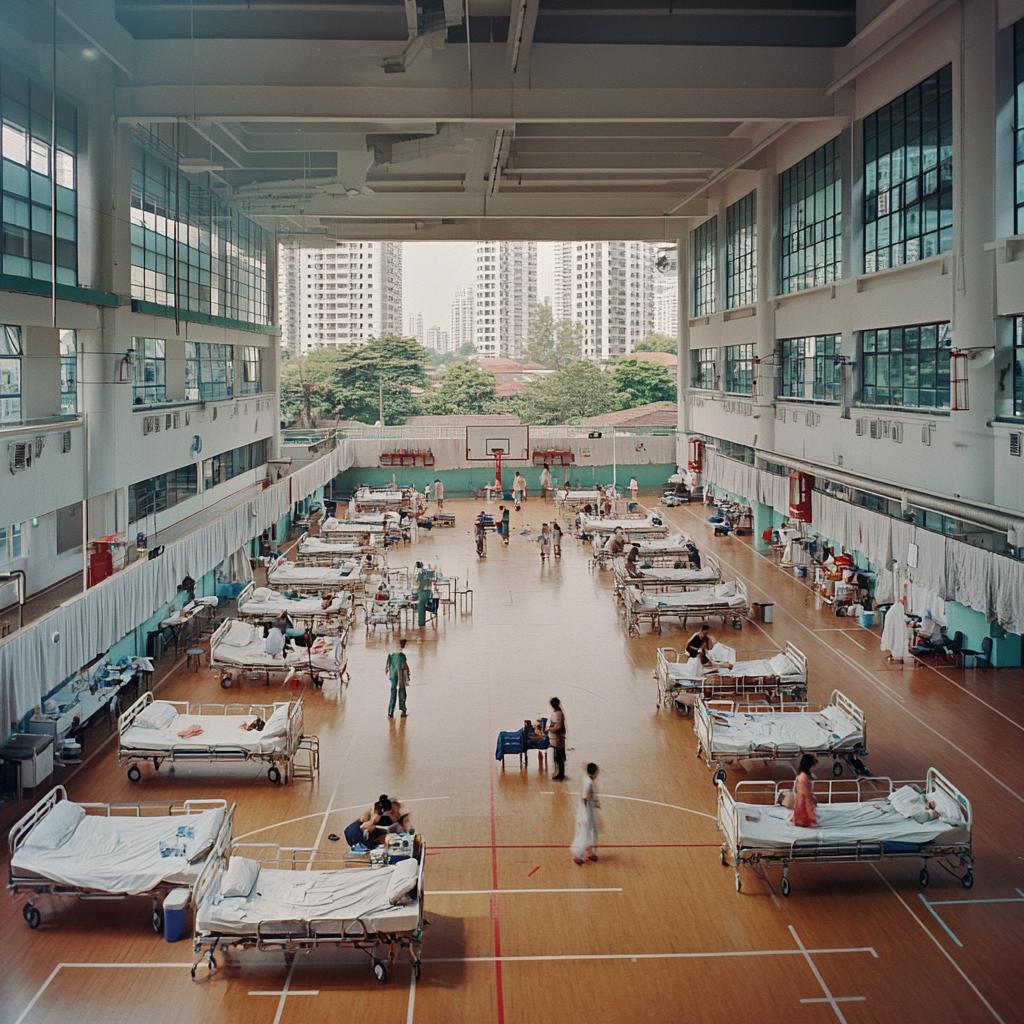
Against a backdrop of basketball hoops and beneath the shadow of towering football goals, a sense of the surreal played out as hospital beds lined a sports hall, echoing the unshakable resilience of the Thai capital's spirit. Patients, temporarily displaced from a Bangkok hospital, found themselves sheltered from the aftermath of a seismic tumult that rattled more than just nerves.
A powerful and shallow 7.7-magnitude earthquake had brazenly announced itself in central Myanmar on a Friday afternoon, only to be trailed by an unsettling 6.7-magnitude aftershock. The earth's shiver extended its reach, felt in Bangkok over 1,000 kilometers (600 miles) to the south, unsettling buildings and cracking the air with a stark call to compassion and quick action.
Rajavithi Hospital, dealing with an emerging tumult of its own, swiftly embarked on a choreographed evacuation, as patients clung to escorts down stairways towards makeshift refuges, transforming spaces like the hospital's canteen and sports hall into sites of last-minute sanctuary.
It was Myanmar, however, that bore the brunt of nature's fury, the junta reporting a heart-wrenching loss of at least 1,002 lives, with nearly 2,400 more injured. In Bangkok, approximately 10 more lives were tragically lost, as the tremors rippled through the midday dive of Friday lunches, sowing chaos and anxiety.
At a construction site for a pioneering 30-storey government edifice, the drama of the disaster unfolded rapidly. Individuals leaped into vehicles, hastened footfalls echoed their escape, while others, amid gasps and heart-wrenching shrieks, absorbed the pandemonium rising around them.
The internet soon bore evidence of the quake's might; high-rise hotels quivered on their foundations, while water from rooftop pools surged and spilt, cascading down facades like liquid apparitions, an articulated portent captured on screen.
A palpable sense of fear gripped those at the hospital, where staff surmounted their own anxious hearts to efficiently relocate patients to safety. Among them was a leukemia patient, who, accompanied by solicitous nurses, meticulously descended flights of stairs, driven by the crucial need for continuous care.
"I need to receive my blood platelets soon," she confided to Agence France-Presse (AFP), speaking under the seal of anonymity. As transitions unfolded, patients were either ushered back into familiar wards or directed to other health facilities equipped to meet their urgent needs.
Even as morning leaned into Saturday, the hum of medical effort thrummed through the makeshift ward, where approximately 30 patients received basic care, including vital blood transfusions, from dedicated hospital staff.
An enveloping fear of further tremors curled through Bangkok's populace, persuading many to seek solace beneath open skies; they traded secure ceilings for confidential privacy under trees, fabricating a community of tents in public parks under the stars' vigil.
Into this climate of uncertainty, the city saw the emergence of human kindness as a balm for distress. Panadda Wongphudee, her charisma once crowned Miss Thailand, now rallied with determined goodwill. With a heart tuned to empathy and a keen sense for action, she distributed refreshments to tirelessly working rescue staff.



Comment verification
Step 1 of 3
Verify your email once to publish your comment. Your email is never shown publicly.
Enter the 6-digit code sent to .
Choose the display name shown next to your comments.