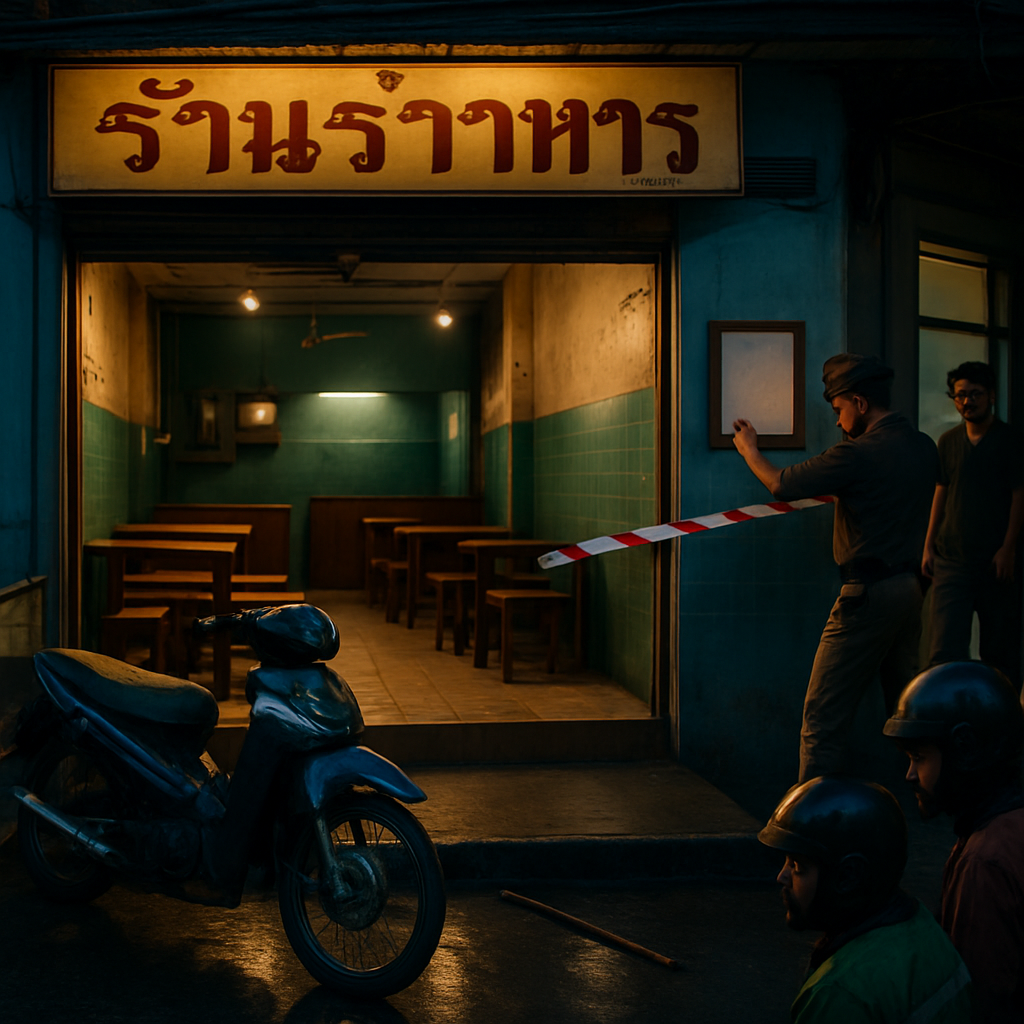
What started as a routine food delivery in Bang Bo, Samut Prakan, turned into a headline-grabbing melee that left three riders injured, six staff members out of a job, and a once-bustling restaurant shuttered indefinitely.
The short version (and the video that made it public)
On January 11, a food delivery rider approached a restaurant in Bang Bo. Calmly, he tried to speak with staff — but the situation escalated rapidly. A bystander’s phone captured the moment a Myanmar worker in a white shirt emerged from the establishment wielding a metal rod and allegedly struck the front of the rider’s motorcycle. What followed was a chaotic scuffle between the rider and several workers, three riders were left injured, and the footage quickly spread online.
Aftermath: firings, apologies and an empty restaurant
By the next day, January 12, authorities had taken swift administrative action. The restaurant was reportedly deserted when officials visited: just empty tables and a stage remained as mute witnesses to the previous night’s violence. The owner — a business partner identified as a 32-year-old Myanmar national named May — arrived later to speak with officers.
May told officials the venue had been operating for roughly two months and was legally registered as a food business. She acknowledged her staff had been involved in the altercation and, by her own account, initially attempted to deny fault. Ultimately, she admitted the workers “acted rashly” and attacked the rider first. All six employees implicated in the incident were dismissed, and May publicly apologized to the injured riders and to the Thai public.
Official response: paperwork, public order and consequences
Bang Bo police intervened at the scene to break up the fight, but their involvement didn’t end there. Inspectors discovered that although May said the restaurant was legally registered, no official documentation was displayed on-site. That lapse prompted the district protection officer to order the establishment closed indefinitely until the necessary paperwork is presented and reviewed.
Authorities used the episode to remind other business owners of two simple rules: get your registration in order, and don’t let workplace disputes spill out into public disturbances. It’s a blunt lesson in how easily a localized conflict can become a municipal headache — and a public relations disaster.
Why this matters beyond the scuffle
Violence against delivery workers has become a recurring concern in cities around the world, and this incident highlights how volatile interactions can be when tempers flare. Delivery riders perform a high-volume, time-sensitive job and often have to negotiate crowded streets, misunderstandings, and occasional hostility. When an argument is met with a metal rod rather than a conversation, the risks multiply.
There’s also a regulatory angle. Displaying valid business documentation isn’t just bureaucratic red tape — it helps authorities act quickly and appropriately when incidents occur. The restaurant’s indefinite closure until paperwork is produced isn’t merely punitive; it’s a practical step to ensure all operations meet legal and safety standards before reopening.
Not an isolated case
The Samut Prakan incident isn’t unique. In related news, police in Pattaya are investigating a violent late-night brawl in which a group of Myanmar workers allegedly attacked a man and left him hospitalized. These recurring clashes have officials urging stricter adherence to law and order — and prompting communities to question how to prevent such episodes from repeating.
Takeaways
- Six Myanmar workers were dismissed after an altercation on January 11 left three riders injured; the restaurant was closed indefinitely the next day.
- A viral video shows a worker using a metal rod to strike a delivery motorcycle, sparking the melee.
- The owner admitted the staff acted rashly and apologized; she said the venue had been operating for about two months.
- Although reportedly registered, the restaurant did not display official documentation on-site and must present it before reopening.
- Authorities are reminding business owners to register properly and maintain public order; similar violent incidents have occurred elsewhere, including Pattaya.
In short, what could have been a small confrontation turned into a cautionary tale about impulse, accountability, and the value of keeping your paperwork—and your temper—in order. For the delivery riders and the injured, the focus now is recovery and justice; for businesses, the message is clear: be legal, be visible, and for everyone’s sake, keep the rods in the shed.


















This is outrageous — a metal rod over a delivery mix-up? That crosses the line from bad service to criminal. The owner should be held fully accountable and not just quietly reopen after paperwork is shown.
I saw the clip and the aggression seemed unprovoked until the rider maybe bumped something, but still, swinging a rod is insane. Businesses need better conflict training, not just firings. Six people fired is just the start; there should be legal consequences too.
Sometimes people react wildly when they feel disrespected, but that doesn’t excuse violence.
Agreed, training isn’t a magic fix but it would help; the pattern of violence against riders is worrying. We also need platforms to enforce codes of conduct on restaurants.
This headline is fuel for anti-migrant sentiment and that’s dangerous. Yes violence is unacceptable, but let’s not generalize about Myanmar workers from one restaurant.
I get your point about generalization, Larry, but communities deserve safety too. When incidents repeat, people worry and demand action, not xenophobia.
I’m not excusing violence either, but labor precarity and long shifts can make tempers flare. Employers share the blame for poor oversight.
Neither side should be romanticized; delivery riders risk a lot for little pay, and workplace discipline must be stricter across the board.
Fair points all, I just fear the wrong narrative will be used to scapegoat migrants instead of fixing systemic issues.
Delivery riders are heroes who get abused on the street and online. This incident shows how vulnerable they are, and they deserve better legal protection. Public outrage should turn into policy change.
Totally. The platforms must intervene when partner restaurants behave violently, or riders will keep paying the price. A no-violence clause with penalties is overdue.
Exactly, Sam — and riders should have easy access to legal support and incident reporting that actually leads to enforcement.
And insurance too. Too many riders work uninsured and can’t afford justice after being attacked.
Why is nobody asking why a place that supposedly had paperwork on file didn’t display it? That’s sloppy and suspicious. Closure was the correct immediate action.
Paperwork display is a small ask but often ignored by transient businesses. It helps regulators, so this should be enforced with fines until compliance is normal.
Exactly, Ravi — fines and public notices would make owners care. Right now the penalty is just bad PR for a day.
From a labor policy perspective, this incident sits at the intersection of informal work, migrant labor rights, and inadequate enforcement. Short-term dismissals address the symptom but not the structural causes. The indefinite closure is a prudent regulatory pause to assess compliance.
Well said. I’d add that municipal registries should be digitized and publicly verifiable to prevent such opacity. Transparent licensing reduces ambiguity during investigations.
Agreed, digitization and community reporting could both improve responsiveness. And there should be cross-border coordination on migrant worker protections to reduce exploitative conditions.
Coordination is ideal but hard. Local NGOs could step in to offer mediation and training to newly opened venues instead of only punitive responses.
Kick them all out and ban the owner forever.
That’s extreme, Tom. I agree consequences are needed, but lifelong bans without due process are dangerous. Let the courts do their work.
Due process doesn’t mean letting the same people reopen and hurt someone else.
As a local, this worries me because it stains the community’s reputation. We need both compassion for migrants and accountability for violence. Officials should push for cultural orientation sessions for new businesses.
Cultural orientation is nice but sometimes rules and consequences teach faster. If you’re going to open publicly, follow the law and don’t attack people.
True, Nina; the point is to combine education with enforcement so it doesn’t keep repeating.
Orientation can be patronizing. Mandatory safety training and clear fines work better than lectures.
I keep thinking about the injured riders; hope they recover and get compensation. Viral videos help accountability but also can mislead if taken out of context. Still, the rod swinging looked bad in any clip.
Videos are double-edged: they reveal truth but can fuel mob justice. Authorities need to act fast and transparently after such clips go viral.
Yes K, transparency is key so the public sees justice happen and not just online outrage.
This incident is symptomatic of urban governance gaps: informal workforces, weak enforcement, and social tensions. Short-term closures are fine, but we need systemic reforms in labor inspection. Otherwise these flare-ups will recur.
I agree — but reforms cost money. Municipalities must prioritize budget for labour inspectors and community outreach, or privatize some compliance functions responsibly.
Budgeting will require political will, which only comes from public pressure and media attention. Sadly, many incidents fade from memory without lasting change.
As someone who runs a restaurant, I sympathize with both sides but violence is never the answer. Owners should train staff on conflict de-escalation and make it part of opening checklists. The industry needs clearer codes of conduct enforced by platforms and local authorities.
From a rider’s view: training and checklists don’t help when you’re cornered by a group. Platforms need to back riders immediately and suspend partner restaurants that show violent behavior.
DeliveryBoy23, that’s fair. Immediate suspensions pending investigation would protect riders and signal zero tolerance.
Platforms have the power but rarely act fast; money seems to slow decisions more than safety does.
This is why proper registration matters. It’s not just paperwork; it’s about traceability when something goes wrong. I’m glad authorities closed the place until papers are shown.
Video culture is wild. One clip can ruin lives, but sometimes that’s the only way justice happens. Mixed feelings here.