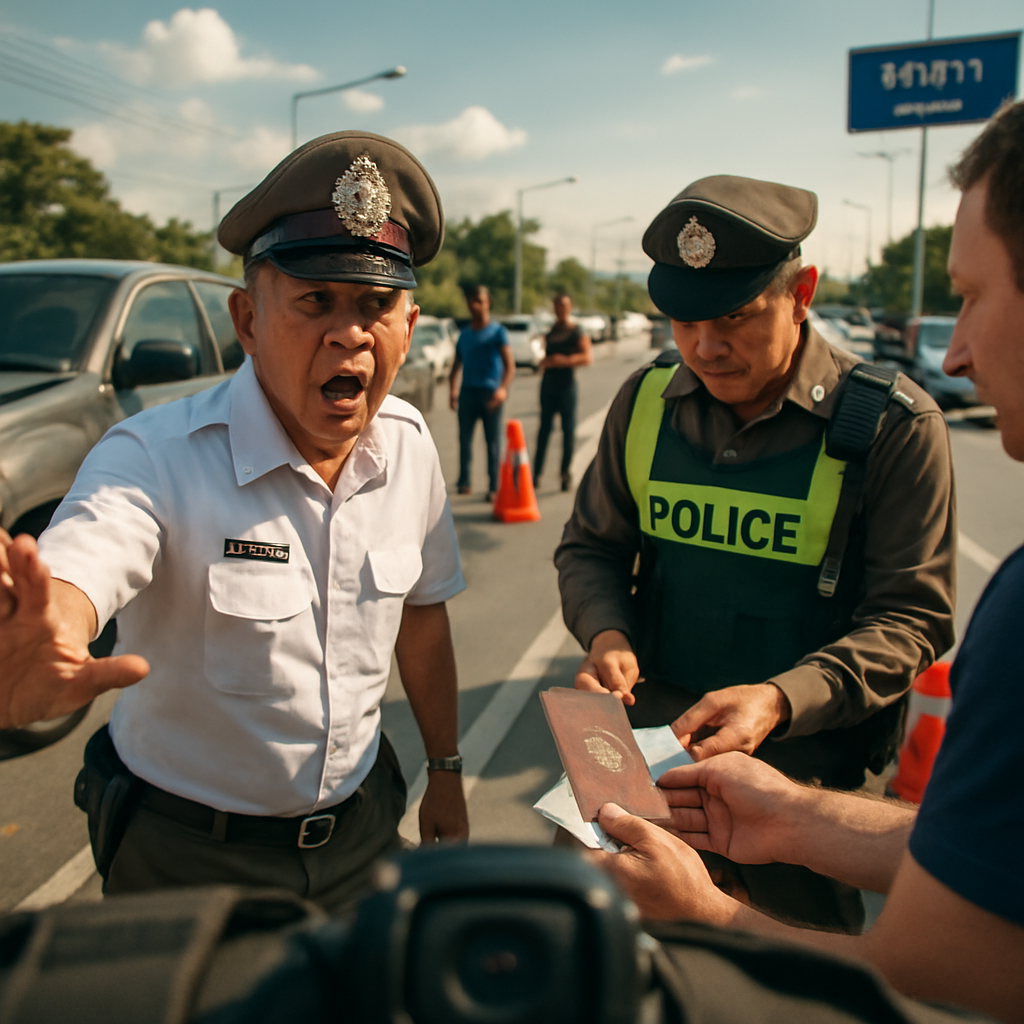
When a routine patrol turned into a roadside showdown, the sleepy stretch of highway in Chon Buri suddenly felt like the opening scene of a police procedural — only this one came with bodycam footage and a very public dispute between two officers from different provinces.
On New Year’s Day, a traffic incident escalated into a clash of rank, rights and responsibility after a pickup truck from Rayong collided with a foreign motorist’s vehicle. The footage, shared by the officer involved in the investigation, identified him as Police Sergeant Saeb from Phanat Nikhom Police Station. The other man — wearing a white shirt stamped with the Royal Thai Police insignia and claiming to be a captain from Mueang Rayong Police Station — refused to follow basic post-crash protocol.
Here’s what the camera (and the reporting officer) captured: Sergeant Saeb arrived on scene to find the Rayong officer arguing loudly with the foreign driver at the left lane of the road. Saeb began the expected checks — asking both drivers for their licenses and documents. The foreign motorist complied immediately, producing valid identification and a legal driving licence. The Rayong officer, however, balked.
Instead of producing his paperwork, the Rayong officer reportedly insisted his rank exempted him from the routine, repeatedly asserting his police status and demanding the investigation target the foreign driver. He also alleged the foreign motorist was in Thailand illegally — an accusation that, according to Saeb’s check, proved false. Saeb verified the foreigner’s legal status and licence and concluded the foreign driver was not at fault in the collision.
What might have been a straightforward exchange turned combustible. As tempers flared, the Rayong officer raised his voice and demanded respect, invoking age and seniority. Saeb, meanwhile, maintained he had shown proper deference but was simply doing his duty. The dispute shifted from the crash itself to a power play: the Rayong officer asking for Saeb’s full name and allegedly threatening to use his influence and connections against him.
It’s an all-too-familiar script for anyone who watches viral bodycam clashes: rank meets accountability, and civilians end up shouldering the confusion. But there are a few details that cut through the drama. First, the foreign motorist cooperated fully and had legitimate documents. Second, the investigating officer reported the Rayong officer’s refusal to follow protocol and his subsequent conduct. Sergeant Saeb has filed an official complaint accusing the other officer of obstructing justice and insulting a fellow officer performing his duties.
As of the last update, authorities have not announced any disciplinary measures against the Rayong officer. That silence has left questions hanging in the air almost as loudly as the confrontation itself: How often do internal disputes like this go unaddressed? What happens when one officer uses rank as a shield against standard procedures? And perhaps most importantly, how soon can the public expect transparency on the follow-through?
Beyond the legalities, the episode is a reminder that even those sworn to enforce the law can sometimes act as if they’re above it. Whether it’s a misunderstanding that spiraled or a deliberate attempt to avoid accountability, the optics are bad: a uniformed officer refusing to show a licence after a crash undermines the principle that no one is above traffic laws, regardless of badge or belt.
Public reaction — as you might expect in the age of social media and bodycam virality — has been swift. Citizens and netizens alike tend to side with transparency, and footage that appears to show a senior officer refusing to cooperate rarely sits well with viewers. The clip shared by Sergeant Saeb has only amplified calls for a clear response from police leadership in Rayong and Chon Buri.
For now, the most concrete outcome is procedural: Saeb filed his report, and the foreign motorist’s documents were verified. The unresolved part — whether there will be disciplinary action, a formal inquiry or even an internal reprimand — remains up in the air. Police agencies would do well to move quickly, if only to restore public confidence and demonstrate that rules apply equally, regardless of rank.
Until then, this incident serves as a small but pointed case study in why routine police procedures exist — whether you’re on a quiet highway in Chon Buri or the boulevards of Bangkok. When everyone follows the same steps after an accident, the facts become clear and tempers have less room to turn into disputes. When they don’t, cameras and complaints pick up the slack.
It’s worth watching how the story develops: will the Rayong officer face consequences, or will the matter fade into departmental discretion? Either way, the clip released by Sergeant Saeb has already done something important — it reminded the public, in very sharp focus, that accountability often begins where the bodycam ends.


















This clip is a textbook case of why bodycams matter; the rules exist to protect everyone, including officers. If rank can be used to dodge protocol, trust erodes quickly. I hope an impartial inquiry is launched and its findings are published.
That cop sounds like he thinks he is untouchable. It’s scary when people in uniform behave like that.
Untouchability isn’t just perception; it’s systemic when departments lack transparency and accountability mechanisms. Independent oversight with public reporting would deter this kind of behavior.
Exactly, Raj. Internal affairs need teeth and public disclosure; otherwise these incidents just simmer and recur.
Why not just fire him? Seems simple to me.
If an officer refuses to show a license after a crash that’s basic negligence. Rank isn’t a magical cloak.
He said ‘respect’ and then acted like a bully. Kids at school do that too.
Bullying in uniform is worse because it carries power. The foreign motorist did everything right and was still harassed.
I’m rejoining because some defenders are saying context matters, but context can’t replace procedure. The officer’s duty was clear.
Procedural compliance is foundational to rule-of-law legitimacy. If enforcement is discretionary along rank lines, legal safeguards are hollow.
I’ve seen similar viral clips before where nothing happens after the outrage fades. I’ll believe consequences when I see them.
Same here. Social media outrage is loud but short-lived. Real reforms take sustained pressure.
I’m glad you agree, Maya. We should demand transparency on investigations rather than just trending videos.
This smells like protectionism within the force. If your badge means you skip rules, what’s the point of laws? People will lose faith.
Loss of public faith has tangible consequences—fewer witnesses, less cooperation, and more vigilantism. It snowballs fast.
Exactly, Elena. It’s not just a single incident; it’s the ripple effects that worry me.
Are there watchdog groups in Rayong and Chon Buri who can push this? Someone needs to keep tabs.
There are civil society organizations but they often lack access or resources. Institutional reforms would be far more effective than ad hoc watchdog work.
The foreign driver followed the rules and still got accused of being illegal. That’s blatant discrimination.
Maybe the Rayong officer was stressed and acted poorly, but viral clips can be misleading without context. We shouldn’t rush to criminalize a single conversation.
Context matters, but the footage shows refusal to follow standard checks. Stress doesn’t excuse obstructing a lawful process.
I hear that, Samira. Still, I hope any inquiry is fair to all involved and not just a public shaming.
Fairness means due process for the accused and transparency for the complainant; both can coexist if institutions are robust.
From a governance perspective, this incident illustrates principal-agent problems within policing and the need for performance monitoring tied to accountability. Video evidence reduces information asymmetry but must be coupled with institutional response.
Good point, Dr. Chen. Video is only the first step; the follow-through determines systemic change.
Exactly — policy design should ensure camera evidence triggers independent review and remedial action, not mere spectacle.
I feel bad for the foreigner. People often face microaggressions that escalate into something worse.
What if the Rayong officer was trying to protect a colleague or family member? Maybe there’s more beneath the surface.
Speculation like that can let bad behavior slide. If there’s evidence of favoritism, it should be investigated, not assumed as justification.
The claim about the foreigner being illegal was easily checked and wrong. False accusations by officers are especially dangerous.
False accusations can ruin someone’s life. This is more than procedure; it’s about preventing abuse of power.
Right, Joe. Accountability protects both civilians and the reputation of honest officers.
I wonder if the Rayong guy will get a slap on the wrist and then act the same next year.
That’s the problem with symbolic disciplinary measures; they don’t change behavior if not enforced consistently and publicized.
Makes me think cameras are only useful if people actually act on what they show.
Legally, refusing to produce identification in the aftermath of a collision could constitute obstruction depending on statutes. The procedural norms exist for evidentiary and safety reasons.
Yes, and the legal remedies must be paired with administrative consequences to alter incentives for officers.
Agreed. Remedies should be comprehensive and transparent to restore public trust.
Public trust is fragile. One high-profile incident handled poorly can undo years of community policing efforts.
So true. People will start avoiding cops or filming everything, which could be good or bad.
Internal hierarchies that reward loyalty over lawfulness are a structural hazard. Reforms need to address promotion criteria and complaint handling.
Changing promotion criteria is easier said than done. Institutions resist, but it’s worth discussing.
Resistance is exactly why transparency and external oversight are crucial — they create pressure for reform.
The foreigner did nothing wrong and still got accused. That should be a headline on human rights, not just local news.
This also raises diplomatic concerns if foreign nationals feel unsafe dealing with law enforcement. Countries care about how visitors are treated.
Honestly, a clear public statement from both departments would calm nerves. Silence breeds suspicion.
Yes, a transparent timeline of the investigation would help. Even interim steps would show the matter is taken seriously.
I’ll believe it when I see it, but communication is a cheap and effective start.
Sometimes footage lacks context like prior interactions or threats, but here the facts are straightforward: refusal to provide documents after a crash is indefensible.
Context rarely negates clear statutory obligations. If officers can point to context to avoid compliance, the norms become toothless.
Why is there no mention of what disciplinary channels exist locally? People need to know how to follow up.
There are channels, but accessibility and independence vary. This is why national standards matter.
Okay, but citizens should still be guided on who to contact. Silence is unhelpful.