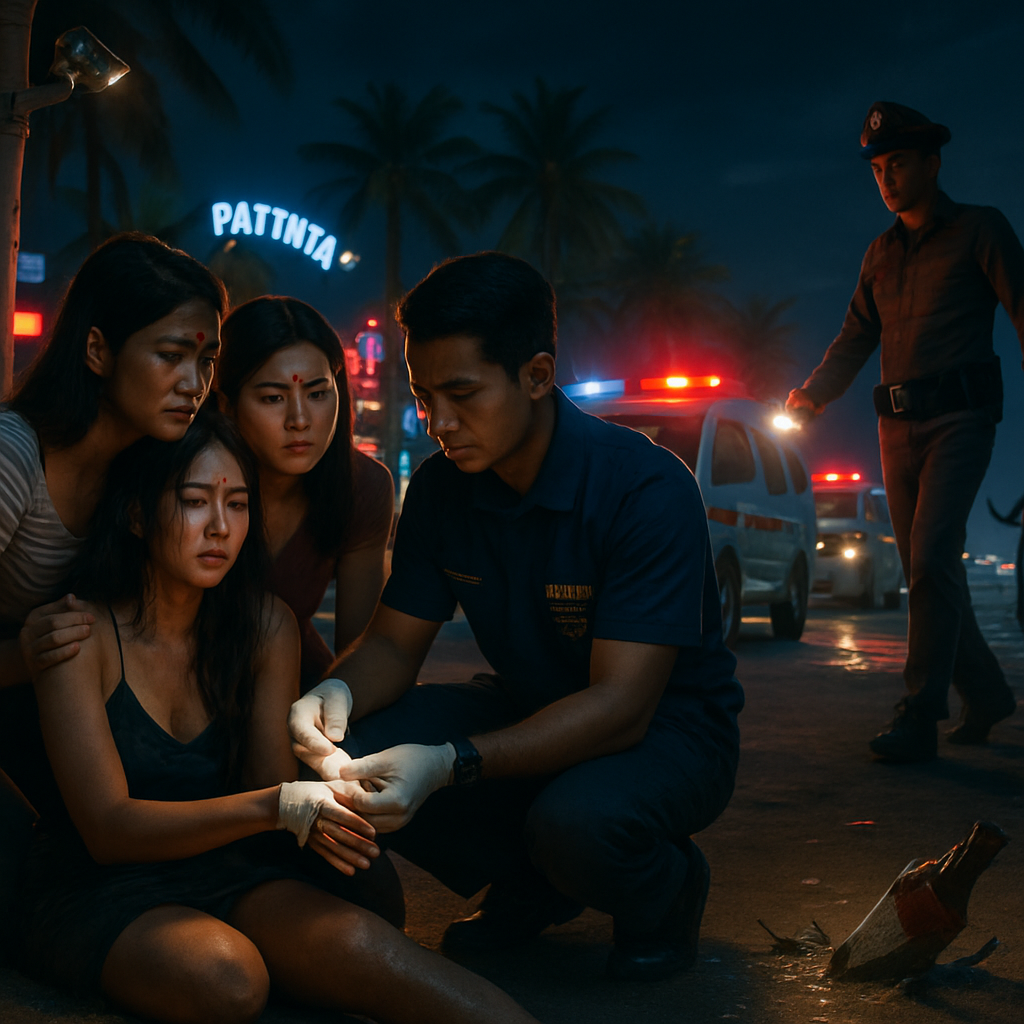
In the early hours of January 21, a peaceful stretch of Pattaya Beach was shattered by a violent confrontation that left a 22-year-old transgender woman with a serious hand injury. The victim, identified as Sila from Khon Kaen province, was attacked at around 1:50 a.m. when a man — described by witnesses as muscular and of unknown nationality — allegedly turned a disagreement into a brutal assault using a broken glass bottle.
According to the account given to Pattaya City Police, Sila and several friends were standing along the beachfront offering companionship services when the man approached and began questioning why they were there. What started as a tense negotiation about fees quickly escalated. The man allegedly walked away after failing to agree, only to return moments later carrying a roughly two-metre wooden stick. He chased the group, smashed a bottle and used the jagged glass shard to slash Sila’s right hand before fleeing the scene.
Rescue workers from the Sawang Boriboon Thammasathan Foundation and officers from Pattaya Police Station arrived promptly after the incident was reported. They found the group visibly shaken and Sila with a deep laceration to her right hand. Emergency first aid was administered on site before she was transported to a local hospital for further treatment. Sources say the wound was severe and required immediate medical attention.
Pattaya police have collected witness statements and launched a manhunt for the suspect. Investigators are combing through CCTV footage from the beachfront and surrounding areas in hopes of identifying and tracking down the attacker. As of now, no arrests have been made; however, police officials stated that the suspect will face legal action once apprehended.
This incident has raised alarm bells in the local community, particularly among sex workers and LGBTQ+ groups who frequent the beachfront at night. While Pattaya’s nightlife is famous for its vibrancy, incidents like this underline persistent safety concerns for vulnerable communities working in public areas after dark. The presence of rescue volunteers and the quick response from law enforcement were praised by witnesses, but many are calling for increased patrols and better protections to prevent similar attacks.
Context matters: this is not an isolated event. Earlier in January — on the 9th — Pattaya Beach was the scene of another violent altercation in which a brawl between two women reportedly ended with one being stabbed by a sharp metal object. Together, these episodes have prompted renewed discussion about public safety, street lighting, CCTV coverage and the need for readily available medical assistance on busy tourist strips.
Local advocacy groups are urging authorities to do more than just investigate after the fact. Suggestions include increased night-time policing, dedicated outreach teams for sex workers and transgender individuals, and public-awareness campaigns aimed at reducing harassment. Community leaders also emphasize that legal protections must be enforced consistently to ensure that victims can feel safe coming forward without fear of stigma or retaliation.
For now, the focus is on Sila’s recovery and on catching the person responsible. Witnesses continue to be interviewed and police are reviewing video from nearby cameras. Anyone with information about the attack or who may have seen a man matching the description — muscular, possibly foreign, carrying a wooden stick — on Pattaya Beach around 1:50 a.m. on January 21 is asked to contact Pattaya City Police. Even small details can help investigators piece together what happened and lead to an arrest.
Beyond the immediate investigation, this episode serves as a stark reminder that nightlife districts need both the shimmer of tourism and the scaffolding of safety. Pattaya’s beachfront draws thousands every night, and the city must find ways to balance its electric social scene with stronger measures to protect all who live and work there — including transgender women like Sila, who should never have to fear for their safety while earning a living.
Updates will follow as authorities continue their inquiries. In the meantime, community groups plan to step up support for those affected and to press for practical changes to reduce the risk of similar attacks in the future.


















This is horrible. People should not be attacked for who they are or for doing a job. Police need to find the man and fast.
Agreed, but we also need to ask why the area is a hotspot for violence and what local authorities are doing about patrols and lighting.
Exactly, better lights and patrols would help, but it also comes down to enforcement and community trust in the police.
Why do sex workers get so much sympathy while regular citizens feel unsafe too? This feels one-sided.
That’s a false choice. You can care about safety for everyone and still call out attacks that target marginalized people.
This could escalate if not addressed. CCTV review must be thorough and public calls for witnesses should continue.
The gendered violence angle matters here. Transgender women already face higher risks and stigma often stops them from seeking help.
From a criminology perspective, marginalization increases vulnerability. Outreach teams that build relationships with sex workers reduce violence over time.
Yes, and those teams need training on transgender issues and legal protections, not just patrol uniforms.
Police are reviewing CCTV and interviewing witnesses. But community reporting and cooperation are essential to locate the suspect.
Thanks for the update. Transparency about progress would help rebuild trust with vulnerable groups.
If he was foreign why mention it? Sounds like blame-shifting to outsiders instead of addressing local lawlessness.
Mentioning nationality matters for identification, not blaming. Still, assumptions about foreigners can be dangerous.
Fair point, but we must be careful not to let fear inflate xenophobia.
This incident reflects systemic failures: inadequate lighting, inconsistent policing, and social stigma. Policy interventions must be multi-pronged.
What policies do you mean specifically? More cops or more social services?
Both. Targeted night patrols, community liaisons, medical first-response points on tourist strips, and anti-discrimination enforcement.
Donations and outreach are fine, but laws must protect sex workers and trans people so they can report crimes without fear.
Also analyze CCTV placement and response times. The tech is only useful if someone acts on footage quickly.
I don’t trust the police to do more than write a report. This will fade from headlines and nothing changes.
I’ve seen it before. Public outrage dies down and vulnerable people keep getting hurt. We need sustained pressure.
We should also focus on first aid training for people who work there. Immediate help can mean the difference between recovery and worse.
Volunteer rescue groups helped here and they deserve support. But formal medical stations would be better than only volunteers.
Exactly, integration between volunteers and official services would save lives and build trust with sex worker communities.
Local tourism boards will be furious but safety is more important than nightlife profits. The city must act now.
Tourism brings money and jobs; over-policing could hurt livelihoods. Balance is needed, don’t destroy the local economy.
No one proposes destroying tourism. Simple safety upgrades protect both workers and tourists and can boost business.
Businesses should chip in for street lighting and security cameras. Corporate responsibility is real here.
And fund training for staff to de-escalate conflicts. Prevention is cheaper than medical bills and bad press.
We ask anyone with information to contact Pattaya Police. Witness cooperation has been good but CCTV remains crucial.
Will the police protect witnesses from retaliation? That’s why some people stay silent.
Witness protection protocols exist and we encourage people to come forward; anonymity can be preserved where necessary.
The narrative that places with lots of nightlife are inherently unsafe is too simplistic. It’s policy choices that shape safety levels.
Agreed; urban design, lighting, policing strategy, and social programs all interact. Evidence-based approaches reduce violence.
I lived in Pattaya for a year. Small changes like more visible patrols at night made me feel safer, so it works in practice.
Also, community awareness campaigns changed how locals treated vulnerable groups, which cut harassment down a lot.
This could have been a hate crime. Are local hate-crime statutes strong enough to set an example?
Many laws exist on paper, but enforcement is patchy. Advocacy must push for consistent application of protections.
Social media can help identify suspects quickly but it can also spread misinformation. Be careful with online manhunts.
True, doxing innocent people worsens harm. Encourage verified tips to police instead of rumors on Facebook.
I’m donating to help with medical bills. This is personal for many of us and we must show up for survivors in concrete ways.
Community-led patrols could help temporarily, but they need training and legal backing. Amateur vigilante measures are risky.