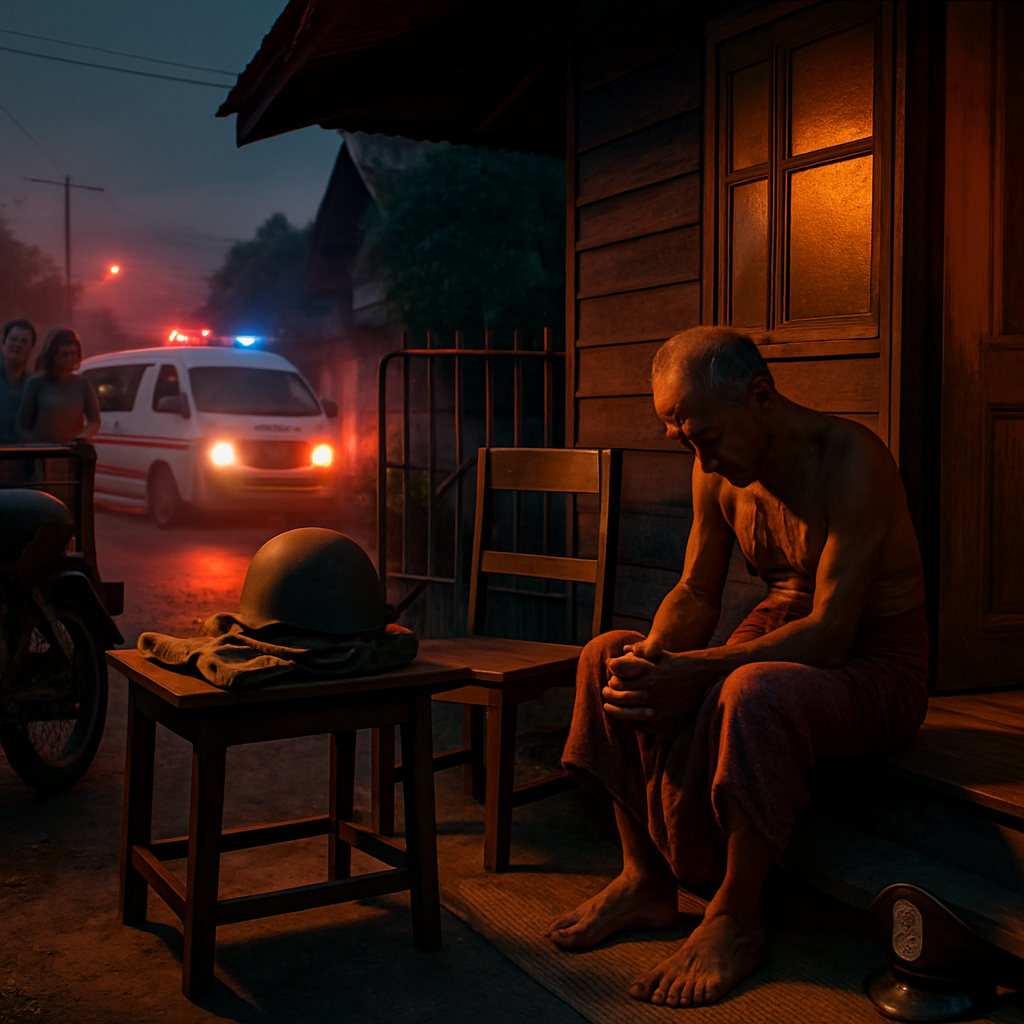
What began as an ordinary January morning in Ubonrat district, Khon Kaen province, turned into a tragic and brutal confrontation that left a soldier dead and a former police officer fighting for his life. The incident, which unfolded around 9:30 a.m. on Monday, January 6, has stunned the local community and left relatives searching for answers.
The victim was 51-year-old Sergeant Major First Class Sangkhom Tonlo, a soldier who had just returned from duty along the Thai-Cambodian border. The suspect, identified as 67-year-old Chainat Nongpue, is a retired police officer and a relative of Sangkhom. According to witnesses, including Sangkhom’s 72-year-old uncle, Sakhon Kunkwan, Chainat arrived at the house on a motorcycle and entered the property without permission while Sangkhom was on the phone.
What followed was sudden and violent. Chainat reportedly attacked Sangkhom from behind, stabbing him multiple times. A desperate struggle ensued; Sangkhom managed to wrestle the knife free and stabbed Chainat in the exchange. Both men were rushed to Ubonrat Hospital, but despite emergency care, Sangkhom later succumbed to his injuries. Chainat was left in critical condition and is currently under medical supervision.
The image of a soldier returning from frontline duty—exhausted, perhaps grateful for a few days at home—and then falling victim to such violence is the kind of story that reverberates through a town. Sangkhom had reportedly been stationed at Chong An Ma, a border area in Nam Yuen district of Ubon Ratchathani province, where tensions and clashes had kept troops on alert. His uncle described him as well regarded by neighbours and family, a man known for helping others. He had come home for a brief respite, having only just been granted time off from the intense assignment.
Community members and relatives say the two men had a long-standing conflict, though the precise cause remains unclear. Sakhon, who witnessed the attack, told reporters he did not know what specifically triggered Chainat’s sudden assault. Police from Ubonrat Police Station have said they are closely monitoring Chainat’s medical condition and intend to conduct formal questioning and press legal charges once he is medically fit to be interviewed.
Stories like this are grim reminders that personal disputes can spiral into fatal outcomes, even between relatives. The twist in this case—that the assailant is a retired police officer and the victim a serving soldier—adds an extra layer of shock. People expect de-escalation from those who once wore a uniform to protect the public, and the contrast between duty and domestic dispute has left neighbours struggling to reconcile what they thought they knew about both men.
Local authorities are now balancing two sensitive tasks: ensuring Chainat receives necessary medical treatment and preserving the integrity of the investigation. Medical teams at the hospital have been providing critical care, while investigators collect witness statements and piece together the timeline. Given the severity of the injuries and the familial ties, this case is likely to attract close scrutiny as investigators try to understand motive, opportunity and any history that might explain the sudden escalation.
Adding to the region’s recent wave of alarm, law enforcement officials noted a separate fatal stabbing on January 4 in which a drunken customer allegedly killed a restaurant waiter following an argument about a missing bucket of ice. That case, while entirely separate, has contributed to a sense of unease in local communities about how quickly tempers can explode into lethal violence.
For Sangkhom’s family, the loss is immediate and raw. Neighbours remember him coming home for the New Year holiday in past years and hope that the community will rally around his loved ones during this painful time. For Chainat, who is hospitalized in critical condition after being stabbed during the struggle, the coming days will determine not only his recovery but the legal path that follows. Police have been clear: once he is stable, formal questioning and any resulting charges will proceed.
As investigators continue their work, several questions remain: What was the long-standing conflict about? Did either man attempt to seek help beforehand? And how will a small community heal after such a violent rupture in a family? In the meantime, the people of Ubonrat and surrounding districts are left to mourn, reflect and await answers.
Tragic incidents like this underscore the fragility of peace in everyday life and the importance of conflict resolution before grievances escalate. For now, attention turns to the hospital wards, the police reports and the quiet mourning of a family who lost a son and a neighbour who once patrolled the roads in uniform. The hope is that clarity—and justice—will follow, offering at least a measure of closure to those most affected.


















A retired cop stabbing a soldier who just came home is sickening. How does someone who once wore the badge end up attacking family like that? We need answers and accountability now.
Maybe long-term grudges finally boiled over, or untreated trauma. But people expect de-escalation from ex-officers, not sudden violence.
From a healthcare view, both men needed immediate support long before the knife. Communities often lack services for conflict and PTSD, especially around veterans and ex-officers.
Police culture fosters impunity and simmering anger sometimes, that’s the problem. If the community had mechanisms to intervene, maybe this wouldn’t have escalated.
Blaming ‘culture’ is easy but vague. We need specific reforms, not slogans.
You’re right to ask for specifics, Larry, but the pattern keeps repeating. Accountability mechanisms, mental health checks, and community mediation could help prevent repeats.
My heart breaks for the soldier’s family. He came home for a brief rest and never made it; that feels so unfair. Small towns feel this loss deeply.
This is so sad. Why would someone hurt their relative like that?
Thanks, Maya. It’s confusing for everyone close to them, and rumours will only make pain worse.
There are often old property or money disputes in families here that fester for years. It may not be heroic but it’s common.
Intergenerational disputes and cultural norms about face and honour can magnify grievance. The forensic timeline and prior complaints will be crucial for investigators.
This reads like an acute escalation of a chronic interpersonal conflict with possible underlying mental health issues. The fact that both men were able to inflict wounds suggests a chaotic struggle rather than a premeditated ambush. Authorities need to document prior incidents and medical histories carefully.
As someone with a military background, I find it hard to accept violence against a comrade. That said, soldiers returning from intense duty can be emotionally fragile, and family dynamics complicate things.
Exactly — discharge evaluations and reintegration support are often inadequate, and we should consider whether Sangkhom had access to post-deployment care.
From what locals say, these two had a long conflict. Not everything ties back to service, sometimes it’s simpler and uglier.
If retired officers start attacking family like normal people, what does that say about training and oversight? There should be mandatory check-ins for retirees who handled traumatic cases.
Mandatory check-ins sound fine but who enforces them? Bureaucracy rarely reaches the rural areas in effective ways.
Enforcement is hard, but community-led watchdogs and local mental health funding might fill the gap. Waiting for national policy won’t save lives.
Watchdogs are just theatre if local officers cover for each other. We need transparency and external review panels, nothing cozy and local.
This is so scary and sad. He was a soldier and came home for the New Year. People should be nicer to each other.
You have a point, Maya. Civility and conflict resolution skills are undervalued, and tragedies like this show the cost.
Also, why did no one stop it? An uncle saw it happen and couldn’t stop it, that makes no sense to me.
From a tactical standpoint, returning soldiers are trained to react under threat which complicates domestic altercations. The law will need to assess intent versus self-defense.
Intent and self-defense both depend on credible timelines and wound patterns. Forensic analysis and witness statements will be central to fair adjudication.
Agreed. The community must resist snap judgments until evidence is clear, even if emotions run high.
Resisting snap judgments is ideal but people already distrust the process. Clear, timely communication from police can help rebuild trust.
I smell cover-up. Retired cops and soldiers often protect one another. Watch how fast investigations slow down once a ‘health’ excuse pops up. Be skeptical.
Conspiracy talk only makes grieving families angrier and tensions worse. Evidence matters more than suspicion.
Skepticism is rational when institutions have histories of hiding things. Demand transparency and independent oversight.
As someone who works in the hospital, I can say both outcomes are handled medically first. Legal procedures follow later, but families often get upset by delays.
Sad story. Two men who once served the public ended up in a family feud that killed one. The local court should act quickly.
Quick action is fine but not at the cost of a flawed investigation. Let them collect all facts first.
I meant speedy justice, not rushed forensics. People want closure and a sense that the law works.
Closure rarely solves root causes. Let’s push for prevention too, not just punishment.
Hospitals often see the immediate aftermath but not the lead-up. Violence like this reflects social stresses and gaps in local support systems. Families need counseling and financial help after such losses.
Counseling sounds good. But will the poor families get it? It feels like only rich people do.
That is the tragic truth, Maya. We should advocate for accessible services so everyone can heal.
I knew both families a little; tensions had been simmering for years. This was a preventable tragedy, not some random act of fate.