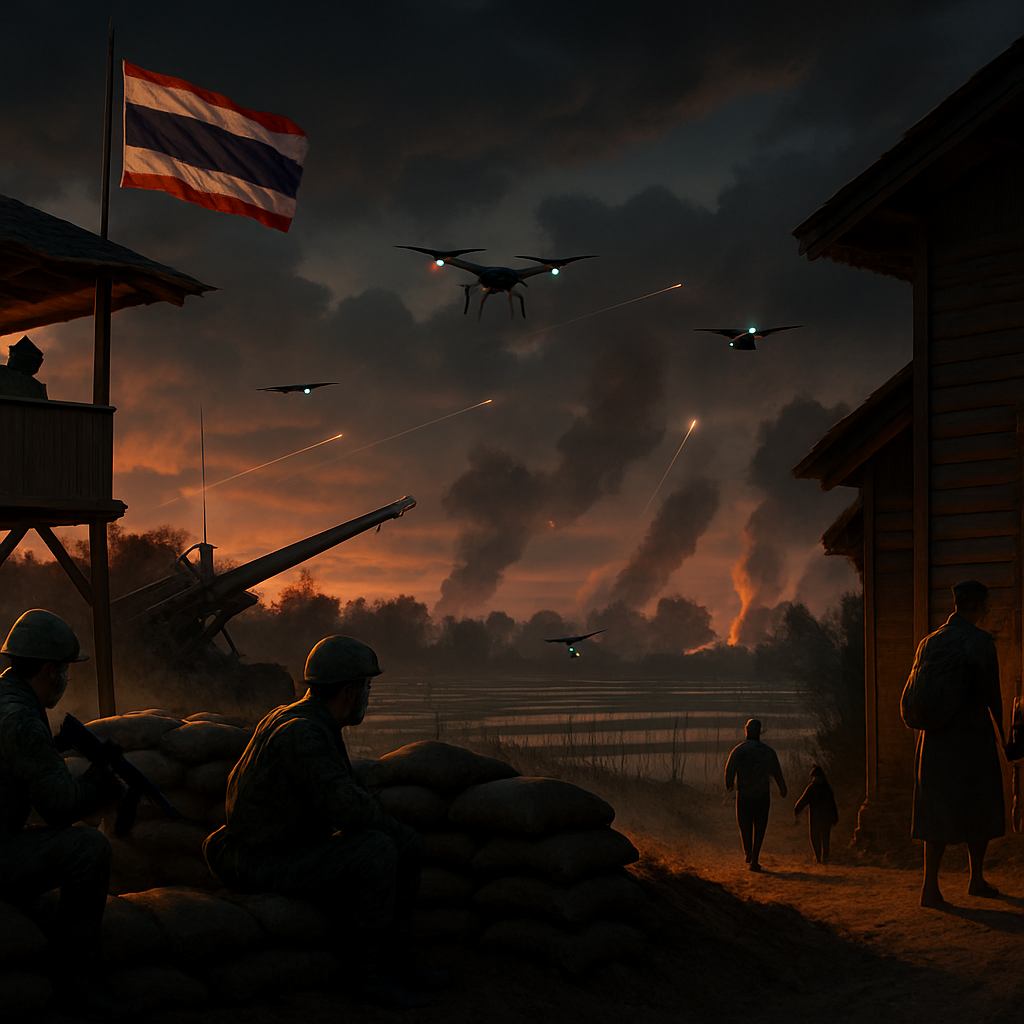
The 2nd Army Region released an update on December 26 detailing a tense day along the Thai–Cambodian border, with the heat of the fighting concentrated in Sisaket province. According to the army, skirmishes flared at multiple points along the frontier, but Thai forces held firm and maintained control of all strategic positions. Troops in neighboring Ubon Ratchathani were also placed along the border, particularly in the Chong Bok and Chong An Ma areas, as commanders pushed to reinforce defensive lines, hasten fortification construction, and clear Cambodian bunkers to stabilize the front.
Sisaket: The epicenter of exchanges
Sisaket emerged as the flashpoint of the day. The stretch running Sam Tae–Don Tual–Phu Phi–Sattasom–Phnom Prasitthiso–Chong Ta Thao saw frequent supporting fire from Cambodian positions, and Thai units answered with a mix of artillery and drone strikes. While the army reported no full-scale ground assault, it did say a convoy of five Cambodian vehicles was identified and destroyed in the evening — a sharp tactical moment that punctuated the day’s clashes.
Another intense sector was Pha Mor E Daeng–Huai Ta Maria, where artillery rounds thundered from dawn into the night. Cambodian forces reportedly employed BM-21 multiple rocket launchers in the area; Thai artillery then targeted and destroyed supporting weapons positions. The army acknowledged that some Thai personnel sustained shrapnel injuries during the exchanges but emphasized that command lines and defensive positions remained secure.
In the Phum Makheua–Chong Don Aow–Phlayan Yao–Phlayan Hin Paet Kon corridor, Cambodian BM-21 rockets were detected before Thai forces carried out targeted drone strikes on identified launch sites. Elsewhere in Sisaket’s Chong Sangam sector, activity was relatively quiet and no significant incidents were reported during the update period.
Surin and Ubon Ratchathani: steady vigilance
Along the Surin province border, Thai commanders continued to deploy troops and bolster security measures. Artillery was used periodically to suppress suspected military targets, while surveillance reported Cambodian use of tanks, BM-21 rockets, and drone activity. Despite these provocations and intermittent small-arms fire, officials said there was no close-range assault on the Ta Muen Thom area and that Thai forces maintained control of the sector.
Ubon Ratchathani remained on alert, with soldiers arrayed along the full length of the border in key areas like Chong Bok and Chong An Ma. The army’s current posture combines fortified defensive positions with active reconnaissance, reflecting a dual focus on deterrence and preparedness.
Clashes in Buriram and civilian safety concerns
Fighting also spilled into Buriram province at the Sae Takoo border crossing during the morning hours. The 2nd Army Region said Thai forces used supporting fire to keep Cambodian positions at bay, and return fire was detected shortly after. In both Sisaket and Surin provinces, rockets and bullets fired from across the border were later found lodged in residential areas. Authorities are assessing damage and keeping a close watch on civilian safety, evacuating or sheltering people as needed and documenting impacts to homes and infrastructure.
Overnight operations and tactical aims
The army’s update noted that clashes continued overnight into the following morning, with repeated use of BM-21 rocket systems by Cambodian forces. Thai units responded with a combination of artillery and air operations designed not only to destroy active military targets but also to disrupt supply routes and reduce the capacity for sustained attacks. The emphasis in the report was on stabilizing the situation and preventing escalation while protecting key positions along the border.
What this means on the ground
From a tactical perspective, the Thai military’s approach combines reinforcement of fixed defenses, increased mobility via drone surveillance and strikes, and periodic artillery countermeasures to blunt enemy capabilities. For civilians living in border districts, the practical effects are immediate — windows shuttered against incoming fire, the hum of aircraft overhead, and the uncertainty that accompanies temporary evacuations or cordoned-off neighborhoods.
Officials continue to monitor the situation closely, coordinating damage assessments and civilian protection efforts alongside military operations. The 2nd Army Region’s message was clear: control of strategic areas remains in Thai hands, but the front lines are active and fragile. As the situation evolves, authorities say their priority is to keep civilians safe while reducing the potential for further escalation.
Original reporting: Khaosod. This summary reflects the 2nd Army Region’s December 26 briefing and the operational picture it described across Sisaket, Surin, Ubon Ratchathani, and Buriram provinces.














The army update sounds calm but firm — holding strategic positions matters more than headlines. Drone strikes and fortifications are what stop escalation, not talk. Civilians deserve protection while troops do their job.
As someone who follows military tech, drones plus artillery is textbook area denial and it’s effective. I’m glad Thai units are using reconnaissance drones to limit risks to ground troops. Still, collateral damage is always a worry.
Tactical success does not negate legal obligations under international humanitarian law, especially where rockets land in residential areas. Attribution and proportionality must be transparent to avoid wrongful escalation. Independent monitoring would help verify claims.
I agree on transparency, Dr. Reed, but in active combat you can’t always wait for international observers. The priority is to protect people and stop incoming fire quickly.
I’m skeptical of a one-sided army brief that keeps saying ‘we held all positions.’ Who’s verifying the battlefield claims? Journalists need safe access to confirm the facts. Civilians are the real victims here.
Exactly — without independent reporting that’s just PR. Did Khaosod send reporters to the front or are they just quoting military communiqués? Ask for timestamps and photos.
They quoted the 2nd Army Region directly. I’m pushing for satellite imagery or NGO reports to corroborate. Otherwise we run the risk of normalizing unchecked military narratives.
This is scary. My cousin lives near Sisaket and she says houses shook. When will this stop? Kids are terrified.
I’m a farmer in Surin and we’ve had rockets hit fields before; the harvest is ruined and no compensation comes quick. Evacuations are hard because livestock can’t move fast, and shelters don’t take animals.
Humanitarian groups need access to border districts immediately for shelter, medical care and trauma support. Local authorities should prioritize safe corridors for civilians and aid.
Thanks, Kanokporn and Maya. My cousin says shelters are crowded and food is short. Someone should bring blankets and medicine.
From an international law standpoint, repeated BM-21 use in proximity to civilian areas raises grave concerns about indiscriminate attacks. Even defensive responses must comply with proportionality. Transparency and evidence collection are essential for accountability.
This all smells like theatre to me. Who benefits from heating up the border? External powers often pull strings and the media is a megaphone. Look for who gains geopolitically.
Khaosod has been reporting local accounts, not foreign conspiracies. Suggest you read the original reporting before accusing others of theatre.
Conspiracy claims distract from legal obligations and civilian suffering. We need verifiable facts to evaluate responsibility and the proportionality of responses.
People are terrified and tired of hearing ‘controlled’ and ‘stable’ while rockets land in homes. My neighbor’s kid won’t sleep without the lights on. This is not about strategy, it’s about people’s lives.
Evacuations were chaotic in Buriram; authorities should have planned better. Some elders refused to leave their houses and now they regret it, but there were no clear instructions earlier.
Exactly, Somsri. Communication is poor and people need help making real choices, not vague reassurances.
The timing is suspicious. Border clashes almost never happen without being useful to someone politically. Question everything and don’t accept any single narrative.
While healthy skepticism is good, throwing conspiracies without evidence just muddles the urgent need to protect civilians. Provide proof if you claim manipulation.
Proof comes from connecting dots: who profits from militarization, which contractors get deals, and which politicians gain from crisis. It’s not hard to follow the money.
Speculation is one thing, but we should also recognize the operational realities. BM-21 rockets and vehicle convoys are tangible military actions, not just political theater.
I’m not anti-army, but numbers and claims need scrutiny. One destroyed convoy of five vehicles — where’s the visual proof? Modern reporting should include open-source validation.
Khaosod’s byline is clear, and frontline reporting is difficult. Expect delays and some reliance on official sources in fast-moving situations.
Delays are understandable, but that doesn’t excuse taking every official line at face value. Media literacy matters right now.
My sister was moved to a shelter in Ubon and the conditions are bad. Volunteers are exhausted and the local health center needs supplies. This is a disaster preparedness failure.
If you can, please PM details of the shelter locations and needs. NGOs can coordinate with local authorities to send emergency kits and medical volunteers.
Military units often coordinate with relief agencies but logistics take time. I hope authorities prioritize supplies and safe zones rapidly.
Destroying mobile rocket launchers and convoys reduces the capacity for repeat strikes. Tactical interdiction like that is textbook and can save lives in the medium term. Still, follow-up humanitarian aid must be immediate.
Agreed on saving lives, but interdiction operations must consider long-term stability. Unchecked escalation risks wider conflict, so restraint and diplomacy are necessary alongside military action.
I just want the bombing to stop so kids can go back to school. Technical talk is fine but stop the noise.
As an NGO worker, I urge authorities and militaries to open humanitarian corridors and allow neutral monitors immediate access. Psychological trauma from nights of shelling will last long after the guns quiet.
Are NGOs actually allowed across those border districts? Local officials say security concerns block outsiders, but people need medicine and clean water now.
We need written guarantees and coordinated escorts. I’ll escalate this through our regional office and request permission for humanitarian teams.
My family lost part of the rice crop when rockets hit last month. Compensation is slow and the economy here depends on that harvest. The government must help farmers or we’ll all suffer.
Compensation talk is always late. People need immediate food assistance and guaranteed markets if crops are damaged. Promises won’t feed families tonight.
Yes, Pim. Immediate aid plus a clear plan for payouts, otherwise many smallholders will never recover.
Khaosod’s reporting is based on the 2nd Army Region briefing but includes local witness statements. It’s not perfect, but it’s closer to the ground than many national outlets. Read it before criticizing.
I did read it; my point is that quoting the army without external verification isn’t enough when civilians are affected. Witnesses help, but we need corroborating evidence.
Fair point, Nina. More independent verification would strengthen the story and help civilians, so I hope reporters push for that access.