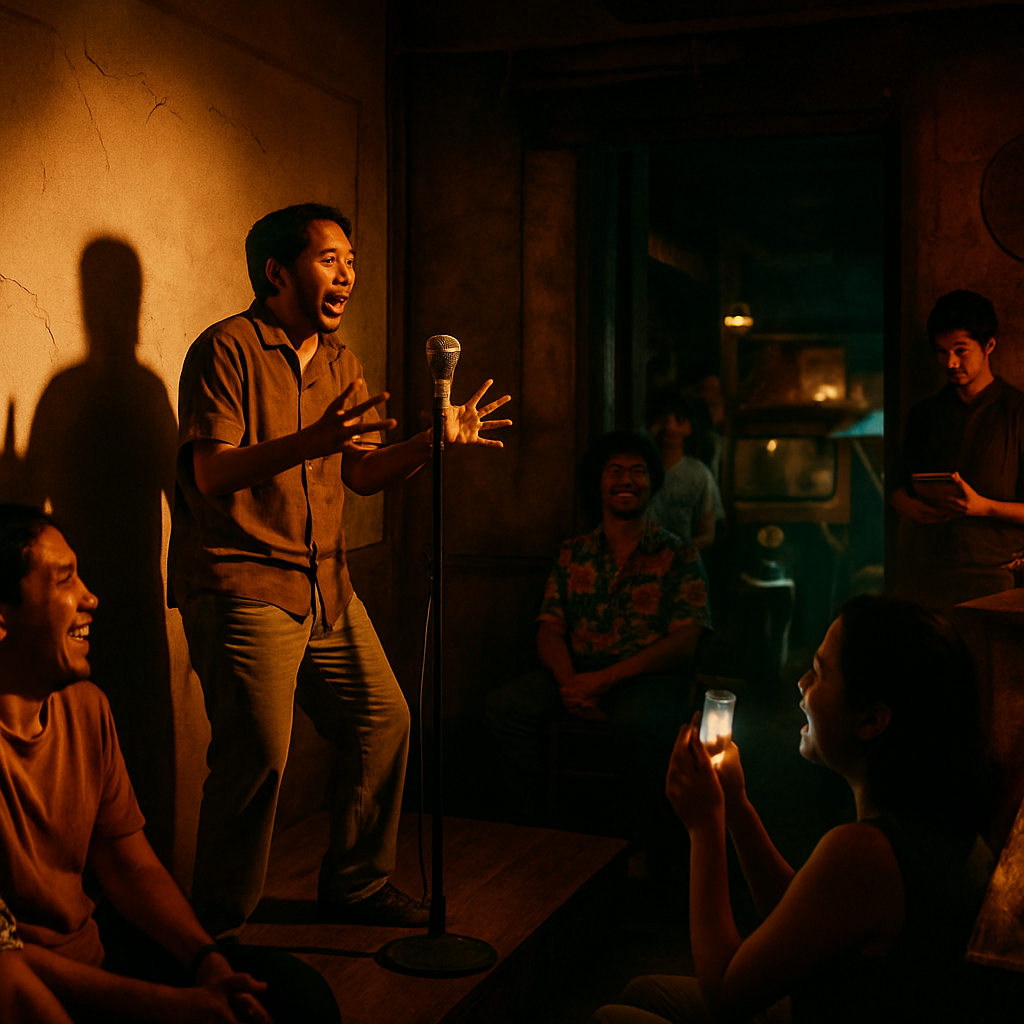
Thai stand-up comedy feels like a late-night improv jam in a half-finished theatre: young, a little unstable, often thrilling, and full of surprising moments. It doesn’t map neatly onto the American club ladder or the British circuit; there are no universal rules, few sponsors, and no agreed-upon language for what “stand-up” officially is. What it does have is a handful of committed performers who show up, experiment publicly, and take the flak that comes with being first. They’re building something that is unmistakably Thai, one awkward, brilliant set at a time.
Note Udom: the shadow and the spark
No conversation about stand-up in Thailand starts without Note Udom. For many Thai audiences, he is the shorthand for stand-up itself. His storytelling, solo-microphone bravado, and observational punchlines shaped how people imagine comedy on stage. To this day, casual audiences still call stand-up “deal, microphone” — a direct echo of his performances.
That influence is double-edged. Newer comics benefit because Note cleared a path — but they also reckon with his shadow. Repeating a joke in another city can read as laziness. Sharing his rhythm can trigger accusations of copying. Note shaped the national taste, and that taste now constrains experimentation. The paradox is simple: the trailblazer’s footprint sometimes becomes a fence.
Mo and the economics of laughter
Tangmo Rodvanich Kittiporn, who performs as Mo or Bang Mo, offers a nuts-and-bolts take on why Thailand’s comedy scene looks different from the U.S. She started doing English sets around 2019 and pivoted into Thai stand-up in 2021–2022. Winning the Young Men Can’t Stand Up competition’s first season opened doors, but it also highlighted a broader truth.
“It’s here, and even though we have it, it’s very niche,” Mo says. “People who would come to see it — it’s not like you just look it up online and call your friend, ‘let’s go find some stand-up club.’ No. A friend brings you because they saw it, and it travels by word of mouth.”
She points out that many shows are theme-driven and built for video clips — Halloween specials and gag nights destined for YouTube. That encourages “one-time” sets designed to pop online rather than tight five- or ten-minute pieces polished over years. Add in local content limits — especially around politics and sensitive topics — and the incentives push comics toward safer, short-lived material. Dark humour can land, but it needs trust; jokes about personal loss, for instance, might kill in the room yet flatten in a clip without the original energy.
KC King: the outsider who isn’t
Noonan Ariyawongmanee, known as KC King, occupies a fascinating space: fluent in Thai, visibly non-Thai, and weaponizing that ambiguity. Audiences often react before the first punchline — the disbelief of seeing someone who “should” be foreign speak Thai so naturally becomes the opening laugh.
“Thai people act like they’re seeing a ghost when I speak Thai,” KC says. “They don’t get the concept of Thai Indian.”
That confusion is fertile comedic soil. KC mines misidentification, cultural shortcuts, and the tiny shocks that expose how much people don’t know about Thai-Indian communities. He jokes about food, religion, dating, and language, skirting the edge between education and offense — and it works because it’s lived experience, not a lecture. For Thai audiences, he offers a new mirror; for expats, he pinpoints the blind spots in their assumptions.
Linen: craft over controversy
Niwatchai Sapphaisan — Linen — takes a quieter route. Chinese-Thai, performing in Thai, he’s less interested in defining the scene and more obsessed with refining his craft. He studies Western comics selectively — borrowing pacing and stage control rather than swagger and shock.
“I’m confident, but I don’t look confident,” Linen says. “People think, ‘Oh, he’s quite a nerd.’ Then everything comes out and they’re like, ‘What the f***!? He’s very confident.’”
That tension is deliberate. Linen reads the room: knowing when not to roast, when a dirty joke will flop, and how Isan audiences respond differently than Bangkok crowds. For him, stand-up is less about theatrical rebellion and more about focused human observation under pressure.
A scene still inventing its rules
Thai stand-up is being learned in public. There are no five-minute light systems, no ironclad club discipline, and only patchy feedback culture. Some comics explode; some plateau. Most survive. The charm of the scene is its honesty: these performers aren’t simply copying Western models — they’re translating them, misusing them, and incubating something local.
When Thai stand-up finally settles into its own voice, it won’t sound imported. It’ll sound familiar, awkward, warm, and very Thai — like overhearing a friend tell a scandalous story at a sticky-walled bar: human, risky, and impossible to ignore.


















This article makes Thai stand-up sound like an exciting experiment, but I worry the Note Udom shadow is suffocating real diversity.
Isn’t that true everywhere though? Big names shape tastes, then everyone either copies or rebels, it’s not uniquely Thai.
Sure, but the article suggests the scene is small enough here that one shadow becomes a fence faster, and that feels dangerous for new voices.
I disagree — small scenes can be more daring because the risk is shared and the audience is forgiving.
I love chaos in art; a dominant figure forces creatives to either innovate or leave, and I prefer innovation.
Innovation needs room to fail though; if audiences punish experiments because they expect Note-style comedy, that’s a problem.
The piece is kind of romantic about being ‘awkward and warm’ — that sounds like an excuse for sloppy craft to me.
Clip-driven comedy is depressing; it trains comedians to chase virality over truth.
But viral clips pay the bills and bring audiences; economics shape art whether we like it or not.
Paying bills is real, yet we should ask at what cost to the art form when short clips replace depth.
As someone who makes shorter sets, I think you can be deep and clip-friendly, it’s about craft not medium.
KC King’s identity bits sound brilliant — lived experience should be allowed to unsettle people, that’s the point of comedy.
Unsettling is fine but there’s a difference between educating and exploiting novelty for laughs.
KC seems to come from the former though; the article made it clear he uses confusion as a starting point, not a punchline at others’ expense.
As an Asian expat who does Thai gigs, I can confirm audiences often laugh before you speak, which you can use or reject.
People calling stand-up ‘deal, microphone’ is hilarious and shows how much of a cultural imprint Note left.
Cultural imprint is one thing, gatekeeping is another; I hear new comedians feel boxed in by expectations.
He paved the road, but fans shouldn’t demand clones; the scene needs room for weirdness too.
The economics section is the clearest part — niche scenes can’t rely on clubs and sponsors, they survive on community and clips.
True, but you can build patronage models or mini-festivals; grassroots funding isn’t glamorous but it works.
Exactly, and comedians should design shows with both live impact and digital life in mind, not compromise one for the other.
Mini-fests are nice but they need curators who understand local tastes, otherwise it becomes a foreign import.
Linen’s approach sounds refreshing — craft over controversy beats cheap shock any day.
I used to think that, but sometimes controversy forces audience reflection; craft and provocation aren’t mutually exclusive.
Fair, but provocation without skill is just noise, and Thai rules about sensitive topics make skilled provocation harder.
The article underplays censorship and social norms. In many places satire thrives precisely because it pushes boundaries; Thailand’s constraints will shape unique forms of subversion.
So you think constraints breed creativity? That feels like a cliché but maybe true with the right context.
Not always a cliché — look at Russian literature or South Korean cinema; limits forced artists to be cleverer with metaphor.
I worry the emphasis on being ‘very Thai’ will gatekeep migrant voices and English-language performers, which seems counterproductive.
I actually think being visibly different helped me open a conversation about Thai identity, not close it.
That’s cool to hear — still, public spaces need to be inclusive, not just tolerant of novelty.
I loved the line about audiences reacting before the first punchline; that context is itself a comedic asset when used honestly.
Using reaction as material is an art — but you should also teach newcomers not to rely solely on audience surprise.
Agreed. Surprise can open the door, but the set has to carry the weight after that initial laugh.
Linen’s nerdy delivery is exactly the kind of subtlety that will help the scene mature, not just monetize clips.
The scene being ‘learned in public’ is both thrilling and brutal; young comics get empathy from peers but also experimental burnout.
Burnout is real; without mentorship and feedback loops, comics either stagnate or flame out quickly.
That’s why veteran comics should organize workshops, not just headline shows.
I liked the bit about dark humor needing trust; context does everything in comedy and clips strip that away.
Clips can misrepresent tone, but they also amplify minor moments into national conversation, for better or worse.
Exactly — one clip can define a career, so comics need to think strategically about what they let go viral.
The claim that Thai stand-up will end up sounding ‘very Thai’ makes me wonder what elements will define it — rhythm, language play, or storytelling?
Probably all of the above plus regional flavors like Isan sensibilities; local audiences reward very specific cues.
Regional cues will be essential — translation into mainstream fame might erase those subtleties though.