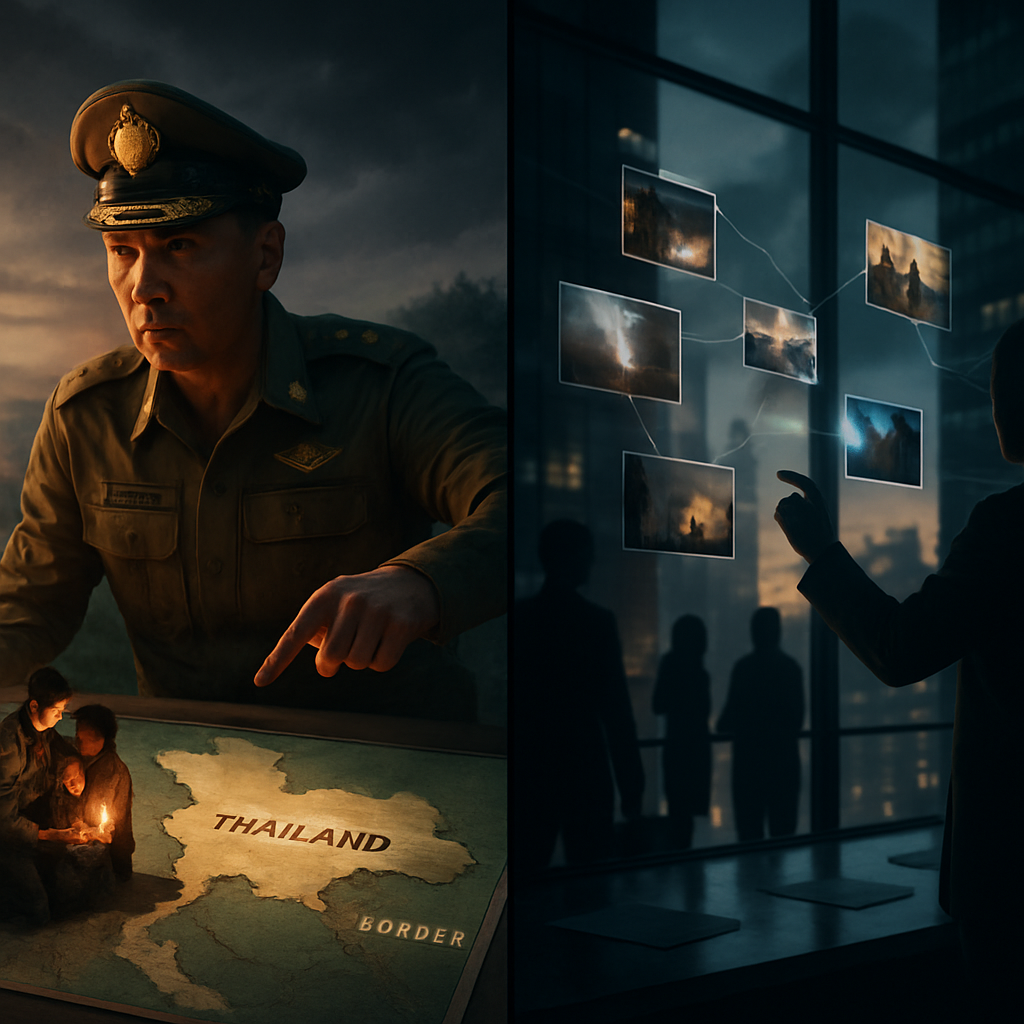
In a diplomatic twist that reads more like a political thriller than a dry press release, Thailand’s Defence Ministry confirmed on December 16 that Cambodia has engaged a US lobbying firm to influence international opinion amid the ongoing border dispute. Rear Admiral Surasant Kongsiri, the ministry’s spokesperson, said this revelation came after the STRONG Anti-Corruption Club Thailand published a confidential document showing Cambodia had hired National Consulting Services, Inc., a Washington-based lobbying and public-relations outfit, to manage its narrative in the United States.
According to RAdm Surasant, this move is not merely routine outreach — it’s part of a deliberate information campaign intended to sway global sympathy toward Cambodia. He pointed to photos and videos circulating online of foreign nationals in Cambodia appealing for international intervention as signs that an “information war” is underway. The implication: media optics are being carefully curated to depict Cambodia as the aggrieved party.
“These activities are clearly designed to evoke global sympathy for Cambodia,” the rear admiral said, arguing that Thailand’s military operations along the border have been conducted without targeting civilians. He pushed back against emotionally charged claims of civilian suffering, noting a lack of “images or concrete proof” to back those assertions and asking why so many foreign voices were denouncing Thailand without presenting verifiable documentation.
The Defence Ministry’s line is straightforward: Thailand is juggling military, diplomatic and informational levers to keep the border calm, and it will not be swayed by what it sees as manufactured narratives. The STRONG Anti-Corruption Club’s disclosure, in this telling, undercuts Cambodia’s credibility by showing it actively enlisted help to shape international opinion.
From the Foreign Ministry, deputy spokesperson Maratee Nalita Andamo took a similar tone. As reported by the Bangkok Post, she emphasized that Thailand will respond to Cambodia’s lobbying campaign with “facts, not propaganda.” The ministry has reportedly already submitted verified reports to international bodies documenting developments on the ground — a counterstrike of official records meant to outlast any short-lived public-relations blitz. “Propaganda may gain attention in the short term, but facts are what truly stand the test of time,” she said.
The diplomatic row comes amid a more grievous flashpoint: rockets fired into Thai territory that the Royal Thai Army and the Thai government say originated from across the border. Those strikes killed a civilian, prompting strong condemnation from Bangkok and raising tensions to a boiling point. The casualty underscores what officials describe as the stakes of both kinetic conflict and the accompanying battle for international opinion.
So what’s really going on here? On the surface, it’s a conventional story of two neighbors clashing over territory and narratives. Underneath, it’s a modern lesson in how international disputes are fought on multiple fronts: troops on the ground, diplomats in the halls of international organizations, and PR firms in the corridors of power in Washington.
Hiring a US lobbying firm is a common — and legal — tactic for countries wanting to shape how the world sees them. But to Thailand’s leaders, the timing and the images accompanying the campaign are evidence of a concerted effort to spin the conflict. To Cambodia, the engagement of a US firm could simply be a bid to make its case heard in influential circles. To the global observer, it is a reminder that information management is now a standard element of modern statecraft.
Thailand’s approach, as outlined by RAdm Surasant and reinforced by Maratee, appears twofold: publicly resist what they label as emotive, unsupported claims, and privately assemble the documentary evidence needed for international scrutiny. Whether that strategy will blunt Cambodia’s lobbying push remains uncertain — public sentiment can be surprisingly resilient, especially when images and personal testimonies stir emotion.
For readers watching the situation unfold, a few things are clear. First, the border conflict is no longer just a local security issue; it has moved into the international communications arena. Second, both sides understand the power of perception, not only to win diplomatic sympathy but potentially to influence the decisions of third-party governments and international bodies. Finally, the human cost remains real: the civilian death from the rocket attack is a tragic reminder that, beyond press releases and strategy memos, people live — and sometimes die — where these policies collide.
As Bangkok and Phnom Penh trade accusations and assemble evidence, the rest of the world is left to weigh competing narratives. In the days to come, expect more statements, more leaked documents, and — almost certainly — more heated exchanges in the court of public opinion. For now, Thailand insists it will counter Cambodia’s lobbying with verifiable facts and a steady insistence on transparency. Whether that will be enough to sway international perception is the next chapter in this unfolding story.














Hiring a US firm to lobby isn’t illegal, but calling it an ‘information war’ sounds like doubling down on paranoia.
Paranoia or not, when rockets killed a civilian people are going to look for who to blame, and PR campaigns shape that fast.
Agreed that civilian deaths change the narrative, but we should demand evidence before accepting either government’s spin.
Evidence? Governments hide plenty, simple as that. Lobbying firms just polish the lies.
That’s cynicism, but understandable. Still, blanket distrust leaves us unable to parse real facts.
This reads like geopolitical theater where both sides pay actors to tug heartstrings in Washington.
As someone who studies international law, engaging lobbying firms is a legitimate soft-power tool, but it raises ethical questions when civilian casualties are weaponized for influence.
So it’s legal and yet morally murky — that’s a weird comfort.
Law and ethics often diverge, especially in foreign policy. The public shouldn’t be the showroom for that divergence.
Don’t forget that Washington firms have direct access to lawmakers; narratives there can shape sanctions or aid in a way a local press release can’t.
Why is Cambodia hiring Americans to tell their side? Sounds like they know they’re lying to their own people.
Or they know the American audience matters. Foreign policy is decided in capitals, not small border towns.
That’s the ugly truth; the people who suffer get ignored while diplomats play chess.
Sometimes outsiders amplify local suffering. Doesn’t mean every PR push is dishonest though.
We should separate three questions: legality of hiring lobbyists, veracity of battlefield claims, and the humanitarian reality on the ground.
That’s sensible, but in practice the lines blur — propaganda can obstruct humanitarian access and investigations.
Exactly; even lawful information campaigns can have deleterious effects on fact-finding and relief operations.
Seems like an academic view. For me, someone died from a rocket and that should be enough to act.
Act how though? Jump to sanctions or send monitors? Those moves can escalate tensions further.
Thailand saying they have ‘facts, not propaganda’ is rich when both sides spin things to suit their voters.
Politicians love absolutes; it’s an effective rhetorical shield even if the reality is complex.
Stop hiring PR. Fix the border. Simple.
I’m worried this will normalize the outsourcing of national narratives to private firms with agendas.
Private firms answer to shareholders and clients, not citizens, which makes transparency crucial but rare.
Then demand transparency. If governments accept private narrative managers, citizens must demand oversight.
Oversight rarely matches the speed of PR campaigns, though. By the time watchdogs react, perceptions are already set.
True, but international bodies can still weigh submitted evidence and insist on independent verification.
I don’t like either side using emotional videos to drum up support, it cheapens real suffering.
Emotion sells better than dry reports. That’s why PR exists, and it’s maddening.
Right, but authenticity matters. Fake or staged clips hurt the credibility of genuine victims.
But dismissing emotional testimony risks silencing survivors who can’t produce forensic proof quickly.
The civilian casualty is the human angle journalists should follow, not just the lobbying memos.
Agreed, yet journalists also need access to verify claims; propaganda can block that access.
Plus, coverage driven by a body count alone can oversimplify root causes and long-term grievances.
If Cambodia paid a US firm, expect more curated testimony and targeted congressional op-eds this month.
Targeted op-eds and think tank events — that’s the playbook. It’s effective at shaping elite opinion.
And elite opinion often trickles into policy. That’s why PR in DC matters far more than a viral video sometimes.
Which makes it all the more important that international institutions independently verify ground events rather than rely on curated narratives.
But who’s going to compel those institutions to act faster than the PR blitz?
Public pressure and media urgency can, but only if reliable evidence surfaces quickly.
People keep saying ‘verify,’ but there are whole villages without cameras. Does absence of video equal innocence?
No, lack of footage doesn’t prove anything, but it does force us to use other investigative tools and testimonies.
Those tools take time, though. PR doesn’t wait for investigations to finish.
We should push for a neutral fact-finding mission with access guarantees from both sides, and transparency around any external lobbying contracts.
Good idea, but both sides must let investigators move freely, which political incentives often prevent.
That’s why international pressure and conditional aid or cooperation can be necessary levers to ensure compliance.
Conditional cooperation risks escalation, though; it’s a delicate balance between accountability and provocation.
Why is the US the go-to place for this kind of lobbying? It’s like a global PR marketplace.
Because Washington shapes global policy and offers media visibility. It’s efficient for influence-seeking states.
I feel for the family who lost someone. Whatever happened, humans shouldn’t be pawns in propaganda.
Totally. The human story matters more than which firm wrote the talking points.
Sounds like both governments are blaming the other while business as usual carries on at the cost of locals.
That’s often the pattern: rhetoric heats up, locals pay, then a negotiated lull appears until the next flare.
Sustainable peace requires addressing border grievances, not just winning PR wars.
Is anyone else worried about leaked confidential documents being weaponized politically at home and abroad?
Leaks can be double-edged swords: they reveal negotiation dynamics but also compromise sensitive operations.
So transparency can both help and harm. Great, now I’m more confused than before.
If a country uses PR to shape sympathy, why aren’t citizens pushing for independent inquiry instead of taking sides online?
Because social media rewards outrage and simple narratives, not slow investigative work.
Then maybe social media is part of the problem, not just the PR firms.
I read the article and feel like both governments are playing with fire by mixing military action and PR campaigns.
Mixing them amplifies risk; a misstep in messaging can justify escalation by the other side.
Exactly, messaging mistakes could be as dangerous as battlefield mistakes.
Let’s not absolve third parties that take money to spin conflicts; accountability should include the firms too.
Agreed, but regulating speech and lobbying is tricky given legal protections in the US.
Tricky doesn’t mean impossible; disclosure requirements could be strengthened at least.
I’m in sixth grade and this sounds like two kids arguing and hiring someone to tell the teacher they’re right.
That’s a great analogy; it makes the situation easier to understand for everyone.
Media literacy matters here; people need to ask who benefits from each story they see.
Yes, follow the money and the access lines. That often reveals motives behind narratives.
If Thailand claims to have submitted verified reports, why are international bodies not acting faster?
International bodies require mandates and impartial access; their processes are deliberate but slow by design.
Deliberate is fine, but people live and die while bureaucracy moves slowly.
This is a reminder that modern conflict is as much about winning hearts abroad as territory at home.
And sometimes hearts abroad decide whether aid, sanctions or military support flows, so it’s not trivial.
I distrust both governments equally, so I hope neutral journalists and NGOs get access.
Independent verification is the only path to lasting credibility, but it’s expensive and risky to deploy.
Who benefits from this escalation? Follow the geopolitical interests, not just the headlines.
Regional powers and big players who sell arms or need influence could all benefit indirectly from a protracted conflict.
Exactly. Geopolitics is the ghost in the machine here.
To the people who said ‘fix the border,’ what does fixing actually look like? Does anyone have a plan beyond slogans?
Fixing requires demarcation, joint patrols, conflict-resolution mechanisms, and socioeconomic projects that reduce incentives for violence.
That’s more substantive than most political statements we hear; I wish leaders spoke like that.
Secure the border, negotiate, and stop the rockets. That’s the plan in three steps.